Le Chat vs ChatGPT: Which Protects Your Data Better?
Jurisdiction: Le Chat (Mistral, France/EU) avoids the transatlantic transfer, ChatGPT (OpenAI, US) relies on it. Anonymise before you send.
The question keeps coming up: Le Chat or ChatGPT to protect your data? On one criterion, jurisdiction, the edge goes to Le Chat for an EU resident. Mistral is a French company. Its processing stays under EU law, with no transatlantic transfer. OpenAI is based in the United States. For an EU user, sending personal data there becomes an international transfer. But watch out: in both cases, the provider receives and processes your prompt. The safest choice, whatever the model, stays the same. Anonymise your sensitive data before you send it.
Jurisdiction: where is your data processed?
Let's start with the clearest point. Mistral presents itself, in its own privacy policy, as a French company. It is registered in Paris. It states that it favours subprocessors located in the European Union and compliant with the GDPR. For an EU user, the processing therefore stays under EU law. There is no transatlantic transfer.
OpenAI, for its part, is based in the United States. For an EU user, sending personal data to ChatGPT is an international transfer. That transfer relies on a European adequacy decision, the EU-US Data Privacy Framework. On this single criterion of jurisdiction, the edge goes to Le Chat for an EU resident. We cover this issue in our piece on US AI and sovereignty.
Training, retention, business tiers: the comparison
Jurisdiction is only one axis. Let's look at the practices each provider declares. Model training, retention, business tiers: here is what each one states. We attribute each stance to its source, without deciding for them.
| Criterion | Le Chat (Mistral) | ChatGPT (OpenAI) |
|---|---|---|
| Jurisdiction / establishment | French company, processing under EU law, no transatlantic transfer (Mistral states) | US company; for an EU user, international transfer via the Data Privacy Framework (OpenAI states) |
| Training on consumer chats | Inputs and outputs used for training, unless you opt out from your account (Mistral states) | Consumer content used depending on settings, unless you opt out of training (OpenAI states) |
| Retention | Le Chat: kept until you delete the account or the chat; API: rolling 30 days for abuse (Mistral states) | Kept depending on settings; a temporary-chat mode is excluded from history and training (OpenAI states) |
| Business tiers / human review | Zero retention can be enabled on the API (Mistral states) | No training by default on Team, Enterprise and the API (OpenAI states) |
One point deserves to be clear. Both free tiers train by default. Each offers an opt-out. So Le Chat should not be presented as a model that does not train. Mistral also trains by default on its consumer offering.
- Mistral states the opt-out is set from your account settings. It notes that this right may face technical limitations.
- OpenAI states you can disable it through the data controls (do not train on my content).
- OpenAI states it does not train its models by default on its business offerings (Team, Enterprise and the API).
- Mistral states that, for the API, data is kept 30 days for abuse detection, unless zero retention is enabled.
Did the CNIL ban ChatGPT?
A confusion often circulates. No, the French authority did not block ChatGPT. It was the Italian authority, the Garante, that issued a temporary suspension in 2023. The Garante also fined OpenAI 15 million euros in late 2024. According to reported information, that fine was reportedly annulled around March 2026. The stated ground was jurisdictional competence, not the merits. This point remains to be confirmed.
The honest conclusion
Let's sum up. For an EU user, jurisdiction leans in favour of Le Chat. The processing stays under EU law, with no transatlantic transfer. That is a genuine advantage. But it does not change one reality. In both cases, the provider receives and processes your prompt. Your sensitive data reaches the model, Le Chat as much as ChatGPT.
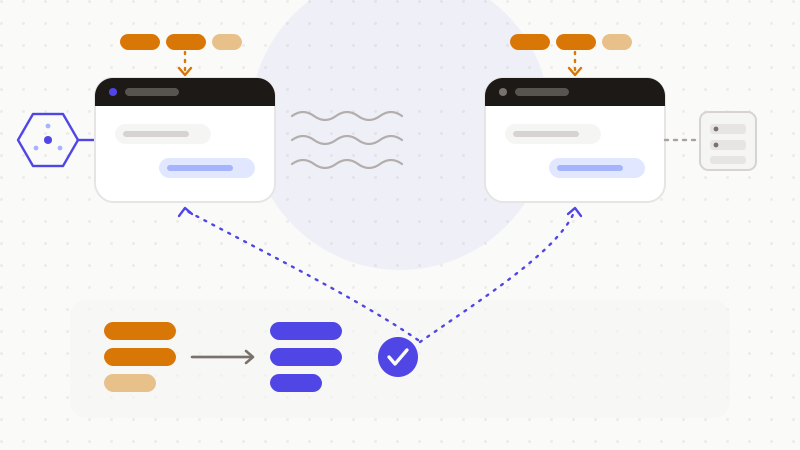
There is a simple fix, neutral about which model you pick. Anonymise the sensitive data before you send. That way, the sensitive data never reaches the model. Neither Le Chat nor ChatGPT. You keep the freedom to choose your assistant, on other criteria.
- 1Spot the sensitive data in your text: names, emails, bank details, API keys.
- 2Replace it with reversible tokens, in the browser.
- 3Send only the anonymised text to the model you chose.
- 4Restore the real values in the reply, locally.
That's what ONYRI Sanitize is for. The engine detects sensitive data and replaces it with reversible tokens before sending. Detection and the mapping stay in your browser. Only anonymised text reaches the model. Le Chat or ChatGPT find only tokens, never your real values. You settle the match on the quality of the answers, while ONYRI keeps your sensitive data out of reach. To go further, read our dedicated analysis of Mistral and Le Chat too.
Frequently asked questions
- Le Chat vs ChatGPT: which protects your data better?
- On jurisdiction, Le Chat has the edge for an EU resident. Mistral is a French company; its processing stays under EU law, with no transatlantic transfer. OpenAI is American; for an EU user, sending data becomes an international transfer via the Data Privacy Framework. But both receive your prompt. The safest path is still to anonymise your sensitive data before you send.
- Does Le Chat train its models on my chats?
- Mistral states it uses inputs and outputs to train its models, unless you opt out from your account settings. It notes that this right may face technical limitations. OpenAI states a similar setup on its consumer offering, with a do-not-train option. So both free tiers train by default, with an opt-out.
- Did the CNIL ban ChatGPT in France?
- No. The French authority, the CNIL, did not block ChatGPT. It was the Italian authority, the Garante, that issued a temporary suspension in 2023. It also fined OpenAI in late 2024. According to reported information, that fine was reportedly annulled in 2026 on a ground of competence. This point remains to be confirmed.
Sources & references
- Mistral AI privacy policy (Le Chat): French company, EU subprocessors, training with opt-out, retention — Mistral AI
- Data transfers to the United States: the European Commission adopts a new adequacy decision (10 July 2023) — CNIL
- US adequacy: the first questions and answers (Data Privacy Framework, post-Schrems II) — CNIL
Keep your sensitive data in your browser
ONYRI Sanitize detects and masks your sensitive data before it reaches the AI, then restores the answer — from names to API keys.