Private ChatGPT Alternatives: Ranked by Privacy
An honest ranking of the most private ways to use AI. Number 1: anonymise before you send, without giving up frontier-model power.
The most private way to use AI? Anonymise your data before you send it. That's number 1 in this ranking, for one plain reason. It's the only option that keeps a top model's full power while never showing it your real data. Next come local models, privacy-first assistants, enterprise no-training tiers, then temporary chat modes. Each option protects your privacy in a different way. Each one also has a limit. This guide ranks them honestly, from the best trade-off to the most partial.
The ranking at a glance
There is no single "most private AI." There are approaches, with different trade-offs. Here they are, ranked from the most complete to the most partial.
- 1Anonymise before you send: keep the frontier model, but strip the sensitive data from the prompt.
- 2Run a local model: inference stays on your machine, nothing leaves.
- 3Privacy-first AI assistants: they add privacy layers, to check case by case.
- 4Enterprise no-training tiers: contractual protection, on paid plans.
- 5Temporary chat modes: they cut retention, without stopping the provider from seeing the content.
| Rank | Option | Why it's private | The limit |
|---|---|---|---|
| 1 | Anonymise before you send | The real data never reaches the model; substitution and restoration happen in the browser | You must run the anonymisation step (a browser tool does it) |
| 2 | Local model (Ollama, LM Studio) | Inference runs on your machine; nothing leaves the device | Less capable than a frontier cloud model; needs hardware |
| 3 | Privacy-first assistant (Duck.ai, Proton, Brave Leo) | Privacy layers: stated no-logging, metadata stripped, proxying | Verify with each provider; capability varies |
| 4 | Enterprise no-training tier | Contractual protection: your content is excluded from training | Paid; verify the contract; absent from consumer plans |
| 5 | Temporary mode / "don't train" | Reduces retention and training use | Partial: the provider still sees the content; a toggle is not a guarantee |
Three questions to judge an option
Before you choose, ask three simple questions. They are enough to place any option on the privacy scale.
- Where does the compute happen: on your machine, or at a third-party provider?
- What does the provider see: the raw content, or only tokens?
- What do they do with it: retention, human review, training — and for how long?
#1 — Anonymise before you send
Number 1 does not ask you to switch AI. You keep the model you like. You only strip the sensitive data from the prompt before you send. A browser tool spots names, addresses, numbers and keys. It swaps them for reversible tokens. The model reasons over tokens.
You restore the real values on your side, locally. It's the only approach that does not trade power for privacy. Substitution and restoration happen on your side, never at the provider. The limit is honest: you have to run this anonymisation step. A good tool makes it almost invisible.
#2 — Run a local model
The second option runs the model on your own machine. Tools like Ollama or LM Studio install an open-weight model locally. Inference happens on-device. Your prompts and the replies stay on the machine. The data does not need to leave. That's the core privacy benefit of the local approach.
There is a real caveat. Local only protects while the model stays local. Ollama binds by default to 127.0.0.1, the local address, with no authentication. If you rebind it to a public address without a firewall, you expose an open AI endpoint to the internet. Another limit: a local model is often less capable than a frontier cloud model. And it needs decent hardware.
#3 — Privacy-first AI assistants
The third option is assistants built for privacy. DuckDuckGo's Duck.ai is a good example. Per its help page, it does not store conversations. It also states they are not used to train models, by DuckDuckGo or by the underlying providers. It strips metadata that could identify you, such as your IP address, before sending the prompt. Requests appear to come from DuckDuckGo, not from you. Duck.ai also cites provider deletion agreements, within 30 days at most.
Two honest caveats. These are the provider's statements, not an independent audit. And protection varies by model. Some offer stricter tiers, to check case by case. Other privacy-first assistants exist, such as Proton or Brave Leo. The right move is the same: read each one's actual terms.
#4 — Enterprise no-training tiers
The fourth option is contractual. Some business or enterprise plans exclude your content from training. The protection comes not from a technique, but from a written commitment. It's solid, on two conditions. First, you must read the contract and check what it really covers. Second, you must pay. Consumer plans usually do not offer this guarantee.
#5 — Temporary chat modes
The fifth option is temporary modes. A temporary chat, a "don't train" toggle: they reduce retention and training use. That's useful, but partial. The provider still sees the content you send. A single toggle is not a guarantee. It can change, be misapplied, or carry an exception. It's the weakest protection in the ranking.
Terms and the law keep shifting
One last useful reminder. A provider's terms and their legal status can move. Here is an example. On 2 November 2024, Italy's Garante fined OpenAI 15 million euros over ChatGPT. In March 2026, the Tribunale Ordinario di Roma (the Rome court) set that fine aside.
The key point: the annulment turned on jurisdiction, not on the merits. The court found the Garante was no longer the competent authority once the Irish Data Protection Commission became lead supervisor. The substantive data-protection questions stay open. In principle, they now sit with the Irish authority. The lesson is not that OpenAI was cleared. It's that these cases move, and you must check the real state of the rules.
The law leans toward the least data
Why does this ranking put anonymisation first? The law helps. The ICO, the UK regulator, sets the data-minimisation principle. Personal data must be adequate, relevant and limited to what is necessary. Holding more than needed is likely unlawful. The ICO warns against collecting data "on the off-chance" it might be useful later.
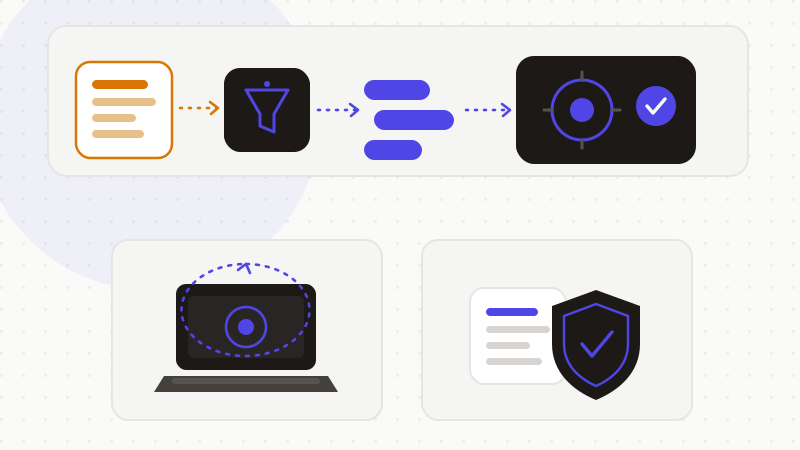
That's the number 1 approach in this ranking, and that's what ONYRI Sanitize is for. The engine detects sensitive data — names, addresses, amounts, keys — and replaces it with reversible tokens before sending. Detection and the mapping stay in your browser. Only anonymized text reaches the model. You keep a top model's power, without showing it your real data. It's the only option in the ranking with no trade-off on capability.
Frequently asked questions
- What is the most private way to use AI?
- The most complete way is to anonymise your data before you send it. You keep the frontier model, but strip the sensitive data from the prompt. It's the only option with no trade-off on power. Next come local models, privacy-first assistants, enterprise no-training tiers, then temporary modes. Each option has a limit, detailed in the ranking.
- Is a local model really private?
- Yes, as long as it stays local. Tools like Ollama or LM Studio run the model on your machine, so nothing leaves. One caveat: Ollama binds by default to 127.0.0.1 with no authentication. If you rebind it to a public address without a firewall, you expose an open endpoint. Another limit: local is often less capable than a frontier cloud model and needs hardware.
- Are assistants like Duck.ai safe?
- Duck.ai states it does not store conversations or use them for training, and that it strips metadata such as your IP address. These are the provider's statements, not an independent audit, and protection varies by model. The right move applies to any privacy-first assistant, including Proton or Brave Leo: read each one's actual terms.
Sources & references
- How does Duck.ai protect my privacy? (no chat storage, no training, metadata/IP stripped, 30-day deletion, ZDR/ZPV tiers) — DuckDuckGo
- How to Protect Sensitive Data by Running LLMs Locally with Ollama (on-device inference; localhost default, no auth; exposure risk) — freeCodeCamp
- Principle (c): Data minimisation (data adequate, relevant and limited to what is necessary; don't collect on the off-chance) — Information Commissioner's Office (ICO)
Keep your sensitive data in your browser
ONYRI Sanitize detects and masks your sensitive data before it reaches the AI, then restores the answer — from names to API keys.