Is It Safe to Use AI for Startups?
Yes, if you anonymise first. Deck, cap table, unreleased code: your edge is your information. Don't paste it raw into consumer AI.
Yes, startups can use AI, on one simple condition. Anonymise before you send. Your edge is your information. The idea not yet shipped. The metrics. The roadmap. The unreleased code. Pasted into a consumer ChatGPT, those go onto third-party servers. They can be reviewed. They may be used to improve a model, unless the terms say otherwise. A trade secret is protected only while it stays secret. And from your very first customer, you are a controller under the GDPR. The clean method: let AI help you, but strip names, numbers, identifiers and keys first.
Your moat is information — and you are pasting it
A lean team puts everything into AI. It's efficient, and it's the trap. The pitch deck. The cap table. The financial model. The product roadmap. The investor updates. The early-customer list. The hiring notes. Each of those documents holds your edge.
The problem is not talking to an AI. The problem is what you leave in it. A prompt sent to a consumer tool leaves your machine. It lands with a third party. You no longer control its retention, its review, or any training use. For a startup, that edge is often the only thing setting you apart.
Trade secret: protected only while it stays secret
WIPO (the World Intellectual Property Organization) sets the frame. Information is a trade secret when three conditions hold. It is secret, so not generally known or easily accessible. It has commercial value because it is secret. And its holder takes reasonable steps to keep it secret. Under WIPO's framework, a trade secret is protected without registration and for an unlimited time. But the protection ends the moment the information stops being secret.
The EU Trade Secrets Directive (Directive 2016/943) mirrors this logic. It defines a trade secret by the same three cumulative criteria. So your roadmap, your metrics or your secret sauce enjoy legal protection only while you keep reasonable confidentiality measures. Disclosing them to a third-party AI can weaken that reasonable-steps prong. It does not automatically destroy your rights. But it undermines protection at a key point.
A useful nuance: regimes differ by country. In the US, trade secrets run on the Defend Trade Secrets Act and state law. The logic is close: stay secret, take reasonable measures. Most trade-secret regimes require you to keep the information secret to protect it.
From the first customer, you are a controller
A startup also holds other people's data. Customer lists. Early-user emails. Candidate CVs. The GDPR (Regulation (EU) 2016/679) defines the controller as the entity that determines the purposes and means of processing personal data. You take on that role from your first customer email or first CV received. There is no minimum-size exemption for being a controller.
GDPR Article 5 sets binding principles. Among them, data minimisation. Personal data must be adequate, relevant and limited to what is necessary. Purpose limitation applies too. Feeding customer or employee data into a general-purpose AI can exceed the purpose for which it was collected. The GDPR applies based on whose data you process, not on where you are based. A US startup with EU users is still in scope.
Code speaks too: secrets and keys in prompts
Unreleased code pasted into a public tool often carries more than logic. It can hold an API key. Credentials. Architecture hints. OWASP's 2025 GenAI Top 10 lists 'Sensitive Information Disclosure' (LLM02:2025) as a top risk. Data such as credentials, secrets or proprietary business details can leak, both through what a user enters and through what a model outputs.
OWASP is blunt on a point people miss. A prompt is not private by default. Without adequate safeguards, what a user submits can be incorporated into training data or otherwise disclosed. That is the concrete mechanism behind the 'the AI trained on my prompt' fear. A model can only leak what it was given.
The good news: OWASP's mitigations match the founder reflex. Sanitise and scrub sensitive content before it reaches the model. Apply strict input controls. Stay cautious about what you share. A secret removed from the prompt can no longer leak.
| What you paste | The risk | The fix |
|---|---|---|
| Deck, cap table, metrics | Edge exposed, trade secret weakened | Anonymise names and numbers before sending |
| Customer list, emails, CVs | GDPR controller duty, minimisation at stake | Strip personal data from the prompt |
| Unreleased code | API keys and architecture disclosed (OWASP LLM02) | Keep secrets and keys out of the prompt |
| Daily AI habits | A finding in a future due-diligence review | Business-tier tool with a DPA and no-training terms |
Tomorrow's due diligence judges today's habits
Sloppy AI habits do not stay invisible. They surface in an acquirer's or investor's security review. What you do now becomes a diligence finding later. A weakened trade secret or a fuzzy GDPR posture then weighs on the deal. Better to set good rules early, when they cost almost nothing.
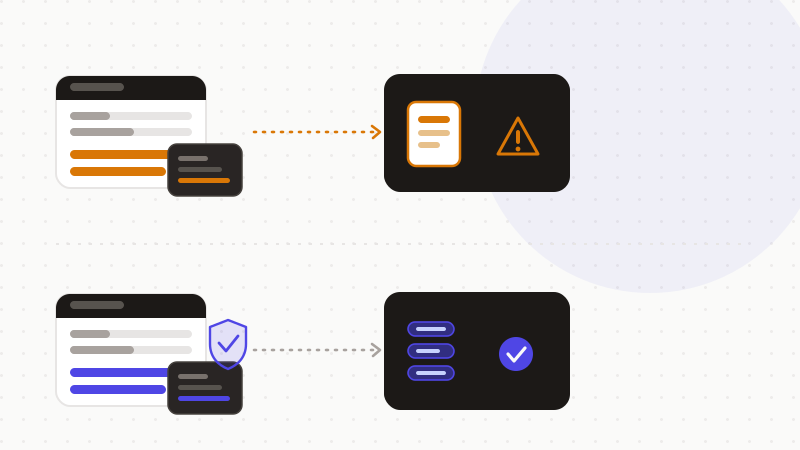
The founder fix: anonymise before the prompt
AI stays a real lever for a startup. It helps you write the deck. It helps you debug the logic. For that, it needs none of your real names, numbers or keys. Give it the shape of the problem. Keep the real values to yourself. Here is the routine to set up from day one.
- 1Anonymise names, metrics and identifiers before every prompt.
- 2Keep secrets and API keys entirely out of your prompts.
- 3Use a business-tier tool with a signed DPA and no-training terms.
- 4Set a simple, written team AI policy early.
- 5Keep the crown jewels off consumer AI altogether.
- A DPA (Data Processing Agreement) governs what the provider does with your data.
- A no-training term guarantees your inputs are not used to train the model.
- The crown jewels are the unshipped idea, the secret formula, the critical code.
That's what ONYRI Sanitize is for. The engine detects sensitive data — names, metrics, customer identifiers, API keys — and replaces it with reversible tokens before sending. Detection and the mapping stay in your browser. Only anonymized text reaches the model. The AI finds only tokens, never your real crown jewels. You keep AI's help, without weakening your trade secret or your controller duties.
Frequently asked questions
- Is it safe to use AI for startups?
- Yes, if you anonymise before sending. AI can write your deck or debug your code without seeing your real values. The risk comes from what you paste: metrics, cap table, customer lists, code with keys. A trade secret is protected only while it stays secret, and from your first customer you are a GDPR controller. Strip names, numbers and keys from the prompt.
- Can pasting my code into AI expose my secrets?
- Yes. Unreleased code often carries an API key, credentials or architecture hints. OWASP lists Sensitive Information Disclosure (LLM02:2025) among the top LLM risks. A prompt is not private by default: without safeguards, what you submit can be disclosed or folded into training. Keep secrets and keys out of the prompt.
- Does the GDPR really apply to my tiny team?
- Yes, with no size exemption. The GDPR defines the controller as the entity that determines the purposes and means of processing personal data. You become one from your first customer email or candidate CV. Article 5 requires data minimisation. Feeding customer or employee data into a general-purpose AI can exceed the original purpose.
Sources & references
- Trade Secrets: overview and the three conditions for protection (secret, value, reasonable steps) — World Intellectual Property Organization (WIPO)
- Regulation (EU) 2016/679 (GDPR): controller definition and Article 5 principles — EUR-Lex (Publications Office of the EU)
- LLM02:2025 Sensitive Information Disclosure (secrets and sensitive data in prompts) — OWASP GenAI Security Project
Keep your sensitive data in your browser
ONYRI Sanitize detects and masks your sensitive data before it reaches the AI, then restores the answer — from names to API keys.