Is It Safe to Use AI for E-commerce?
Mostly yes, but an order export is customer PII and card data falls under PCI DSS. Anonymise orders before the prompt; never paste full card numbers.
Mostly yes, with one firm rule: never paste raw customer data or card numbers. AI can write your product copy, answer buyer questions and summarise returns. It does not need real names to do it. But an order export is your customers' personal data. It ties a name to an address, an email, a phone and a purchase history. Paste it into a consumer chatbot, and that data goes to a third party your customer never chose. Card numbers are stricter still. Under PCI DSS, a card's security code must never be stored anywhere. The fix is simple: anonymise the order before the prompt, and keep full card numbers out.
An order is customer data
Start with what an order actually holds. An export is not one field. It is a whole profile of one person.
- A customer name and a shipping address.
- An email address and a phone number.
- A full purchase history, order by order.
- Sometimes a partial card number or a payment reference.
That bundle is personal data. Your customer handed it to you to complete a sale. They did not agree to send it to an AI vendor. Paste an export into a consumer chatbot, and it leaves your control. It reaches a third party your customer never picked.
Card data has its own rules: PCI DSS
Card data follows its own rulebook. It is called PCI DSS (Payment Card Industry Data Security Standard). The PCI Security Standards Council draws a hard line. Some data must never be kept after a payment is approved. That means the full magnetic-stripe or chip track data. It means the security code, the three or four digits printed on the card (the CVV/CVC). And it means the PIN. Even encrypted, these must not be retained.
Other fields may be kept for a real business reason. The name, the card number, the expiry date. But they must be protected. And when a card number is shown, it must be masked. At most, the first six and last four digits may appear. Pasting a full, raw card number into a chatbot runs straight against that principle.
You are the controller: GDPR
Now the legal side. If you serve customers in the EU, the GDPR applies. GDPR is Regulation (EU) 2016/679. It defines the 'controller' as the party that decides why and how personal data is processed. When you choose to run order data through an AI tool, you are that controller. You answer for it.
This does not go away because a vendor holds the data. The export ties a name to an address, an email, a phone and a history. That is personal data you are accountable for. It stays your responsibility wherever you send it. In the US, state laws like the CCPA play a similar role, and there you are the 'business'.
The support-bot trap: OWASP
There is a subtler risk with support bots. Say you fine-tune a model on your own customer tickets. The OWASP GenAI project tracks this. Its Top 10 for LLM Applications lists Sensitive Information Disclosure as a leading risk. A model can leak data it memorised during training.
OWASP flags one point that matters for merchants. Memorisation is often stronger on small, organisation-specific datasets. Low-volume, repeated data sticks harder. That is exactly a support bot trained on your own tickets. In rare cases, one customer's details could surface in another customer's session. It is probabilistic, not guaranteed. But it is a real reason to minimise what the model ever sees.
One more category is easy to forget: your own numbers. Supplier cost prices and negotiated terms are commercially sensitive. They are not regulated personal data. So no law protects them automatically. Their value comes from staying secret. Paste them into an unvetted AI tool, and you can quietly erode your margin advantage.
| Data in your store | The rule that applies |
|---|---|
| Customer name, address, email, phone | Personal data under GDPR; you are the controller |
| Full card number, CVV/CVC, PIN | PCI DSS: security code and track data must never be stored |
| Support tickets used to train a bot | OWASP: can be memorised and, in rare cases, surfaced |
| Supplier cost prices and terms | No automatic legal shield; value depends on staying secret |
The fix: anonymise before you send
Good news: AI still does the work. It drafts the product copy. It answers the buyer. It summarises the returns. It just needs no real name to do any of it. Minimise the data at the source.
- 1Anonymise customer names, addresses and order IDs before the prompt.
- 2Never paste a full card number, a CVV/CVC code or a PIN.
- 3Prefer vetted, integrated tools bound by a DPA (Data Processing Agreement) and no-training terms.
- 4Keep a human check on anything a customer will read.
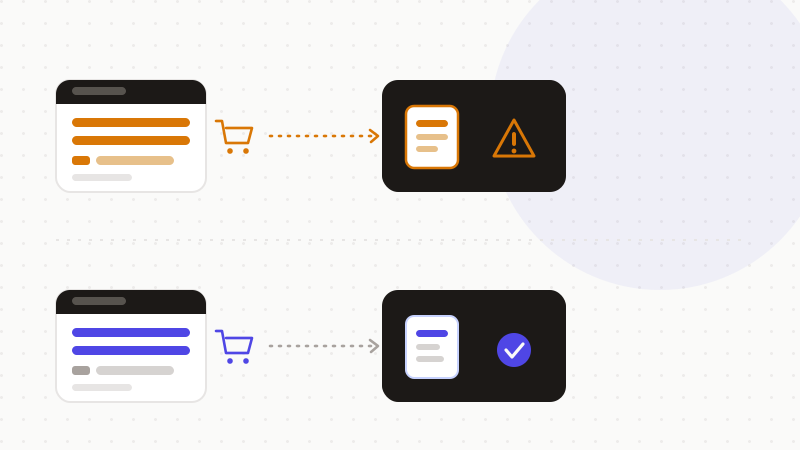
That's what ONYRI Sanitize is for. The engine detects sensitive data — name, address, email, phone, order identifier — and replaces it with reversible tokens before sending. Detection and the mapping stay in your browser. Only anonymized text reaches the model. The AI finds only tokens, never your customers' real data. You get the copy and the support, without the risk that PCI DSS, the GDPR and OWASP ask you to rule out.
Frequently asked questions
- Is it safe to use AI for e-commerce?
- Mostly yes, with one firm rule. AI can write your product copy, answer buyers and summarise returns with no real data at all. But an order export is your customers' personal data: name, address, email, phone, history. Don't paste it into a consumer chatbot. And never paste a full card number: under PCI DSS, the security code must never be stored. Anonymise before you send.
- Can I paste a card number into ChatGPT for a dispute?
- No. Under PCI DSS, the security code (CVV/CVC) and track data must never be retained, even encrypted. A displayed card number must be masked — at most the first six and last four digits. A chatbot is not a payment flow. Describe the dispute without the number, or replace it with a token before you send.
- Am I responsible if I run customer data through an AI?
- Yes. Under the GDPR, the controller is whoever decides the purposes and means of processing. If you choose to run order data through an AI tool, that's you. You answer for it wherever the data goes. In the US, the CCPA puts you in a similar 'business' role. The fix is to anonymise the data before the prompt.
Sources & references
- PCI DSS Data Storage Do's and Don'ts (data that must never be retained, card-number masking) — PCI Security Standards Council
- Regulation (EU) 2016/679 (GDPR) — definition and duties of the controller — EUR-Lex (Publications Office of the EU)
- LLM02:2025 Sensitive Information Disclosure — OWASP Top 10 for LLM Applications (memorisation, sensitive data) — OWASP GenAI Security Project
Keep your sensitive data in your browser
ONYRI Sanitize detects and masks your sensitive data before it reaches the AI, then restores the answer — from names to API keys.