Is It Safe to Use AI for Salons and Spas?
A client card is personal data; a consultation note can be health data. Never paste it, or a card number, into a consumer AI. Anonymise it first.
Here is the short answer. AI can help your salon with bookings, marketing and review replies. But it should never see your raw client cards. A client card is personal data. The name, phone and visit history all identify a person. Consultation notes go further. An allergy, a skin condition or a pregnancy is health data. Under the GDPR (the EU data protection regulation), health is a special category. Its Article 9 grants it stronger protection. Card numbers follow their own rules under PCI DSS (the payment-card security standard). Paste any of this into a consumer chatbot, and you hand it to a third party. The fix is simple. Anonymise names and identifiers before you write your prompt.
A client card is personal data
A salon keeps a lot of information on its clients. The name, the phone number, the email address. The history of appointments and treatments. Under the GDPR, all of this is personal data. Each field identifies a real person. The full list is far more than a simple address book.
One point matters most: you are the data controller. The salon decides why and how this data is used. So you stay responsible for how it is shared. Team size does not change that. A solo barber has the same duties as a chain of spas.
A consultation note can be health data
Some notes go beyond simple contact details. An allergy to a hair dye. A sensitive scalp. A patch-test result. A pregnancy flagged before a treatment. These are health data. The GDPR places health in the special categories of its Article 9. Processing them is banned in principle, unless a specific condition applies, such as explicit consent. That protection is stronger than for a plain name.
The ICO, the UK data regulator, spells this out. Health data is not limited to formal medical diagnoses. Any information that reveals something about a person's state of health counts. A note flagging an allergy or a skin condition is therefore health data. It deserves extra safeguards. Pasted into a consumer AI, it slips out of your control.
Card numbers: never in a chatbot
Deposits and payments follow their own rules. PCI DSS applies to any business that stores, processes or transmits card data. The size of the shop makes no difference. The standard forbids keeping certain data after a payment is authorised. The security code (the CVV) must never be retained. Nor may full magnetic-stripe track data.
The conclusion is clear for a salon. A card number and its code have no place in an unvetted chatbot. Payment belongs in a compliant processor, not in an AI prompt. Here is what should never enter a consumer tool.
- A full card number and its security code (CVV).
- A client list with names, phone numbers and emails.
- Consultation notes: allergy, skin, pregnancy, medical concern.
- Before/after client photos, which show an identifiable face.
Photos are personal data too
Before/after photos are very useful for marketing. But they show an identifiable face. So they are personal data, and sometimes intimate images. They can also edge toward biometric data. Do not upload them into a consumer AI without a clear lawful basis and the client's informed understanding.
Why small salons are exposed
The risk often grows from a very ordinary mix. A small team. A free consumer tool. No data processing agreement. Without that agreement, you lose control of what happens to the data. And the data-controller duty still rests on your shoulders.
| What small salons often do | Why it's risky |
|---|---|
| Use a consumer chatbot with no agreement | No data processing agreement, so you lose control of the data |
| Paste the whole client list | Names and visit history are personal data under the GDPR |
| Include consultation notes | Allergy or skin flags are health data, GDPR Article 9 |
| Type a deposit card number | PCI DSS forbids storing the code; a chatbot is not compliant |
The fix: anonymise before you prompt
Good news: AI is still useful for the salon. It can draft a promo, reply to a review or write a booking message. For that, it needs none of the real identities. Replace names and contact details with neutral tokens before the prompt. The AI works on anonymised text. It returns the promo or the reply, without ever seeing your real clients.
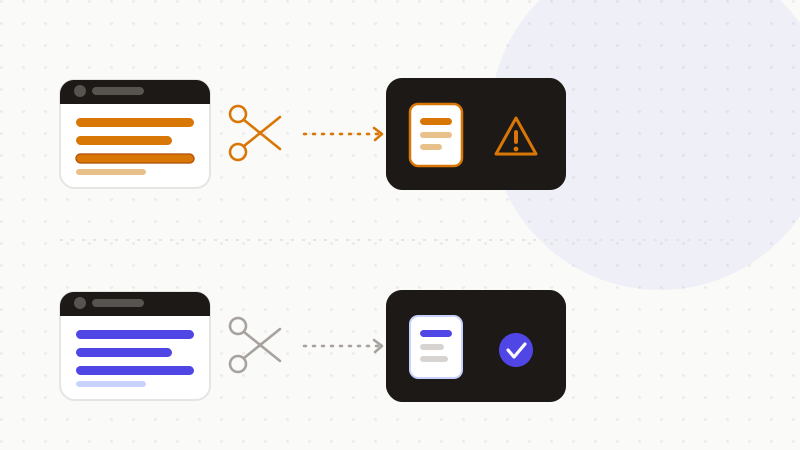
The rule comes down to a few habits. Anonymise anything that identifies a person. Never paste a card number. Keep health notes out of consumer AI. And prefer a vetted business tool that offers a data processing agreement.
- 1Spot the identifiers in your text: name, phone, email, consultation note.
- 2Replace them with reversible tokens, in the browser.
- 3Send only the anonymized text to the AI.
- 4Restore the real values in the reply, locally.
That's what ONYRI Sanitize is for. The engine detects sensitive data — names, phone numbers, emails, consultation notes — and replaces it with reversible tokens before sending. Detection and the mapping stay in your browser. Only anonymized text reaches the model. The AI finds only tokens, never your real clients. You keep your data-controller duty, without giving up the help of AI.
Frequently asked questions
- Is it safe to use AI for salons and spas?
- Yes for general tasks, no with raw client cards. AI can draft a promo, reply to a review or write a booking message with no real data at all. But never paste a name, phone, consultation note or card number into a consumer chatbot. Under the GDPR, this data is personal, and health notes fall under Article 9. Anonymise it before you send.
- Are a salon's consultation notes health data?
- Often, yes. The GDPR places health in the special categories of Article 9. The ICO notes health data is not limited to diagnoses: any information that reveals a state of health counts. A note about an allergy, a sensitive scalp or a pregnancy is therefore health data. It needs extra safeguards and has no place in a consumer AI.
- Can I put a deposit card number into a chatbot?
- No. PCI DSS applies to any business that handles card data, whatever its size. The security code (CVV) must never be retained after authorisation. So a card number has no place in an unvetted chatbot. Handle payment in a compliant processor, never in an AI prompt.
Sources & references
- General Data Protection Regulation (Regulation (EU) 2016/679), full text including Article 9 on special categories of personal data — EUR-Lex (Publications Office of the European Union)
- What is special category data? — guidance including health data — Information Commissioner's Office (ICO), UK
- PCI DSS Data Storage Do's and Don'ts (what cardholder data may and may not be stored) — PCI Security Standards Council
Keep your sensitive data in your browser
ONYRI Sanitize detects and masks your sensitive data before it reaches the AI, then restores the answer — from names to API keys.