Is It Safe to Use AI for Notaries?
Yes on de-identified text, no with client data: never paste a client's ID, deed or succession file into a consumer AI. What secrecy and the GDPR require.
The short answer: yes, but only on de-identified text. AI can help a notary draft, summarise or translate a document. It should never see the client's real data. A notary handles the most sensitive records that exist. Government identity documents. Property deeds. Wills and succession files. Each one is tied to a named person. Professional secrecy, also called notarial confidentiality, binds you to protect that information. Pasting a client's deed or ID into a consumer AI is a disclosure to a third party. Under the GDPR you are the 'controller' and carry the legal duty to protect that data. The fix is simple: replace names, ID numbers and amounts with tokens before you prompt.
Why a notary's files are the most sensitive there are
A notary works with identified people, not anonymous ones. Every file names a real person. The documents concentrate the most sensitive record types at once. Official IDs are the identity-theft jackpot. Property deeds reveal wealth and a home address. Wills and succession files reveal family, assets and a death. Each record is attached to a named individual.
The role differs by country. A common-law notary public mainly witnesses signatures. A civil-law notaire or notario does far more. In France and much of Europe, they handle property deeds, estates and family contracts. That means a broader and far more sensitive dataset. Both share one duty: keep the client's information confidential.
- Government identity documents — passports, national ID cards, driving licences.
- Property deeds — sale contracts, mortgages, ownership records.
- Wills and succession files — heirs, assets and estate details.
- Marriage and financial contracts — matrimonial regimes, amounts, bank details.
What professional secrecy asks of you
Notarial practice treats confidentiality as a core duty. Guidance for notaries is clear on the point. Information in the documents you handle must not be disclosed to unauthorised parties. Notarisations should happen in private settings. And you should get the client's explicit consent before sharing any information with a third party. The only exception: when the law compels you.
A consumer AI service is an external third party. So pasting a client's deed, ID or succession file into such a tool is a disclosure. It hands that data to an outside party. That sits uneasily with your confidentiality duty. It also strains a controller's duty to protect the data it holds.
The law: you are the controller
The GDPR names you clearly. Under the GDPR (Regulation 2016/679), anyone who decides the purposes and means of processing personal data is a 'controller'. That controller carries the legal responsibility for the data. Names, addresses and financial figures in a deed are personal data. So are government ID numbers.
One category is stricter. When an estate or capacity file reveals health information, it becomes 'special category' data. The GDPR reserves that regime for the most sensitive data. Not every notarial file contains it. But succession, medical or capacity files often do. Those deserve extra care.
Two risks you cannot ignore
The first risk is identity theft. The US Federal Trade Commission (FTC) describes it plainly. Someone uses another person's ID number to commit fraud in that person's name. They open accounts, file taxes or get medical care as if they were the victim. The FTC's advice is to give out ID numbers sparingly and keep them secure. Exposing an ID document multiplies the paths open to an impersonator. And the harm lands on a named, identified person — exactly who a notary serves.
The second risk is AI hallucination. AI language models can produce fluent but fabricated statements. In a notarial instrument that takes legal effect, an invented clause, citation or figure carries real consequences. So any AI output on legal drafting has to be checked. Verify it against the official requirements, through official channels.
| Document in the file | What it exposes if leaked |
|---|---|
| Government ID (passport, ID card) | Identity-theft jackpot — impersonation in the person's name |
| Property deed | Wealth and home address of a named owner |
| Will or succession file | Family, assets and a death |
| Marriage or financial contract | Bank details, amounts and private arrangements |
The fix: de-identify before you prompt
You do not have to give up AI. You just have to keep the client's data out of it. De-identify before prompting. Replace names, ID numbers and amounts with placeholder tokens. The AI still helps with structure, phrasing or translation. It works on stripped-down text, never the real values. You restore the real values afterwards, locally.
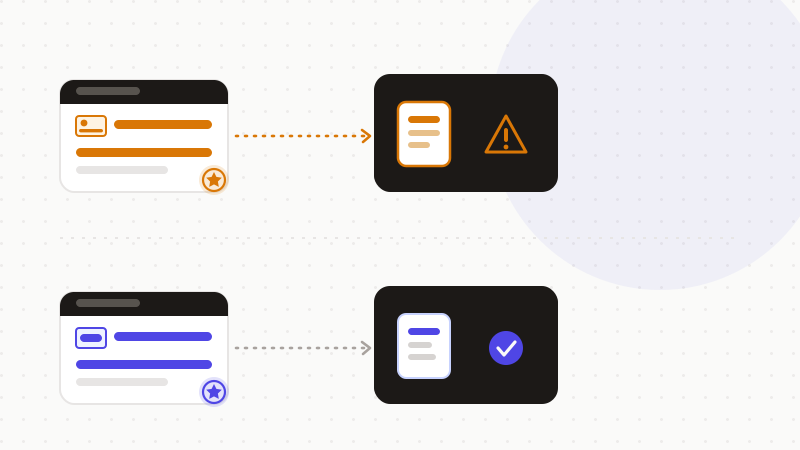
- 1Never paste whole ID documents or full deeds into a consumer AI.
- 2Replace names, ID numbers and amounts with reversible tokens, in the browser.
- 3Send only the de-identified text to the AI.
- 4Restore the real values in the reply, locally, and check the output against official requirements.
That is what ONYRI Sanitize is built for. The engine detects sensitive data — names, ID numbers, addresses, amounts — and swaps it for reversible tokens before anything is sent. Detection and the mapping stay in your browser. Only de-identified text reaches the model. The AI sees tokens, never your client's real identity or deed. You get the drafting help, while honouring the professional secrecy and controller duties that bind you. Always verify the legal requirements through official channels.
Frequently asked questions
- Is it safe to use AI for notaries?
- Yes on de-identified text, no with client data. AI can help you draft, summarise or translate on text stripped of real details. But never paste a client's ID, deed or succession file into a consumer AI. Professional secrecy binds you, and under the GDPR you are the controller of that data. Replace names, ID numbers and amounts with tokens first.
- Can I paste a client's ID or deed into ChatGPT?
- Better not. A consumer AI is an external third party. Pasting a client's ID or deed into it is a disclosure that can breach notarial confidentiality. ID documents are also an identity-theft target, per the FTC. If you need AI help, de-identify the text first and keep the whole document out of the tool.
- Does the notaire or notario face more risk than a notary public?
- Often, yes. A common-law notary public mainly witnesses signatures. A civil-law notaire or notario handles deeds, estates and family contracts. That is a broader and more sensitive dataset. Both are bound by confidentiality, but the civil-law role concentrates far more personal data in one file.
Sources & references
- General Data Protection Regulation (Regulation (EU) 2016/679) — official text (controller duties, personal data, special categories) — EUR-Lex (Publications Office of the European Union)
- The Notary's Guide to Handling Sensitive Documents — confidentiality duty and third-party disclosure — California Notaries
- What To Know About Identity Theft — how ID numbers and documents are misused — U.S. Federal Trade Commission (FTC Consumer Advice)
Keep your sensitive data in your browser
ONYRI Sanitize detects and masks your sensitive data before it reaches the AI, then restores the answer — from names to API keys.
Anonymize my prompt