Is It Safe to Use AI for French Taxes?
Yes for a general rule, no with your file: never paste your numéro fiscal, your RIB or your avis d'imposition into a consumer ChatGPT.
The answer fits in one line. AI can explain a tax rule, but never hand it your file. A French tax file is dense. It combines your numéro fiscal (your tax number), your income, your RIB (bank details) and your family situation. Pasted into a consumer ChatGPT, these items travel to a third party, often hosted outside the European Union. The official channel, by contrast, is impots.gouv.fr. The CNIL advises entering only what is strictly necessary into an AI. There is a clean method: anonymise the numéro fiscal, the RIB and the amounts before you send, then verify the rule on impots.gouv.fr.
What a French tax file lays bare
Every spring, the tax return comes back around. With it comes the urge to ask an AI for help, full file in hand. The problem is not the question you ask. It's what the file contains.
A tax file blends two sensitive worlds. On one side, identity: your numéro fiscal, your family situation, your address. On the other, finance: your income, your tax amounts, your RIB. Together, these items paint a very precise portrait of you. That is exactly what a fraudster is after.
The official channel is impots.gouv.fr
Your return and your payment happen on impots.gouv.fr. That is the tax authority's official channel. A consumer AI, by contrast, is a third party. It plays no role in your relationship with the tax office.
The numéro fiscal is not a mere reference number. These 13 digits are your login credential to the Finances publiques account. That is where the return and the payment take place. In other words, it's a personal access key to your tax account, not a trivial piece of data.
impots.gouv.fr warns against phishing. Fraudulent emails and texts try to steal your numéro fiscal, your credentials or your bank details. The goal: to hijack your tax account. Here are the items most often targeted.
- The numéro fiscal, which serves as the login credential to your account.
- Your username and password for the Finances publiques account.
- Your bank details, including your RIB.
- Your avis d'imposition (tax notice), which gathers all of this on one document.
The tax authority never asks for this data by message. If in doubt, the guidance is simple. Go to impots.gouv.fr yourself. And never share this information. A third-party AI is no exception to that rule.
Numéro fiscal and RIB: fraud targets
The numéro fiscal is a strong identifier. Be careful not to confuse it with the social security number: these are two distinct numbers. The numéro fiscal opens access to your tax account. A third party who obtains it already holds a key piece of your tax identity.
The RIB (bank account details) is just as sensitive. It hands over your bank coordinates. Combined with the rest of the file, it becomes a direct target for identity fraud. These two items should never land in a consumer prompt.
What the CNIL and the GDPR say
The CNIL (France's data protection authority) is the country's data regulator. It points out one essential thing. Pasting personal data into a public generative AI prompt amounts to transferring it to the model's provider. That provider is often hosted outside the European Union.
The CNIL therefore recommends minimisation. In plain terms: enter only what is strictly necessary for the task. It also advises against entering personal or confidential data into public versions of an AI. Many of these services keep the chat history. Some reuse it to improve their models.
The GDPR (General Data Protection Regulation) frames all of this. As soon as an AI processes personal data, its principles apply. The CNIL notes they also apply to training the model. The GDPR does not ban AI innovation. But it does frame it.
| You assume | The reality |
|---|---|
| “My numéro fiscal is just a reference” | These 13 digits are the login credential to your tax account |
| “Pasting my RIB into an AI is no big deal” | impots.gouv.fr lists bank details among phishing fraud targets |
| “The AI keeps nothing from my chat” | The CNIL notes many public services retain the history |
| “The AI's answer on tax is reliable” | An AI can be confidently wrong; verify on impots.gouv.fr |
AI can be confidently wrong
There's a second risk, less visible. A general-purpose AI can be wrong about French tax rules. Brackets, allowances, boxes on the return: it can invent an answer with total confidence. With taxes, a mistake is costly. Always cross-check the answer against impots.gouv.fr before you act on it.
The fix: anonymise before you send
Good news: AI is still useful for your taxes. It can explain a rule, clarify a deadline, reword a letter. For that, it needs none of your identifiers. Ask the question in general terms. Keep the numéro fiscal, the RIB, the amounts and the avis d'imposition out of the prompt.
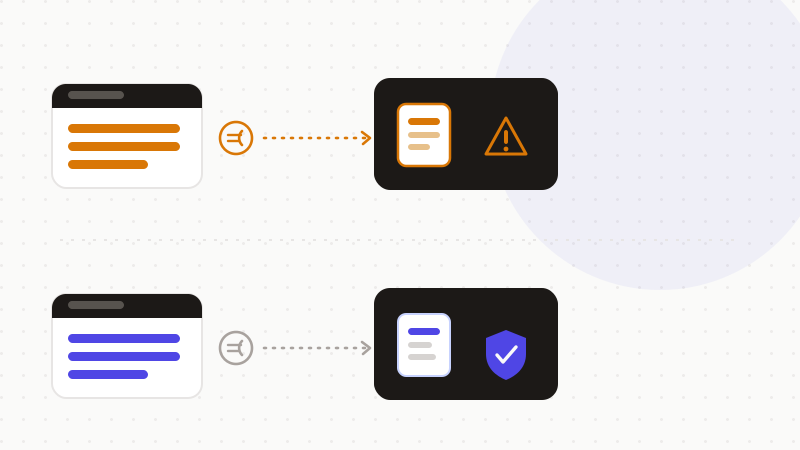
When you really must include a concrete case, anonymise it first. Replace each sensitive item with a token. The AI reasons about the shape of your situation, without ever seeing the real values. You restore the real values afterwards, locally.
- 1Spot the sensitive data: numéro fiscal, income, RIB, family situation.
- 2Replace it with reversible tokens, in the browser.
- 3Send only the anonymised text to the AI.
- 4Restore the real values in the reply, locally, then verify the rule on impots.gouv.fr.
That's what ONYRI Sanitize is for. The engine detects sensitive data — numéro fiscal, RIB, amounts, family situation — and replaces it with reversible tokens before sending. Detection and the mapping stay in your browser. Only anonymised text reaches the model. The AI finds only tokens, never your real tax file. You get the help, without the fraud risk that the CNIL and impots.gouv.fr ask you to rule out.
Frequently asked questions
- Is it safe to use AI for French taxes?
- Yes for a general rule, no for your file. AI can explain a deadline, an allowance or reword a letter with no personal data at all. But never paste your numéro fiscal, your RIB, your income or your avis d'imposition into a consumer ChatGPT. The CNIL recommends entering only what is strictly necessary, and the official channel remains impots.gouv.fr. Anonymise this data before you send.
- Can I paste my numéro fiscal or my RIB into ChatGPT?
- Better to avoid it. impots.gouv.fr lists the numéro fiscal and bank details among phishing fraud targets. The numéro fiscal is also your login credential to the tax account. A consumer AI has no need for this data. If you must describe a case, replace these items with tokens before you send.
- Can AI help with my tax return without my data?
- Yes. AI can explain a rule, a deadline or a box on the return in general terms. It needs none of your identifiers for that. One caveat, though: an AI can be confidently wrong about French tax rules. Always verify the answer on impots.gouv.fr before you act on it.
Sources & references
- Fraudulent emails and texts (phishing): numéro fiscal, credentials and bank details targeted — impots.gouv.fr (DGFiP)
- The CNIL's Q&A on using a generative AI system (minimisation, public versions) — CNIL
- Create and access my account (the numéro fiscal, login credential for impots.gouv.fr) — impots.gouv.fr (DGFiP)
Keep your sensitive data in your browser
ONYRI Sanitize detects and masks your sensitive data before it reaches the AI, then restores the answer — from names to API keys.