Is It Safe to Use AI for Podcasting?
Yes for general tasks, no with raw recordings: a voice is personal data and an unreleased episode is your edge. Anonymise names before you paste.
The short answer fits in one line. AI can transcribe, edit and draft show notes, but don't hand it your raw recordings. A podcast holds two treasures. First your unreleased episodes, your real edge. Second the voice of your guests. Under the GDPR, a recording of an identifiable person is their personal data: the ICO says so. Upload it to a consumer AI, and the file sits on a third party's servers. It may be reviewed. It may help train future models. There is a clean method: anonymise names and details before you paste a transcript, and keep raw audio off consumer tools.
Your unreleased episodes are your crown jewels
An unaired episode is your edition. An embargoed interview. An exclusive guest. A story not yet told. It is what sets you apart. Upload that raw file to a consumer AI, and it lands on a third party's servers. It may be reviewed there. It may feed model improvement. Your exclusive leaks before it ever airs.
The legal framework backs this up. According to WIPO (the World Intellectual Property Organization), confidential business information can qualify as a trade secret. The condition: it gives a competitive edge and stays unknown to others. An embargoed episode or an unaired exclusive fits that frame. But WIPO adds one big requirement. Protection depends on taking “reasonable steps” to keep the information secret. Handing that content to a third party without controls undercuts the status.
A guest's voice is their personal data
A recording is not just sound. It is a person's voice. According to the ICO (Information Commissioner's Office, the UK data protection regulator), a recording of an identifiable person is their personal data. It relates to them and can identify them. One nuance: a raw recording is not automatically “special” biometric data. It only becomes that when a system analyses the voice to identify the speaker. By default, then, it is ordinary personal data, but personal data all the same.
The GDPR spells out your role. Personal data is any information relating to an identified or identifiable person. The controller is the party that decides the purposes and means of processing. A podcaster who chooses to run a guest's interview through an AI acts as controller of that data. That is what Article 4 of the GDPR (Regulation (EU) 2016/679) sets out.
A raw recording often holds far more than the published interview.
- The guest's voice, a personal identifier that relates to them.
- Off-the-record asides, said before “we're recording” felt real.
- Contact details or private facts dropped into the conversation.
- Sensitive topics raised: health, opinions, private life.
Sources, off-the-record and contracts: the blind spots
Some interviews go further. Investigative work can involve source protection. A guest may have spoken under a promise of confidentiality. Handing that file to a third-party service can break the promise. The GDPR treats as a “third party” anyone other than the subject, the controller and the processor. Disclosing the data to that third party stays your responsibility.
Contracts add a layer. A guest release or a sponsor deal can restrict sharing with third parties. This is not a regulator's rule, but common practice. Check those clauses before you upload a file anywhere.
| You assume | The reality |
|---|---|
| “A guest's raw take is just audio” | It's their personal data under the GDPR, and you're the controller |
| “My unreleased episode is no risk” | It's confidential, competitively valuable content, to be kept secret |
| “The off-the-record part doesn't count” | It lives in the raw file and travels with it to the third party |
| “A consumer AI is a neutral tool” | It's a third party: disclosing the data to it is on you |
The fix: anonymise before you send
Good news: AI is still very useful. It can draft your show notes. It can summarise a theme or surface ideas. For that, it does not need the real names. Anonymise the transcript first. Replace each name and identifying detail with a token. The AI works on de-identified text, and the result stays just as useful.
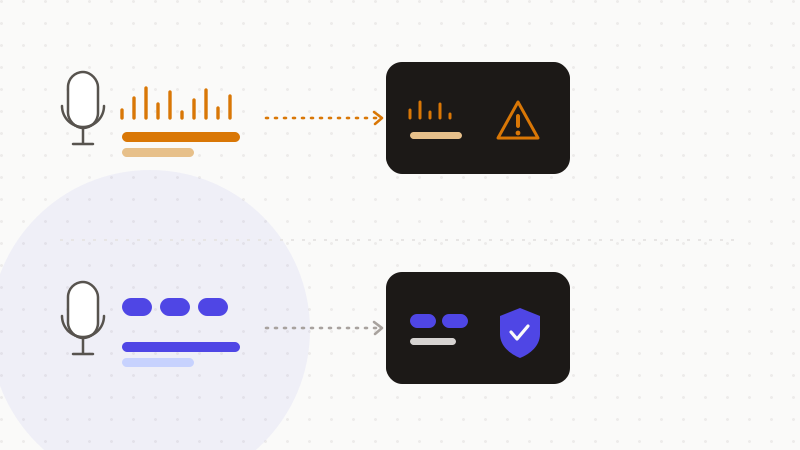
Two simple rules complete the fix. Never upload an embargoed episode or off-the-record material to a consumer AI. Keep the sensitive raw audio off those tools. And check your guest releases before any sharing.
- 1Spot the sensitive parts: guest names, contact details, off-the-record asides.
- 2Anonymise the transcript in the browser, with reversible tokens.
- 3Send only the de-identified text to the AI for show notes.
- 4Keep raw takes, embargoed episodes and raw audio off consumer AI.
That's what ONYRI Sanitize is for. The engine detects sensitive data — guest names, contact details, identifying facts — and replaces it with reversible tokens before sending. Detection and the mapping stay in your browser. Only de-identified text reaches the model. The AI drafts your show notes on tokens, never on the real names. You keep the help of AI, without disclosing to a third party the guest data the GDPR asks you to protect.
Frequently asked questions
- Is it safe to use AI for podcasting?
- Yes for general tasks, no with your raw recordings. AI can draft show notes or summarise a theme from an anonymised transcript. But don't upload an embargoed episode, off-the-record material or a guest's raw audio to a consumer AI. Under the GDPR, a guest's voice is their personal data, and an unreleased episode is confidential content. Anonymise names and details before you paste.
- Is a guest's voice personal data?
- Yes. According to the ICO, a recording of an identifiable person is their personal data: it relates to them and can identify them. It becomes “special” biometric data only when a system analyses the voice to identify the speaker. Either way, you are its controller the moment you decide to run it through an AI.
- Can I upload an unreleased episode to an AI tool?
- Better to avoid it. An embargoed episode is confidential, competitively valuable content. According to WIPO, its protection depends on “reasonable steps” to keep it secret. Handing it to a third party without controls undercuts that status and any promise made to a guest. Keep the sensitive raw audio off consumer AI.
Sources & references
- Biometric recognition — key data protection concepts (a voice recording is personal data; becomes special-category biometric once analysed to identify the speaker) — Information Commissioner's Office (ICO)
- Regulation (EU) 2016/679 (GDPR) — Article 4 definitions: personal data, controller, third party, recipient — EUR-Lex, Publications Office of the European Union
- Frequently Asked Questions on Trade Secrets (confidential business information; reasonable steps / confidentiality agreements) — World Intellectual Property Organization (WIPO)
Keep your sensitive data in your browser
ONYRI Sanitize detects and masks your sensitive data before it reaches the AI, then restores the answer — from names to API keys.