Is It Safe to Use AI for Sales?
Yes, if you anonymise prospect data before the prompt. Pasting raw CRM into a consumer AI is still processing you are accountable for.
The answer fits in one line. AI helps your sales, but the prospect must not end up in the prompt. A sales team pastes sensitive data every day. A contact's name. Their email and phone. A deal's value. Call notes. In a consumer AI, this data can be retained, reviewed or reused for training. And you are the one deciding on that use. Under the GDPR and the CCPA, that choice is your responsibility, not just the vendor's. There is a clean method: anonymise the identifiers and the deal details before you send.
What a sales team really pastes into AI
The use cases are everywhere in a sales cycle. Draft an outreach email. Summarise a customer call. Score a lead. Prep a follow-up. Each time, the temptation is the same. You copy the CRM export or the transcript, and you paste the whole thing into the AI.
The problem is not the AI. It is what you feed it. A CRM export holds real personal data. So does a call transcript. The AI does not need those values to work. It needs the structure of the message.
GDPR: you are the controller
The GDPR (Regulation (EU) 2016/679) sets a simple rule. Whoever decides why and how personal data is processed is the 'controller'. When a rep pastes a name, an email or notes into the AI, it is their company that processes that data. Not the AI vendor alone.
Article 5 sets the accountability principle. You must be able to demonstrate that the processing follows the data-protection principles. Article 24 adds a concrete duty. You must put appropriate technical and organisational measures in place.
Article 5(1)(c) carries another key principle: data minimisation. Data must be adequate, relevant and limited to what is necessary. Sending a full CRM record to draft an email is hard to justify. The model only needs the shape of the message. That is the technical basis for anonymising before the prompt.
CCPA: prospect data fits the definition
In the United States, the California Consumer Privacy Act (CCPA) defines 'personal information' broadly. It is any data that identifies a consumer or household, or can reasonably be linked to one. Names, emails, purchase records, inferences: it all counts. The prospect data pasted into AI tools falls squarely within this definition.
The CCPA is enforced by the California Privacy Protection Agency and the California Attorney General. Civil penalties can reach $2,500 per violation. They rise to $7,500 per intentional violation. Covered businesses must implement reasonable security practices. They must also have contracts in place with third parties that receive personal information.
OWASP: an AI is not a vault
OWASP lists Sensitive Information Disclosure as the LLM02 risk in its 2025 Top 10 for LLM applications. An AI system can unintentionally expose private or confidential data through its outputs. That exposure can come from data placed in the prompt, held in memory, or embedded in training data.
OWASP describes LLMs as probabilistic text generators, not secure vaults. In rare cases, a model exposed to raw CRM data can surface one prospect's details to another user. This is not a routine event, but a real risk. And even accidental disclosure can leave the organisation responsible for missing safeguards.
| You assume | The reality |
|---|---|
| “The AI vendor is the one responsible” | Under the GDPR, you are the controller (Articles 5 and 24) |
| “A prospect's name isn't sensitive data” | The CCPA calls it personal information; the GDPR, personal data |
| “I can just paste a call transcript” | The recording may include non-consenting voices; rules vary by state |
| “The AI keeps my data to itself” | OWASP warns a model can disclose data from the prompt or its memory |
The fix: anonymise, contract, keep a human
Good news: AI is still an excellent sales copilot. It can draft, summarise and score without ever seeing the real values. The principle is simple. You replace each identifier and deal detail with a token. The AI reasons about the structure. You restore the real values afterwards, locally.
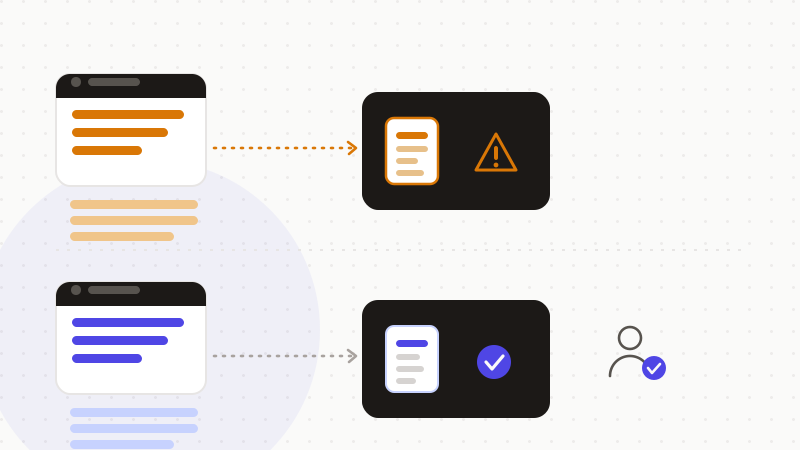
Anonymising is not a guarantee of compliance. It is risk reduction and a real minimisation lever. Pair it with a few simple habits, summarised below.
- 1Anonymise prospect identifiers and deal details before the prompt.
- 2Prefer a CRM-integrated tool with a signed DPA (Data Processing Agreement) and a no-training clause.
- 3Check the product's current terms: consumer tiers may retain and review data differently from enterprise tiers.
- 4Respect call-recording consent according to your jurisdiction.
- 5Keep a human check on every output before it reaches the prospect.
- What the AI should see: the email frame, the objection type, the summary structure.
- What the AI does not need to see: the name, email, phone, deal value, or target account.
That's what ONYRI Sanitize is for. The engine detects sensitive data — name, email, phone, deal value, notes — and replaces it with reversible tokens before sending. Detection and the mapping stay in your browser. Only anonymized text reaches the model. The AI finds only tokens, never your real prospects. You gain the speed of AI, without handing a third party data the prospect never gave you for that.
Frequently asked questions
- Is it safe to use AI for sales?
- Yes, as long as you anonymise first. AI can draft an email, summarise a call or score a lead without seeing any personal data. But don't paste a raw CRM export, a prospect's email or a transcript into a consumer AI. Under the GDPR and the CCPA, that processing is your responsibility. Replace identifiers and deal details with tokens before you send.
- Am I responsible if a rep pastes a prospect into ChatGPT?
- Yes, largely. Under the GDPR, whoever decides why and how data is processed is the controller. When your team pastes a name or notes into an AI, it is your company that processes that data (Articles 5 and 24). The CCPA also requires reasonable security practices and contracts with third parties that receive personal information.
- Can I have AI summarise a call transcript?
- With caution. A transcript can hold the voice of people who consented neither to the recording nor to the AI processing. Some US states require all-party consent, and rules vary; in the EU, this engages the GDPR. Check your jurisdiction, get consent, then anonymise the identifiers before you summarise.
Sources & references
- Regulation (EU) 2016/679 (GDPR) — consolidated text (Article 5: accountability and data minimisation; Article 24: controller duties) — EUR-Lex (Publications Office of the European Union)
- California Consumer Privacy Act (CCPA) — definition of personal information, business obligations and enforcement penalties — California Office of the Attorney General
- LLM02:2025 Sensitive Information Disclosure — OWASP Top 10 for LLM Applications — OWASP GenAI Security Project
Keep your sensitive data in your browser
ONYRI Sanitize detects and masks your sensitive data before it reaches the AI, then restores the answer — from names to API keys.