Is AI Safe for Kids? A Parent's Privacy Guide
Yes, with age-appropriate tools and supervision. But kids overshare names, schools and photos. What COPPA and the UK Children's Code mean.
Yes, AI can be safe for a child. But only with the right tools and a parent nearby. A child treats a chatbot like a private friend. They type their name, their school, their address, sometimes a photo. Young users do not grasp that this data can be stored. In the US, COPPA (the Children's Online Privacy Protection Act) requires parental consent before a service collects data from a child under 13. In the UK, the Children's Code asks online services to protect under-18s by default. The practical fix is simple. Choose age-appropriate tools, use them together, and teach the child to never share identifying details.
Why children share too much
Children are wired to trust. A chatbot answers warmly. It remembers what they said. It never judges. To a child, that feels like a real friend. So they open up. They give their full name. They name their school and their class. They mention their street or their town. Some even upload a photo of themselves. Chatbots are built to sound like a companion or confidant. That design encourages trust. It also encourages oversharing.
The problem is what comes next. A child's inputs can be stored. Depending on the service and its settings, that text can be used to improve the model. Your child cannot weigh that trade-off. That is why the responsibility sits with the adult in the room.
In the US: what COPPA says
In the United States, children's privacy has its own law. COPPA stands for the Children's Online Privacy Protection Act. It is enforced by the FTC (the Federal Trade Commission). COPPA protects children under 13. That age matters: it is under 13, not under 18.
The rule sets a clear duty. A service aimed at under-13s, or one that knowingly collects their data, must tell parents first. It must obtain verifiable parental consent before collecting, using or sharing a child's personal information. COPPA does not force one single method of consent. It asks operators to use a method reasonably designed to confirm the person consenting is really the parent.
The FTC updated the COPPA Rule in 2025. The amendments were published in April 2025. They tighten how companies share and monetise children's data. For example, parents must now separately opt in before a child's data is disclosed to third parties for targeted advertising. Some compliance deadlines phase in later, so check the FTC page for current dates.
In the UK: the Children's Code
The United Kingdom takes a broader approach. The Age Appropriate Design Code — known as the Children's Code — comes from the ICO (the Information Commissioner's Office). It applies to any online service likely to be accessed by someone under 18. That threshold is wide. It is not limited to services aimed at children.
The Children's Code sets 15 standards, all built around the best interests of the child.
- Settings must be high-privacy by default.
- Only the minimum necessary data should be collected.
- Geolocation should be off by default.
- 'Nudge' techniques must not push a child into weakening their privacy.
The code took effect on 2 September 2020. Under the UK GDPR, the UK version of the GDPR, a child's personal data is treated as needing greater protection.
Companion chatbots and AI toys
Regulators are now watching companion chatbots closely. On 11 September 2025, the FTC opened a study into AI companion chatbots and their effect on children and teens. It sent orders to seven reported recipients, including major AI and social companies. This is fact-finding, not a ruling. No company has been found to break the law. The study looks at age limits, disclosures to parents, and how conversation data is used.
AI toys deserve the same care. A toy with a microphone or camera can capture audio and video in your home. Treat it like any connected device. Check what it records, where that data goes, and whether you can turn collection off.
| Kid detail | Why it's sensitive | Safer habit |
|---|---|---|
| Full name | Identifies your child directly | Use a nickname or an initial |
| School or class | Pinpoints your child each day | Keep the school out of the prompt |
| Address or town | Reveals where your child lives | Never type it; stay general |
| Photo or face | Biometric-grade personal data | Don't upload; describe instead |
The fix for parents
Here is the good news. AI can be genuinely useful for kids. A homework helper can explain a maths step. A chatbot can answer a curious question. The goal is not to ban these tools. The goal is to use them with care.
- 1Check the app's age rating and read its privacy policy.
- 2Use the tool with your child and supervise younger ones.
- 3Teach one rule: never share name, school, address or photos.
- 4Turn on family or parental controls.
- 5Prefer tools that let you opt out of training on your child's inputs.
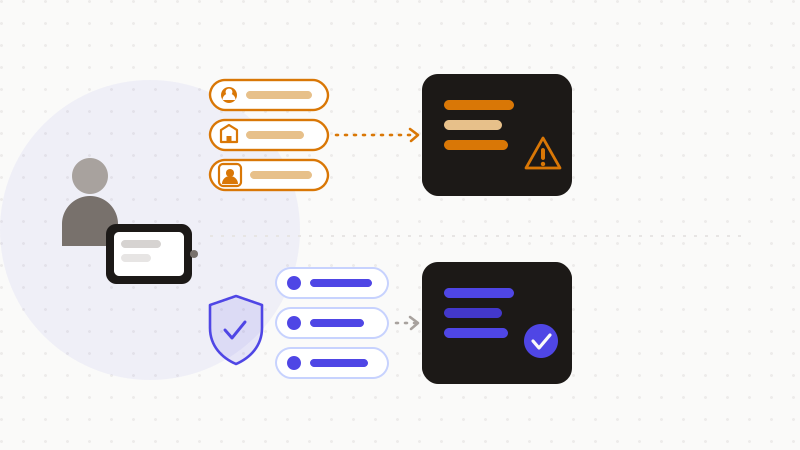
One habit ties it all together. Before your child's words reach an AI, strip the identifying details. The name, the school, the address and photos do not belong in a prompt. The AI can still help without them.
That is what ONYRI Sanitize is for. The engine detects sensitive data — name, address, photos, and much more — and replaces it with reversible tokens before anything is sent. Detection and the mapping stay in your browser. Only anonymized text reaches the model. It never sees your child's real details. You keep the help, and you keep the habit COPPA and the Children's Code point toward: protect a child's data by default.
Frequently asked questions
- Is AI safe for kids?
- Yes, with the right tools and supervision. AI homework helpers and chatbots can be useful and age-appropriate. The risk is not the AI itself. It is what a child shares with it: their name, school, address or photos. In the US, COPPA protects data from children under 13. In the UK, the Children's Code protects under-18s. Choose age-appropriate tools, use them together, and teach kids never to share identifying details.
- What is COPPA and what age does it cover?
- COPPA is the Children's Online Privacy Protection Act, enforced by the US FTC. It covers children under 13, not under 18. A service aimed at under-13s, or one that knowingly collects their data, must first obtain verifiable parental consent. The FTC updated the rule in 2025 to tighten how children's data is shared and monetised.
- Are AI toys and companion chatbots safe for a child?
- They can be, with supervision. AI toys with a microphone or camera collect audio and video at home, so check what they record and where it goes. Companion chatbots are under regulator scrutiny: in 2025 the FTC opened a fact-finding study into their effect on kids and teens. Use these tools with your child and teach safe sharing habits.
Sources & references
- Children's Privacy (COPPA business guidance: verifiable parental consent, under 13, 16 CFR Part 312) — US Federal Trade Commission (FTC)
- Introduction to the Children's Code (Age Appropriate Design Code: 15 standards, under 18, high-privacy by default) — UK Information Commissioner's Office (ICO)
- FTC Launches Inquiry into AI Chatbots Acting as Companions (Section 6(b) study, effects on children and teens) — US Federal Trade Commission (FTC)
Keep your sensitive data in your browser
ONYRI Sanitize detects and masks your sensitive data before it reaches the AI, then restores the answer — from names to API keys.