Is It Safe to Use AI for a Mortgage Application?
Yes to learn the process, no with your file: never paste your SSN, bank statements or pay stubs into a consumer ChatGPT to apply for a mortgage.
The short answer fits in one line. AI can explain the mortgage process, but never hand it your file. A loan application gathers your most sensitive data in one place. Your national identity number, the SSN in the US (Social Security Number, the number that anchors your identity). Your income and pay stubs. Your full bank statements. The property details. It is the densest identity dossier you will ever assemble. Pasted into a consumer ChatGPT, it becomes the jackpot for identity theft. The right method: ask your questions, but anonymise your file before you send.
The densest identity dossier of your life
No other document concentrates so much sensitive data. A mortgage application gathers everything at once. Your national identity number. Your proven income. Your bank statements, line by line. The property address. Apart, these elements are already sensitive. Together, they form the identity-theft jackpot.
The Federal Trade Commission (FTC, the US consumer-protection agency) defines identity theft plainly. It is the use of your personal or financial information without permission. Name, address, bank or card numbers, Social Security number. A mortgage file holds exactly these elements, all at once. That is what makes it so valuable to a fraudster.
- The SSN or national ID number — the key to your identity.
- Pay stubs and tax records — your proven income.
- Full bank statements — every movement on the account.
- Account numbers and the address of the financed property.
The lender is regulated, the chatbot is not
Here is the asymmetry that changes everything. Your lender carries heavy legal duties. A consumer chatbot does not. In the US, the Gramm-Leach-Bliley Act (GLBA, a federal law on financial data) mandates the FTC's Safeguards Rule. That rule requires financial institutions to build a written information security program. Access controls, encryption, multi-factor authentication, monitoring.
This duty binds your lender, your broker, your loan servicer. It does not bind the AI you paste your file into. The lender must protect the confidentiality of your financial data by law. The chatbot has no such duty. You would be moving your most sensitive file from a regulated channel into a service that is not regulated.
In the US, the Consumer Financial Protection Bureau (CFPB, the federal consumer-finance regulator) oversees mortgage lenders and servicers. It also handles complaints and runs the official loan documents, such as the Loan Estimate and the Closing Disclosure. That is the right source to verify a loan rule, not a chatbot.
AI can be confidently wrong
A second risk has nothing to do with your data. Generative AI can make things up. On rates, eligibility or loan rules, it sometimes answers with confidence and gets it wrong. This is called a hallucination. On a commitment worth hundreds of thousands, it is a bad place to trust a false answer.
There is also the wider landscape of automated decisions. A lender's underwriting systems can carry a discrimination risk. That risk sits with the lender's system, not with your use of a chatbot. But it is part of the picture. The practical rule stays the same. Verify any loan rule with the lender or an official source such as the CFPB.
| You assume | The reality |
|---|---|
| “Pasting my file saves time” | It gathers SSN, income and statements — the identity-theft jackpot |
| “The chatbot is as safe as my bank” | The FTC Safeguards Rule binds the lender, not the chatbot |
| “The AI knows the loan rules” | It can be confidently wrong on rates and eligibility |
| “My statements aren't personal data” | Per the ICO, if you can be identified, they are personal data |
Retention: where does your data go?
Pasted into a third-party service, your file lives on outside servers. It can be retained there. It can be reviewed. It can feed model training. The FTC advises keeping your Social Security card and tax records in a safe place, and shredding tax records before disposal. That simple principle, guard the SSN and financial papers, argues clearly against pasting them into an AI.
The law points the same way. Under the UK GDPR, the UK version of the GDPR, the ICO (Information Commissioner's Office, the UK data regulator) notes a key point. Information is personal data whenever a living individual can be identified, directly or indirectly. So the names, addresses and account numbers scattered through your file are personal data, even before you reach the SSN.
If your file leaks, the harm is real and documented. The FTC directs identity-theft victims to IdentityTheft.gov, where a step-by-step recovery plan awaits them. That page exists because exposing a full financial dossier causes concrete damage, not a hypothetical risk.
The fix: anonymise before you send
Good news: AI is still useful for your mortgage. It can explain the process. It can clarify a step, a term, a document. It can even tighten an explanation letter you have already de-identified. For that, it needs none of your real identifiers. Ask the question in general terms. Keep the SSN, the account numbers, the names and the address out of the prompt.
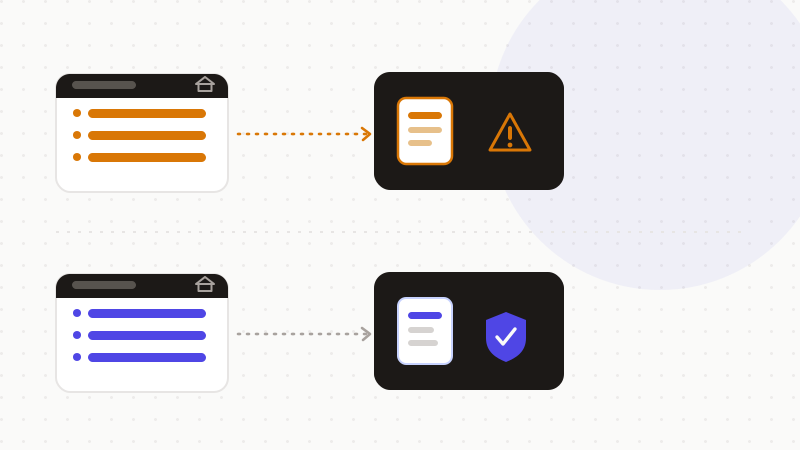
When you really must include a concrete case, anonymise it first. Replace each identifier with a token. The AI reasons about the shape of your situation, without ever seeing the real values. You restore the real values afterwards, locally. The real documents stay in the lender's secure channel.
- 1Spot the identifiers: SSN, account numbers, names, addresses.
- 2Replace them with reversible tokens, in the browser.
- 3Never paste a full statement or an SSN into the AI.
- 4Verify every rule with the lender or an official source.
- 5Restore the real values in the reply, locally.
That's what ONYRI Sanitize is for. The engine detects sensitive data — SSN, account numbers, names, addresses, amounts — and replaces it with reversible tokens before sending. Detection and the mapping stay in your browser. Only anonymized text reaches the model. The AI finds only tokens, never your real file. You get the help, without the identity-theft risk the FTC asks you to rule out.
Frequently asked questions
- Is it safe to use AI for a mortgage application?
- Yes to learn the process, no with your file. AI can explain the steps, a term or a document with no personal data at all. But never paste your SSN, pay stubs, bank statements or the property address into a consumer ChatGPT. A mortgage file gathers these elements and becomes the identity-theft jackpot the FTC describes. Anonymise them before you send.
- Can I paste my SSN or bank statements into ChatGPT?
- Better to never do it. The FTC advises keeping your SSN and financial records in a safe place. A chatbot lives on outside servers where your data can be retained, reviewed or used for training. Unlike your lender, bound by the GLBA Safeguards Rule, the chatbot has no legal duty to protect that data. Anonymise before you send.
- Can AI help with my mortgage without my data?
- Yes. AI can explain the loan process, clarify a term or improve an already-anonymised explanation letter, with no real identifiers. Be careful, though: it can be confidently wrong on rates or eligibility. Always verify a loan rule with the lender or an official source such as the CFPB, never with the chatbot alone.
Sources & references
- FTC Safeguards Rule: What Your Business Needs to Know (security program required of financial institutions under the GLBA) — Federal Trade Commission (FTC)
- What To Know About Identity Theft (definition of identity theft, guarding the SSN, IdentityTheft.gov) — Federal Trade Commission (FTC)
- What is personal data? (information identifying a person is personal data under the UK GDPR) — Information Commissioner's Office (ICO)
Keep your sensitive data in your browser
ONYRI Sanitize detects and masks your sensitive data before it reaches the AI, then restores the answer — from names to API keys.