Is It Safe to Use AI for HR? Employee Data and GDPR
Yes, but never with raw employee data. Salaries, health and address data are protected under GDPR — anonymise before the AI prompt.
Yes, HR teams can use AI safely — but not with raw employee data. AI can draft a policy, a letter or a summary without any names. The problem starts when you paste a real record. HR holds the most sensitive data in the company. Salaries. Performance reviews. Sickness and occupational-health records. Home addresses. Bank details. Some of it is even 'special category' data under the GDPR (the EU's General Data Protection Regulation). Pasted into a consumer chatbot, that data can be retained, reviewed by humans, or used to train models. The fix is simple: anonymise names, salaries, health details and addresses before you send the prompt.
What an HR file actually holds
HR sits on a deep well of personal data. Think about a single employee record. It can list a salary and a pay band. It can hold performance reviews and past ratings. It can carry disciplinary and grievance notes. It can store a home address and next-of-kin contacts. It can include bank details for payroll. Each field is personal data. Each field deserves care.
Some records go further. Sickness records and occupational-health notes describe an employee's health. Diversity monitoring can capture ethnicity, disability or religion. These fields are more sensitive than a salary line. The GDPR treats them as a class apart. We explain that next.
Special category data: the extra-protected tier
The GDPR draws a line between two kinds of data. Ordinary personal data is one kind. Special category data is the other. Article 9 of the GDPR lists the special categories. Processing them is banned unless a narrow legal condition applies. So HR must handle them with extra care.
- Health data, including sickness records and disability accommodations.
- Racial or ethnic origin, often found in diversity monitoring.
- Trade union membership.
- Religious or philosophical beliefs.
- Genetic and biometric data used to identify someone.
- Sex life and sexual orientation.
Now the common trap. Not every HR field is special category. Salaries, pay bands and bank details are not. Home addresses and next-of-kin contacts are not. Performance reviews and disciplinary records are not. But they are still personal data. They still need a lawful basis. They still stay fully protected under the GDPR.
The EU AI Act: HR systems are high-risk
There is a second rulebook to know. The EU AI Act (Regulation 2024/1689) governs how AI is built and used. Its Annex III lists 'high-risk' uses. AI for employment and worker management is on that list. It covers recruitment and selection. It covers task allocation based on behaviour or traits. It covers monitoring and evaluating performance. And it covers decisions on promotion, terms or termination.
High-risk does not mean banned. It means extra obligations. An organisation can still use these systems lawfully. But it must meet the Act's requirements. Those include risk management, human oversight, transparency and record-keeping. Employers who deploy such a system must also inform the affected workers.
Two risks, kept separate
It helps to keep two threads apart. One thread is the AI Act. It applies when you build or deploy an HR decision system. The other thread is everyday data protection. It applies the moment you paste a record into a chatbot. That second act is mainly a GDPR issue, not an AI Act breach. Both matter, but they are not the same problem.
| The concern | What it really is |
|---|---|
| Building an AI tool to score staff performance | A high-risk use under the EU AI Act, with duties attached |
| Pasting a sickness record into a public chatbot | A GDPR issue: special-category data sent to a third party |
| Sharing a salary table with a consumer AI | Ordinary personal data disclosed, often with no lawful basis |
| Anonymising the record first, then prompting | Data minimisation — the model sees tokens, not people |
The fix: anonymise before the prompt
Here is the good news. AI stays useful for HR work. It can draft a policy, a warning letter or a review summary. For that, it needs no real names or numbers. So strip the identifiers first. Replace names, salaries, health details and addresses with tokens. Let the AI work on the tokens. Then restore the real values on your own machine.
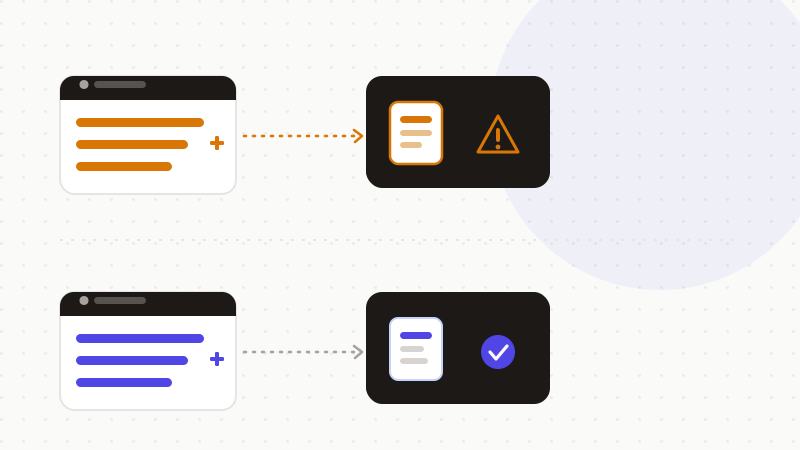
The model only ever sees anonymised text. So retention, human review or training cannot expose a real employee. You still owe your own checks, though. A DPIA (Data Protection Impact Assessment) and legal review remain your job. Anonymising the prompt is data minimisation, not a full compliance guarantee.
- 1Spot the sensitive fields: names, salaries, health notes, addresses, bank details.
- 2Replace each one with a reversible token, in the browser.
- 3Send only the anonymised text to the AI.
- 4Restore the real values in the reply, locally.
That's what ONYRI Sanitize is built for. The engine detects sensitive data — names, salaries, health details, addresses, bank numbers — and swaps it for reversible tokens before sending. Detection and the mapping stay in your browser. Only anonymised text reaches the model. The AI sees tokens, never a real employee record. Your team gets the drafting help, while the data the GDPR and the EU AI Act protect stays under your control.
Frequently asked questions
- Is it safe to use AI for HR?
- Yes for general work, no with raw employee data. AI can draft a policy, a letter or a summary using no personal data at all. But never paste salaries, performance reviews, sickness records or addresses into a consumer chatbot. Under the GDPR, health and some diversity data are special category, with extra protection. Anonymise the record before you send it.
- Is employee health data special category under the GDPR?
- Yes. Sickness records, occupational-health notes and disability data are health data. GDPR Article 9 treats health as special category, with stricter conditions. Diversity data can also be special category where it captures ethnicity, religion or sexual orientation. Salary, address and bank details are not special category — but they are still personal data.
- Does the EU AI Act ban AI in HR?
- No. The EU AI Act classifies employment and worker-management AI as high-risk, not banned. High-risk means extra obligations: risk management, human oversight, transparency and record-keeping. Employers who deploy such systems must also inform affected workers. That is separate from the everyday risk of pasting employee data into a chatbot, which is mainly a GDPR issue.
Sources & references
- GDPR — Article 9: processing of special categories of personal data (health, ethnicity, union membership, and more) — EUR-Lex (Publications Office of the EU)
- EU AI Act (Regulation 2024/1689) — Annex III: employment and worker management as a high-risk use — EUR-Lex (Publications Office of the EU)
- Employment: guidance on handling workers' data under the UK GDPR — Information Commissioner's Office (ICO)
Keep your sensitive data in your browser
ONYRI Sanitize detects and masks your sensitive data before it reaches the AI, then restores the answer — from names to API keys.