Is It Safe to Use AI for Financial Advisors?
Yes for general cases, no with a client's data: never expose net worth, an SSN or account numbers. Anonymise identifiers and amounts before any prompt.
The answer fits in one line. AI can draft a report or summarise a meeting, but never with a client's raw data. A financial adviser holds something rare: a person's entire financial life in one place. Net worth. Accounts and portfolio. Income and goals. A Social Security number or national ID. Pasted into a consumer chatbot, that concentration can be retained, reviewed or reused for training. You are regulated; the chatbot is not. The fix is simple: anonymise identifiers and amounts before any prompt.
One client, their whole financial life in one place
This is what makes the adviser's role unique. An accountant sees ledgers. A broker sees one loan. You see the full picture. A client's net worth. The detail of their accounts and portfolio. Their income. Their life goals. And often a strong identifier: an SSN in the US, a national ID number elsewhere.
Together, these pieces are the fraudster's jackpot. It is exactly the concentration of data that fuels identity theft and financial fraud. A lone name can be replaced. A full net worth with an identifier cannot. That is why protecting this file is not a courtesy. It is a fiduciary duty at the core of your job.
You are regulated; the chatbot is not
This is the central asymmetry. In the US, advisers fall under the SEC (Securities and Exchange Commission) and FINRA (Financial Industry Regulatory Authority). Client-data safeguarding sits under Regulation S-P and the FTC Safeguards Rule, both descended from the Gramm-Leach-Bliley Act (GLBA).
In May 2024, the SEC adopted amendments to Regulation S-P. They require written policies to safeguard customer records. They also require an incident-response program, with notice to affected people when data is accessed without authorization. The compliance deadlines phase in after June 2024. This rule ties your handling of client data to a federal obligation.
The GLBA has required firms since 1999 to protect the confidentiality of a customer's nonpublic personal information. The FTC defines this 'customer information' broadly: any record holding nonpublic personal data, in any form. Its amended Safeguards Rule even requires reporting an event that affects 500 consumers or more. Mishandling this data carries regulatory consequences, not just reputational ones.
In the UK, the regulator is the FCA (Financial Conduct Authority). Its stance is clear: AI is a technology, not a separate regulated activity. The duties that apply when a firm uses AI are the same duties that already apply to everything else. Data protection. Fairness. The Consumer Duty. The firm stays fully accountable for the outcome, even when an AI tool produced the draft.
The FCA expects firms to explain their use of AI to regulators. How the risks were identified, assessed and managed. It is working with the ICO to clarify where data protection sits, with further guidance expected during 2026. In Europe, MiFID II governs conduct. The common thread is simple: the consumer chatbot you paste the file into is covered by none of these regimes.
| You | The consumer chatbot |
|---|---|
| Regulated by the SEC / FINRA (US), the FCA (UK) | Regulated by none of these authorities |
| Bound to safeguard client data (Reg S-P, GLBA) | May retain, review and reuse the content |
| Accountable for the outcome, even if AI produced it | Carries no fiduciary responsibility |
| Must be able to explain its use of AI | Answers to no financial regulator |
Two risks people underestimate
The first risk is confident error. A general AI can be wrong with total conviction about a suitability rule, a product or a duty. The answer reads smooth and sure. That does not make it correct. Copied as-is, it becomes a compliance risk and possible harm to the client.
The second risk is retention. A consumer assistant may keep submitted content on the provider's servers. That content may be reviewed by people. It may train future models, unless enterprise terms say otherwise. Your client's file then lives on a third party, outside any compliant channel.
The law leaves no escape on what this data is. Under the UK GDPR, as the ICO explains, personal data is any information relating to an identified or identifiable person. Even pseudonymised, it stays personal if it can be linked back to someone. A client's financial file, with its identifiers, stays regulated personal data wherever it is sent.
The fix: anonymise before you send
Good news: AI is still a powerful tool for an adviser. It drafts reports. It summarises meetings. It sharpens portfolio analysis. For all of that, it does not need to know who the client is. It needs the shape, not the identity.
The rule comes down to a few moves. Anonymise identifiers and amounts before any prompt. The AI then drafts the report or summary on de-identified data. Never paste an SSN, an account number or a full statement. Keep client data in compliant channels. And use only vetted tools, with a data-processing agreement (DPA) and a no-training commitment.
- Never paste an SSN, an ID document or an account number.
- Never paste a full statement or the real net-worth figure.
- Keep client data in compliant channels.
- Require a DPA and a no-training clause for any vetted tool.
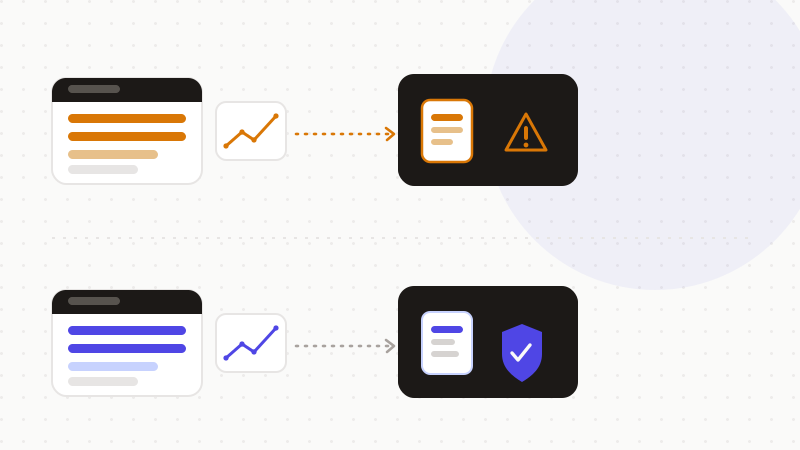
In practice, work in order. You keep the value of AI without exposing your client.
- 1Spot the identifiers and amounts: SSN, accounts, net worth, income.
- 2Replace them with reversible tokens, in the browser.
- 3Send only the de-identified text to the AI.
- 4Restore the real values in the reply, locally.
That's what ONYRI Sanitize is for. The engine detects sensitive data — net worth, accounts, SSN, amounts, goals — and replaces it with reversible tokens before sending. Detection and the mapping stay in your browser. Only de-identified text reaches the model. The AI finds only tokens, never your client's real financial life. You get the help, without betraying the fiduciary duty the SEC, the FCA and the ICO ask you to honor.
Frequently asked questions
- Is it safe to use AI for financial advisors?
- Yes for general cases, no with a client's raw data. AI can draft a report, summarise a meeting or sharpen an analysis with no real identity. But never expose net worth, an SSN, account numbers or statements in a consumer chatbot. You are regulated by the SEC, FINRA or the FCA; the chatbot is not. Anonymise identifiers and amounts before any prompt.
- Why is pasting a client's file into a chatbot risky?
- Because an adviser's file gathers a person's whole financial life: net worth, accounts, income, goals and a strong identifier. That is the identity-theft jackpot. A consumer chatbot may retain the content, have it reviewed and use it for training. Under the UK GDPR, this is regulated personal data, even when pseudonymised. Protecting this file is a fiduciary duty.
- How do I stay compliant while still using AI?
- Anonymise identifiers and amounts before sending: the AI then drafts on de-identified data. Never paste an SSN, an account number or a full statement. Keep client data in compliant channels. Use only vetted tools, with a data-processing agreement (DPA) and a no-training clause. This aligns with the safeguarding duties of the GLBA and Regulation S-P.
Sources & references
- Regulation S-P: Privacy of Consumer Financial Information and Safeguarding Customer Information (2024 final rule: written policies, incident response, notification) — U.S. Securities and Exchange Commission (Federal Register)
- AI: artificial intelligence in financial services (AI is not a separate regulated activity, same duties, Consumer Duty, work with the ICO) — Financial Conduct Authority (FCA)
- What is personal data? (personal data = an identified or identifiable person, pseudonymised data is still personal data) — Information Commissioner's Office (ICO)
Keep your sensitive data in your browser
ONYRI Sanitize detects and masks your sensitive data before it reaches the AI, then restores the answer — from names to API keys.
Anonymize my prompt