Is It Safe to Put Financial Data Into AI?
No, not as-is: a bank statement or invoice packs your IBAN, BIC, amounts and name — exposed to retention, training and human review. The fix that works.
No: pasting a bank statement, invoice or payslip as-is into a consumer assistant (ChatGPT, Claude, Gemini) isn't risk-free. These documents pack your most identifying financial data — IBAN/account number, BIC, balances, amounts, account holder name, tax IDs — and by default, consumer accounts can feed model training, have a portion of their conversations read by humans, and retain exchanges far longer than you'd expect. Financial press and identity-protection experts advise against putting sensitive financial data in until the sharing implications are clear. The fix that works: anonymize the document before sending.
What a financial document actually contains
A single financial file combines several directly identifying data categories. A bank statement ties your name to your IBAN and your transactions; an invoice links a company, an amount and contact details; a payslip reveals salary, tax ID and employer. Pasting them into a chat means transmitting all of it in the clear to the provider.
- IBAN / account number — directly exploitable.
- BIC / SWIFT and banking details.
- Named amounts: balances, salaries, margins, forecasts.
- Account holder name and tax IDs (tax number, company registration).
- Beyond privacy: margins and forecasts may fall under trade-secret protection.
Retention, training, human review: the real risk
By default, consumer accounts feed model training. Anthropic announced on August 28, 2025 that conversations from Claude Free, Pro and Max users would be used to train its models unless they explicitly opt out, with an October 8, 2025 deadline to choose; and retention climbs to five years for those who accept sharing, versus thirty days for those who decline. On Google's side, a sample of Gemini exchanges is reviewed by human reviewers (including service providers), and those reviewed conversations are kept up to three years, disconnected from the account — and are not deleted when you clear your activity.
User-side deletion doesn't always erase the data. In the New York Times v. OpenAI litigation, a May 2025 order forced OpenAI to preserve output logs that would normally have been deleted — including deleted chats and API content outside Zero Data Retention agreements. A court proceeding can therefore impose retention well beyond the usual thirty days. And the risk is massive in companies: Cyberhaven research measured that 8.6% of employees pasted company data into ChatGPT, 4.7% pasted confidential data, and that sensitive data makes up 11% of what employees paste in.
| You assume | The reality |
|---|---|
| “It's just for analysis, it won't be kept” | Consumer accounts can feed training by default, unless you opt out |
| “I delete it, it's erased” | Retention up to 3 years (reviewed Gemini) or 5 years (shared Claude); a court order can force preservation |
| “Only the machine reads my statement” | A sample is reviewed by human reviewers, contractors included |
| “My personal account is like a business one” | Business (Team/Enterprise/API) isn't trained by default; personal is — with no retroactive effect |
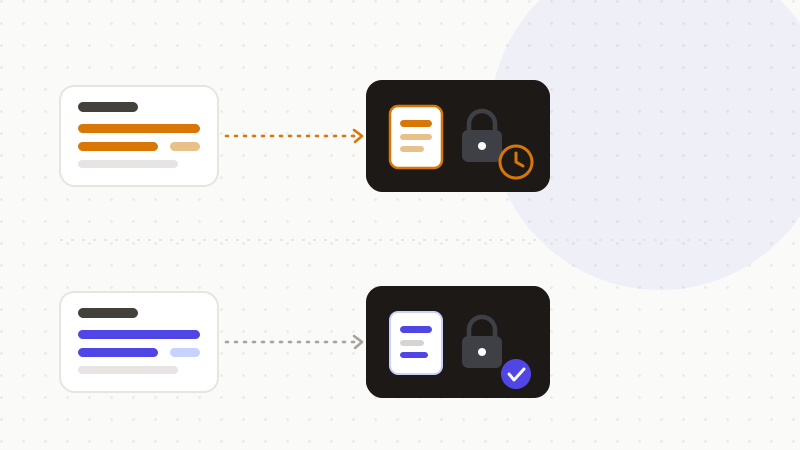
Personal or business: a different status
Personal use and business use aren't treated the same way. OpenAI states it does not, by default, train its models on the inputs and outputs of its business offerings — ChatGPT Team, Enterprise and the API. For a personal account, however, the model-improvement setting is on by default, and opting out isn't retroactive: it doesn't undo what was already transmitted. For a small business or an individual handling a financial document, it's precisely the least-protective account that gets used most.
Then there's the regulatory dimension. The compliance of AI use remains under scrutiny on the consumer-financial-data protection side — the Federal Trade Commission's Safeguards Rule imposes safeguards on financial information. Sharing margins, salaries or forecasts in a consumer tool can therefore create a double risk: leaking personal data and breaching confidentiality or trade-secret obligations.
The fix: anonymize before sending
Still want an AI to analyze a cash-flow sheet or categorize expenses? The prudent rule comes down to one move: remove the identifying elements before sending, then restore them after the answer. Concretely:
- 1Replace each identifying financial element — IBAN, account number, BIC, named amounts, tax IDs, names — with a reversible token.
- 2Send only the tokenized document to the model, which reasons over the structure without seeing the real values.
- 3Restore the original values in your browser once the answer comes back, thanks to the mapping that stayed local.
That way, you get the analysis without exposing the raw data to retention, training or human review. Whether the conversation is reviewed, kept three years or five years, it only contains tokens.
That's exactly what ONYRI Sanitize does: its financial detectors spot IBAN, account numbers, BIC, amounts and tax IDs, then replace them with reversible tokens. Detection and the token↔value mapping stay in your browser; only anonymized text reaches the model. Your real figures never leave your machine.
Frequently asked questions
- Is it safe to put a bank statement into ChatGPT?
- No, not as-is: a statement packs your IBAN, amounts and account holder name, and a consumer account can feed training by default, have a portion of conversations read by humans, and retain them for a long time. The prudent rule is to anonymize those elements before sending, then restore the real values after the answer.
- How long is my financial data kept by the AI?
- It varies: Anthropic keeps data up to five years for consumer accounts that accept sharing, versus thirty days if they decline; Google keeps Gemini conversations reviewed by humans for up to three years. And a court proceeding can force retention beyond those windows, as in the New York Times v. OpenAI litigation.
- Does a business account protect my financial data better?
- Generally yes: OpenAI states it doesn't train its models by default on ChatGPT Team, Enterprise and the API, whereas a personal account is trained by default, with no retroactive opt-out. But neither removes the need to anonymize a truly sensitive document before sending.
Sources & references
- Anthropic shifts Claude to training by default with opt-out and raises retention to five years for consumer accounts — TechCrunch
- Google Gemini keeps human-reviewed conversations up to 3 years, even after you delete your activity — Gizmodo
- Cyberhaven study: share of employees pasting company and confidential data into ChatGPT and the proportion of sensitive data — Cyberhaven
Keep your sensitive data in your browser
ONYRI Sanitize detects and masks your sensitive data before it reaches the AI, then restores the answer — from names to API keys.