Can You Put Your Cover Letter in ChatGPT?
Yes, AI rewrites a cover letter very well. But it holds your personal data, so anonymize those identifiers before the prompt.
Yes, you can put your cover letter in ChatGPT, and the AI rewrites it very well. It tightens the opening, clarifies the structure, fixes the tone. But a cover letter holds your personal data. Your name, your email, your phone number. Sometimes more intimate details: reasons for leaving, family situation, personal constraints. Yet the quality of the rewrite depends on neither your name nor your contact details. The simple reflex: anonymize those identifiers before the prompt, then reinject the real values afterward.
The problem: a letter is full of personal data
A cover letter isn't just plain text. By nature, it identifies you. It almost always contains:
- Your direct identifiers: name, first name, email address, phone number.
- The name of the target company, and sometimes the recruiter's.
- Personal or sensitive details: reasons for leaving, family situation, health constraints, availability tied to a private matter.
This information doesn't help the AI write better. It only serves you later, in the final version. Pasting it into a consumer AI means handing it to a third party for no reason.
The stakes: this data enters the provider's processing
Once pasted, your letter enters the AI provider's processing. It can be stored. Depending on the offering, it may also help improve the model. You lose control over its lifespan. This is where a simple GDPR principle comes in (the EU data regulation): minimization.
The same logic applies on the recruiting side. The CNIL notes that a recruiter must collect only data with « a direct and necessary link to the job offered or to assessing professional aptitude ». It even issued a formal notice against a company for excessive collection of candidate data: place of birth, spouse details, children, past salaries. The same common sense applies when you, the candidate, send your letter to an AI.
| Element of the letter | Useful to the rewrite? | Anonymize before the AI? |
|---|---|---|
| Name, first name | No | Yes |
| Email, phone | No | Yes |
| Target company name | No | Yes |
| Opening, structure, arguments | Yes, that's the core work | No, they stay as is |
The fix: anonymize identifiers before the prompt
The good news: you keep the full benefit of AI while reducing your data's exposure. Just replace the identifiers with neutral tokens before sending. The AI works on an anonymized letter. It doesn't see who you are, but it sees all the useful text. Here's how to do it:
- 1Spot the identifiers: name, email, phone, target company name.
- 2Replace them with tokens before pasting the text into the AI.
- 3Run the rewrite prompt on the anonymized version.
- 4Reinject the real values into the final version, on your own device.
The opening, the structure and the arguments stay intact. Those are what the AI improves. Your contact details never leave your private mapping.
« But I just want to improve my opening »
It's a common objection, and the answer is reassuring. An opening improves just as well on an anonymized letter. The AI works on wording, rhythm, the order of ideas. None of that needs your real name. Replace « John Smith » with a token, and the rewritten opening will be exactly the same. You lose zero quality, and you reduce the exposure.
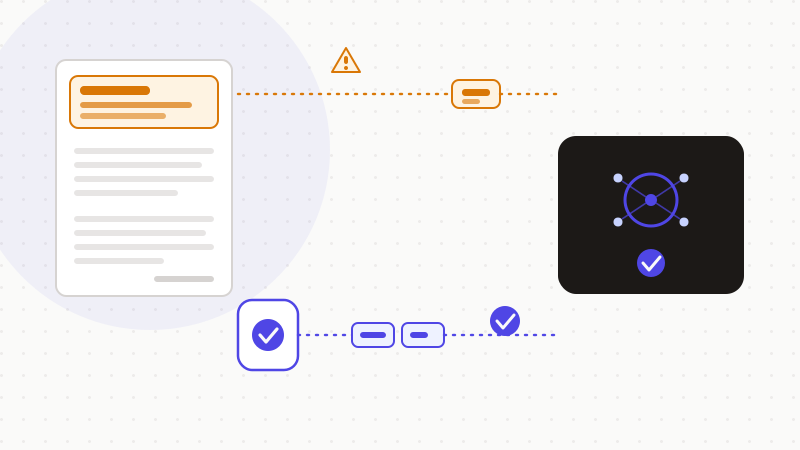
That's what ONYRI Sanitize does. The engine detects your identifiers and replaces them with reversible tokens before sending. Detection and the token↔value mapping stay in your browser. Only anonymized text reaches the AI. This minimization reduces your data's exposure: it doesn't remove it on its own. But it lets you enjoy the AI while keeping control of what matters — your identity.
Frequently asked questions
- Can you put your cover letter in ChatGPT?
- Yes, and the AI rewrites it very well: opening, structure, tone. But a letter holds your personal data (name, email, phone) and sometimes sensitive details. Yet the rewrite quality doesn't depend on them. The safe reflex: anonymize those identifiers before the prompt, then reinject the real values afterward.
- Does the AI rewrite an anonymized letter just as well?
- Yes. The AI works on style, rhythm and the order of ideas, not on your identity. Replacing your name with a token changes nothing about the quality of the opening or the structure. You keep the full benefit of the rewrite while reducing your data's exposure.
- Why talk about minimization for a cover letter?
- Because pasting your letter into an AI transmits your data to a third party. The CNIL defines minimization as limiting data « to what is necessary » for the purpose. It's a GDPR principle (Article 5). Improving a text needs neither your name nor your contact details.
Sources & references
- Minimization — definition (data « adequate, relevant and limited to what is necessary ») — CNIL
- Recruitment: the CNIL issues a formal notice for a company to minimize its collection of candidate data — CNIL
- Regulation (EU) 2016/679 (GDPR) — Article 5, principles relating to processing of personal data — EUR-Lex (European Union)
Keep your sensitive data in your browser
ONYRI Sanitize detects and masks your sensitive data before it reaches the AI, then restores the answer — from names to API keys.