Can You Put a Lease in ChatGPT?
Yes, to understand the text. But a lease identifies landlord, tenant and rent. Anonymize this personal data before pasting it into an AI.
Yes, you can paste a lease into ChatGPT to understand its text. But a lease identifies people. It names the landlord and the tenant. It also states their addresses and the rent amount. Sometimes it adds a guarantor's details, or even bank details. Yet understanding a clause doesn't depend on these identities. The rule is simple: anonymize the lease before sending it to an AI.
The problem: a lease identifies people
A lease isn't a neutral text. In France, it must state the identity of both parties. According to service-public.gouv.fr, the contract must state the identity of the parties: the surname and first name of the landlord (and their address) and of the tenant, plus the address of the rented property. These are personal data. And they concern everyone: you and the other party.
- The surname and first name of the parties, plus the address of the rented property.
- The precise location of the rented home.
- The rent, the charges and the security deposit amount.
- Sometimes a guarantor's details, or even bank details for payment.
Pasted into an AI, all this information goes to the provider. You expose your data, but also the other party's. Nobody agreed to that.
The stakes: this data enters a processing operation
Once the lease is pasted, its content enters the AI provider's processing. It can be stored. Depending on the offering, it may also help improve the model. You lose control over its lifespan. Yet understanding a clause requires no identity. The landlord's name doesn't help the AI explain a notice period.
What your lease becomes once inside the AI
Comparing two contexts helps you decide. Entrusting a lease to a notary or an agency is nothing like pasting it into a consumer AI. The table below sorts what actually serves the analysis of a clause.
| Lease element | Useful to understand a clause? | Reflex before the AI |
|---|---|---|
| Party names (landlord, tenant) | No | Replace with a token |
| Home address | No | Replace with a token |
| Rent and charges amount | Rarely | Replace with a token |
| Text of the clause to analyze | Yes | Keep as is |
« I just want to check if a clause is legal »
That's a fair question, and a legitimate objection. Good news: the explanation works just as well on an anonymized lease. To analyze a notice or charges clause, the AI doesn't need your name. It reads the text, not the identities. Still, an honest caveat applies. An AI doesn't replace legal advice. For a real dispute, a legal professional's opinion stays useful.
The fix: anonymize the lease before the prompt
So you can use AI while greatly reducing data exposure. The principle: replace each identifying value with a token before sending. The AI receives a neutralized lease. You keep the mapping on your side. Here's how to proceed:
- 1Spot the identifying data: names, addresses, rent, guarantor, bank details.
- 2Replace each real value with a neutral token before the prompt.
- 3Send the anonymized lease to the AI and ask your question about the clause.
- 4For a dispute or a binding decision, consult a legal professional.
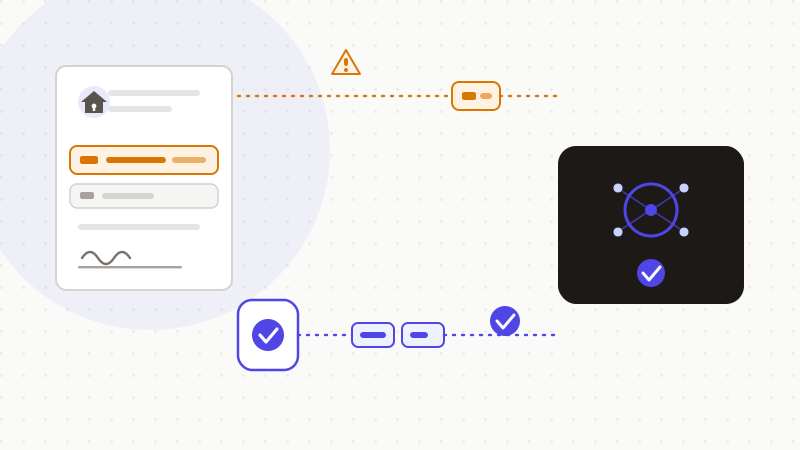
That's what ONYRI Sanitize does. The engine detects identifying data and replaces it with reversible tokens before sending. Detection and the token↔value mapping stay in your browser. Only anonymized text reaches the AI. This pseudonymization reduces exposure: it doesn't remove it, and it isn't legal advice on its own. But it lets you understand your lease while keeping control of the identities.
Frequently asked questions
- Can you put a lease in ChatGPT?
- Yes, to understand its text. But a lease identifies people: landlord and tenant names, addresses, the rent, sometimes a guarantor. This personal data doesn't help explain a clause. The safe reflex: anonymize the lease before sending it to an AI.
- Can an AI tell me if a clause in my lease is legal?
- An AI can explain a clause's meaning, on an anonymized lease as well as the original. But it doesn't replace legal advice. For a real dispute or a binding decision, a legal professional's opinion stays useful. Anonymization, for its part, reduces your data's exposure during the analysis.
- What data should I mask in a lease before the AI?
- Mask anything that identifies a person or a place: party names and first names, addresses, the home's location, the rent and charges. Also think of a guarantor's details and any bank details. The text of the clause to analyze can stay as is.
Sources & references
- Drafting a residential lease (rental contract) — mandatory details: identity of the parties, rent — Service-Public.gouv.fr (DILA)
- Minimization — definition of the principle (data adequate, relevant and limited to what is necessary) — CNIL
- GDPR (EU 2016/679) — article 5, principles for processing personal data — EUR-Lex (European Union)
Keep your sensitive data in your browser
ONYRI Sanitize detects and masks your sensitive data before it reaches the AI, then restores the answer — from names to API keys.