Can You Put a Contract in ChatGPT?
Technically yes, but a contract mixes personal data with confidential clauses. Anonymize names and amounts before the AI.
Technically, yes: nothing stops you from pasting a contract into ChatGPT to review, summarize or translate it. But it's tricky, and here's why. A contract isn't neutral text. It mixes personal data (names, addresses, sometimes salaries or bank details) with confidential information (clauses, amounts, trade secrets). Often, it also contains a confidentiality clause that binds you toward the other party. The simple rule: anonymize the contract before handing it to an AI. The AI can review the structure without seeing the parties' real identity.
The problem: a contract stacks two kinds of sensitive data
People often assume a contract is a « technical » document, and therefore harmless. That's wrong. An employment contract, a lease, a commercial or service agreement holds two sensitive layers stacked together. The first is the parties' personal data. The second is the confidential information of the agreement itself.
- Personal data: names, addresses, dates of birth, sometimes salaries or bank details of the parties.
- Confidential information: negotiated clauses, amounts, pricing terms, trade secrets.
- Contractual commitment: a confidentiality clause that often forbids disclosing the content to a third party.
These three layers sit in a single file. Pasting the whole contract into an AI exposes all three at once.
The stakes: GDPR, confidentiality clause and loss of control
As soon as a party to the contract is an identified or identifiable natural person, their data falls under the GDPR. The GDPR is the European data protection regulation. It sets a key principle: minimization. Its article 5.1.c requires processing only data that is adequate, relevant and limited to what is necessary for the purpose. The CNIL, France's data protection authority, sums it up: favor the technique that reaches the intended result with as little personal data as possible.
Yet pasting an entire contract to review a single clause goes beyond that strict necessity. You transmit far more than the AI needs.
There's a third point. Once pasted, the content enters the AI provider's processing, outside your control. You no longer govern its lifespan or its spread. This holds for any external AI service. The table below compares the two situations.
| Criterion | Contract in a controlled channel | Contract in a consumer AI |
|---|---|---|
| Purpose | Precise (signing, performance) | Vague: review, summarize, translate |
| Data transmitted | Limited to what is needed | Often the whole contract |
| Confidentiality clause | Honored between the parties | A third party receives the content |
| Control over the content | Framed by the contract | You lose control once sent |
The fix: anonymize before the prompt
The good news: you can use AI while greatly reducing the contract's exposure. The idea is to anonymize before sending. You replace names, addresses, amounts and parties with neutral tokens. The AI then reviews the contract's structure without seeing the real identity. Here's how to proceed.
- 1Spot the identifying elements: party names, addresses, amounts, dates, bank details.
- 2Replace them with neutral tokens before pasting the text into the AI.
- 3Send the anonymized version and ask your question about the structure or the clause.
- 4Reinject the real values into the answer locally, on your side.
This technique aligns with the minimization principle: the AI receives as little personal data as possible for the intended result. It reduces exposure, but it doesn't release you from your contractual obligations. Let's stay honest on that point.
« I just want a clause rephrased »
It's the most common objection, and it makes sense. You don't want to summarize the whole contract: just rephrase one clause. Good news, rephrasing works very well on an anonymized version. The company name, the amount or the address have no bearing on the quality of a clause's rewrite. You work on the neutralized text, then reinject the real values on your side. The real values stay with you, which greatly reduces exposure.
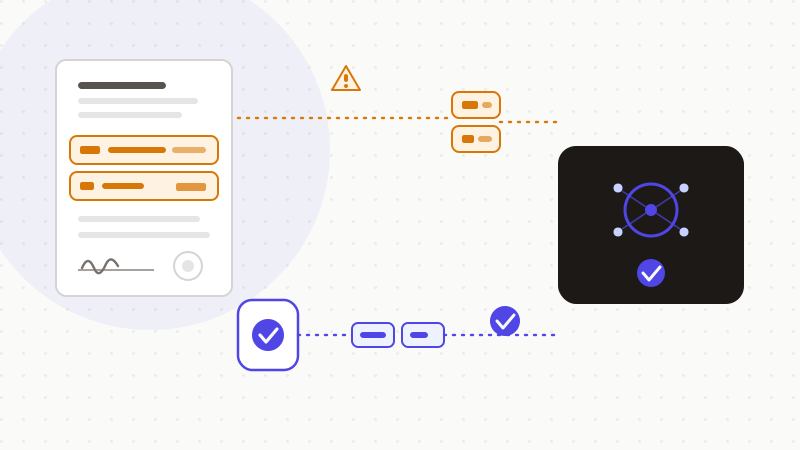
That's what ONYRI Sanitize does. The engine detects names, addresses, amounts and parties, then replaces them with reversible tokens before sending. Detection and the token↔value mapping stay in your browser: this is reversible, local pseudonymization, not data made anonymous under the GDPR. Only anonymized text reaches the AI. This minimization reduces the contract's exposure; it doesn't by itself remove your contractual obligations. But it keeps you in control of what matters most — the parties' real identity and the amounts.
Frequently asked questions
- Can you put a contract in ChatGPT?
- Technically yes, but it's tricky. A contract mixes personal data (names, addresses, sometimes salaries) with confidential information (clauses, amounts). It often contains a confidentiality clause that binds you toward the other party. The safe reflex: anonymize names, addresses and amounts before handing the contract to an AI, so it reviews the structure without seeing the real identity.
- Does a contract contain personal data under the GDPR?
- Yes, as soon as a party is an identified or identifiable natural person. Their names, addresses or details then fall under the GDPR. The minimization principle (article 5.1.c) requires processing only the data necessary for the purpose. The CNIL recommends using as little personal data as possible. Pasting a whole contract to review a single clause goes beyond that strict necessity.
- Does a confidentiality clause prevent using an AI?
- It can raise a problem. Many contracts forbid disclosing their content to a third party, and the AI provider is a third party. Service-public.fr recommends providing a specific confidentiality commitment for personal data. The workaround is to anonymize the contract before sending: the AI reviews a neutralized version, and the real values stay on your side.
Sources & references
- Minimization — definition and principle (data adequate, relevant, limited to what is necessary) — CNIL
- Personal data protection obligations (GDPR) — confidentiality clause and commitment — Service-Public.fr (DILA)
- Regulation (EU) 2016/679 (GDPR) — consolidated text, art. 5 principles of processing — EUR-Lex (European Union)
Keep your sensitive data in your browser
ONYRI Sanitize detects and masks your sensitive data before it reaches the AI, then restores the answer — from names to API keys.