Can You Put Your Customer List in ChatGPT?
Technically yes, but risky: a customer list is third parties' data. You are responsible for it. Anonymize the columns before the AI.
Technically, yes: nothing stops you from pasting your customer list into ChatGPT. But it's risky, and rarely a good idea. A customer list isn't only your data. It's a concentrate of third parties' personal data: names, emails, phone numbers, purchase histories. Pasting it into a consumer AI exposes your clients' data, not just your own. And you are responsible for it. The simple rule: anonymize the sensitive columns before the prompt.
The problem: a customer list is third parties' data
We think « my data ». In reality, a CRM export mostly holds other people's data. Each row describes a real person: a prospect, a client, a contact. Pasting that file into an AI means handing third parties' identities to a service you don't control. Those people didn't choose this. A customer list usually gathers:
- Names tied to identifiable people.
- Direct emails and phone numbers.
- Purchase histories, amounts and preferences.
- Sometimes sensitive sales notes on each contact.
A name alone is already personal data. Cross-referenced with an email and a history, it becomes very telling. That's exactly what a customer list bundles into a single row.
The stakes: you are the data controller
As soon as you hold and use a customer list, one word matters: controller. According to the CNIL, the data controller is the person, natural or legal, who determines the purposes and means of a processing operation. In other words, you decide. You decide why and how the data is used. That responsibility doesn't vanish because you route through a third-party AI.
The GDPR (the European regulation on personal data) also sets a key principle: minimization. Data must be adequate, relevant and limited to what is strictly necessary. Handing your clients' real identity to an AI just to sort or write goes beyond what's needed. You can segment without revealing who is who.
| Criterion | Customer list in your CRM | Customer list in a consumer AI |
|---|---|---|
| Purpose | Precise and documented | Vague, often just sorting or formatting |
| Data transmitted | What is necessary | Clients' full identity, often too much |
| Control over the data | Kept on your side | Lost once the prompt is sent |
| GDPR responsibility | Owned within a framework | Still yours, but without control |
« It's just for segmenting »
The objection is fair. You want to sort your contacts by average basket, region or activity. Good news: the AI doesn't need to know who Mr. Smith is for that. It needs a stable identifier and the sorting criteria. Segment on masked identifiers. Then re-link the real people on your side, locally. The result is the same. The exposure, however, drops sharply.
The fix: anonymize column by column
A customer list is a table. So you can neutralize it column by column. You replace the sensitive columns with tokens, before sending. The structure stays usable by the AI. The real identity, though, doesn't leave. Here's the sequence:
- 1Spot the columns that identify a person: name, email, phone.
- 2Replace those columns with stable tokens, in the browser.
- 3Send the AI the anonymized table to sort, segment or write.
- 4Get the answer back, then re-link the real values locally.
The AI sees a coherent but neutralized table. It segments and writes normally. Only you hold the mapping between token and real person. This is pseudonymization, reversible on your side. It sharply reduces exposure, without removing your GDPR obligations.
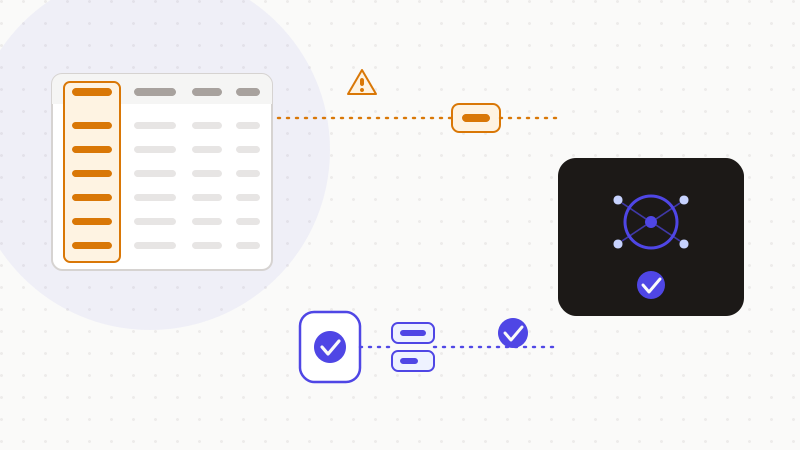
That's what ONYRI Sanitize does. The Tables section anonymizes your customer list column by column. Each sensitive value becomes a reversible token before sending. Detection and the token↔value mapping stay in your browser. Only an anonymized table reaches the AI. This minimization lowers the risk: it doesn't by itself make a use « 100% compliant ». But it keeps you in control of what matters — your clients' real identity.
Frequently asked questions
- Can you put your customer list in ChatGPT?
- Technically yes, but it's not advisable. A customer list holds third parties' personal data: names, emails, phones, histories. Pasting it into a consumer AI exposes your clients' data. Yet you are the data controller under the GDPR. The safe reflex: anonymize the identifying columns before sending, then re-link the real values locally.
- Am I responsible if I put client data into an AI?
- Yes. As soon as you hold and use a customer list, you are the data controller per the CNIL. You determine the purposes and the means. Confidentiality, minimization and security stay your obligations, even when routing through a third-party AI tool. Using an AI doesn't transfer that responsibility.
- How do I anonymize a customer list before giving it to the AI?
- A customer list is a table: you anonymize it column by column. Replace the identifying columns (name, email, phone) with stable tokens, in the browser. The AI receives a usable but neutralized table to sort or segment. You then get the answer back and re-link the real values locally. It's reversible pseudonymization that reduces exposure.
Sources & references
Keep your sensitive data in your browser
ONYRI Sanitize detects and masks your sensitive data before it reaches the AI, then restores the answer — from names to API keys.