Is It Safe to Use AI for Car Rental?
Yes for general tasks, no with real identifiers: never paste a driver's licence or card number into a consumer AI to handle a car rental.
The short answer fits in one line. AI can help you run rentals, but don't hand it your customer identifiers. A rental record holds two things: identity and movement. It ties a name to a driver's licence number, an ID or passport, a payment card, an address. It adds the exact vehicle, the dates and the trip locations. Pasted into a consumer ChatGPT, this data can be retained or reused. There is a clean method: anonymise the customer's identifiers before you send. The AI then drafts the reply or the ad on text with no real data.
A rental record is identity + movement
Look at what a single booking holds. A name. A driver's licence number. An ID or passport. A payment card. An address. Then the rented vehicle, the dates, and the pick-up and drop-off locations. Each field is already sensitive. Together, they map a person and their trip.
That is the heart of it. A rental record is identity coupled with location. It says who the customer is. It also says where they went, and when. That combination has no place in a consumer chatbot. Agents forget this because the tool is handy for bookings, customer service, damage claims and marketing.
A driving licence is a strong identifier
The FTC (Federal Trade Commission, the U.S. consumer-protection agency) is clear on this. Government-issued documents are prime targets for identity thieves. A driver's licence. A passport. An ID card. When one is lost, stolen or misused, the FTC points victims to a dedicated report site and the issuing agency.
The mechanism is simple. A licence number, with a date of birth and an address, is often enough to open fraudulent accounts. That is exactly the trio sitting in a rental record. So it must be de-identified before any AI prompt. Never paste a licence number into a consumer tool.
The law: the GDPR covers identity and location
The GDPR (Regulation (EU) 2016/679) defines 'personal data' as any information relating to an identifiable person. The text names precise examples. An identification number. Location data. An online identifier. A licence number lands squarely inside that definition.
A rental firm that processes a customer's licence and trip data is a data controller. It needs a lawful basis. And for any third-party AI vendor, it needs a data processing agreement (DPA). A consumer chatbot with no contract does not meet that condition.
Location deserves its own note. The GDPR names it explicitly as personal data. Yet many rentals track the vehicle by telematics or GPS. That tracking reveals where the customer actually drove. It is personal data in its own right. It must stay tightly controlled, never fed into a general-purpose AI.
| Field in the record | What the rule says |
|---|---|
| Driver's licence number | Strong identifier; identity-theft material per the FTC |
| ID card or passport | Government document, a prime target for thieves |
| Payment card number | Governed by PCI DSS; outside a consumer chatbot |
| Location / telematics | Personal data named by the GDPR (Art. 4) |
Card data falls under PCI DSS
Card numbers follow a rule of their own. PCI DSS (the Payment Card Industry Data Security Standard) is a security standard from the PCI Security Standards Council. It applies to any organisation that stores, processes or transmits cardholder data. It is a mandatory requirement, not a nice-to-have.
A consumer chatbot sits entirely outside a PCI-compliant environment. Pasting a card number into it pulls the data out of any secure perimeter. So the rule is plain: payment details never go into an AI prompt.
The fix: anonymise before you send
Good news: AI is still useful for a rental firm. It can draft a customer reply. It can summarise a damage claim. It can write a marketing ad. For that, it needs no real identifiers. The method is to de-identify before the prompt.
In practice, you strip the sensitive data first. The licence number. The ID. The card. The address. Any location or telematics data. The AI works on anonymised text. It drafts the reply or the ad on the tokenised version, without ever seeing the identifiers. Use only vetted tools, covered by a contract.
- Never paste a driver's licence number into a consumer AI.
- Never paste a payment card number into a prompt.
- Keep location and telematics data tightly controlled.
- Use only vetted tools, covered by a data processing agreement (DPA).
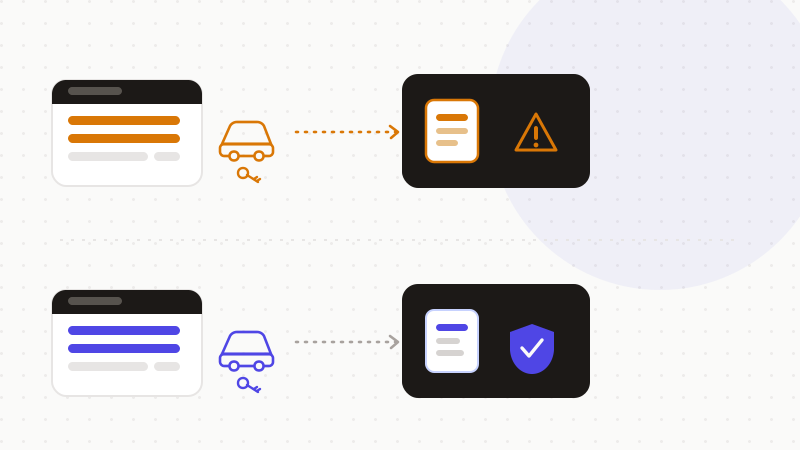
The order of steps matters. Spot, replace, send, restore. The AI reasons about the shape of the record, never the real values. You restore the real data afterwards, locally.
- 1Spot the identifiers: licence, ID, card, address, location.
- 2Replace them with reversible tokens, in the browser.
- 3Send only the anonymized text to the AI.
- 4Restore the real values in the reply, locally.
That's what ONYRI Sanitize is for. The engine detects sensitive data — licence, ID, card, address, location — and replaces it with reversible tokens before sending. Detection and the mapping stay in your browser. Only anonymized text reaches the model. The AI finds only tokens, never your customers' real identifiers. You get the help, without the identity-theft risk that the FTC, the GDPR and PCI DSS ask you to rule out.
Frequently asked questions
- Is it safe to use AI for car rental?
- Yes for general tasks, no with real identifiers. AI can draft a customer reply, summarise a damage claim or write an ad with no real data at all. But never paste a licence number, an ID, a card number or an address into a consumer ChatGPT. A rental record is identity plus location. Anonymise that data before you send.
- Can I paste a driver's licence number into ChatGPT?
- Better to avoid it. The FTC treats a licence as a government document, a prime target for thieves. A licence number, with a date of birth and an address, opens fraudulent accounts. That trio sits in every rental record. Replace the number with a token before any prompt.
- What does the GDPR say about vehicle telematics and location?
- The GDPR (Regulation (EU) 2016/679) names location data as personal data. Many rentals track the vehicle by telematics or GPS. That tracking reveals where the customer drove. It is personal data in its own right. It must stay tightly controlled and never enter a general-purpose AI.
Sources & references
- Identity Theft — consumer advice (government documents and driver's licences as identity-theft material) — U.S. Federal Trade Commission (FTC)
- Regulation (EU) 2016/679 (GDPR) — definition of personal data: identification number and location data — EUR-Lex (Publications Office of the European Union)
- PCI DSS — Payment Card Industry Data Security Standard (handling cardholder data) — PCI Security Standards Council
Keep your sensitive data in your browser
ONYRI Sanitize detects and masks your sensitive data before it reaches the AI, then restores the answer — from names to API keys.