Is Character.AI Safe With Your Data? What to Know
Treat companion AI chats as stored, not private. Never share your real name, location or secrets with Character.AI — here's how to stay safe.
Character.AI is not private, and you should treat it that way. It is a companion AI, built to feel like a friend. You chat about feelings, relationships, secrets, even your daily routine. But those chats are stored. Character.AI's own Privacy Policy says it keeps conversation content and uses it to run and improve the service, including its AI models. So the safe rule is simple. Enjoy the roleplay, but never type your real name, your school, your home or work address, or your live location. Assume anything you send could be stored or reviewed later.
Why companion chats feel private
Companion AI is designed to bond with you. The FTC (the U.S. Federal Trade Commission, a consumer-protection regulator) notes these chatbots imitate human emotions. They act like a friend or a confidant. That design makes people trust them. It works especially well on children and teens. The feeling of a private, judgment-free ear is the product. But a feeling of privacy is not the same as real privacy.
What happens to your chats
Your messages do not vanish when you close the app. Character.AI's Privacy Policy describes storing the content of your conversations. It uses the data it collects to operate, personalize and improve its services. That includes improving its AI models. It may also share data with service providers. Content can be reviewed for moderation. It says it does not sell personal information. Still, the takeaway holds: a stored chat is not a private chat.
Here is what should never enter a companion chat.
- Your real name, or the real names of people you know.
- Your school, workplace, or home or work address.
- Your live location or your daily routine.
- Passwords, financial details, or account logins.
- Photos, or anything that could identify you.
Minors and children's data
Many companion-AI users are young. That matters, because children's data carries extra legal duties. In the U.S., COPPA (the Children's Online Privacy Protection Act) limits collecting personal information from children under 13. Regulators also expect services to check ages in a meaningful way. If you are a parent, this is worth a calm conversation. Ask what your child shares. Explain that the bot is not a real friend, and that its memory is a database.
There is a human risk too, not just a data risk. Companion AI is built to keep you engaged. Emotional attachment and manipulation are real design concerns. And the bot is not a substitute for real support. If a conversation turns to distress, that is the moment to step away from the screen.
Safety scrutiny and ongoing lawsuits
Companion AI is under a spotlight. In September 2025, the FTC opened a study into AI companion chatbots. It sent orders to seven companies, including Character.AI. It asked how they protect minors and how they use chat data. This is an inquiry, not a ruling. It is a signal that regulators are watching this space closely.
There is also ongoing litigation. A lawsuit, Garcia v. Character Technologies, alleges that a 14-year-old died after becoming dependent on the platform's characters. It also names the founders and Google. In May 2025, a judge allowed much of the case to proceed past an early motion to dismiss. As of late 2025 it was in discovery. The allegations are unproven. No liability has been decided. We share this plainly, without sensationalism.
Character.AI has announced changes in response. The company said it would remove open-ended chat for users under 18, phased in around late November 2025. It also announced an interim cap of about two hours of chat a day for teens. It added age-assurance technology, including a third-party tool. And it said it would fund an independent AI safety lab. These are company announcements. They show the picture is still evolving.
How to use companion AI more safely
You can still enjoy Character.AI. The trick is to keep the story and drop the identifiers. Give your character a nickname, not your real name. Keep places vague. Never confirm where you live or study. Treat every message as if a stranger might read it one day.
Here is a simple routine before you type.
- 1Use a nickname and invented details, never your real identity.
- 2Keep locations, school and workplace out of the chat.
- 3Assume anything you send could be stored or exposed.
- 4For genuinely sensitive topics, anonymise them or don't share them.
- 5For real distress, reach out to a trusted person or a local helpline.
| You assume | The reality |
|---|---|
| “It feels private, so it is private” | Chats are stored and may be used to improve the service |
| “It's just a bot, sharing is harmless” | Identifying details can be stored, reviewed or exposed |
| “Kids are fine on companion apps” | Children's data carries extra duties under COPPA |
| “The bot is my friend and my support” | It is not a substitute for real help or a helpline |
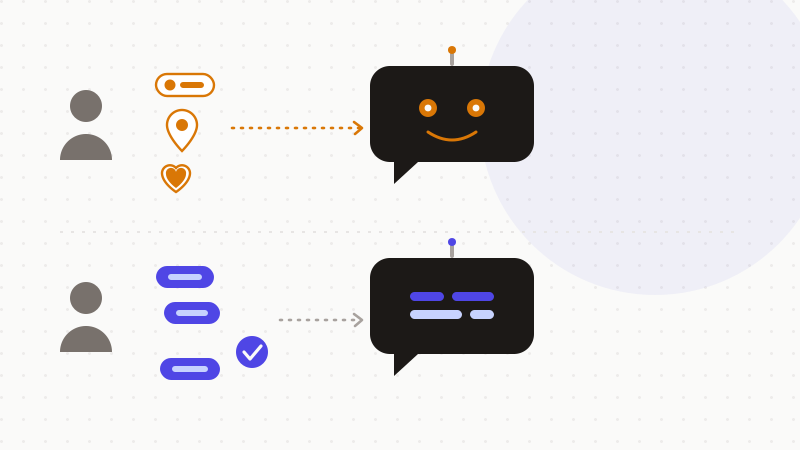
That's the idea behind ONYRI Sanitize. The engine spots sensitive data — names, locations, contact details, secrets — and replaces it with reversible tokens before anything is sent. Detection and the mapping stay in your browser. Only anonymized text reaches the model, and you restore the real values locally. Companion AI can be fun. Just keep the parts that identify you out of the chat.
Frequently asked questions
- Is Character.AI safe with your data?
- Treat it as not private. Character.AI stores your conversations and, per its Privacy Policy, uses that data to run and improve its services, including its AI models. Content can also be reviewed for moderation. So enjoy the roleplay, but never share your real name, school, address or live location. Assume anything you type could be stored or exposed.
- Is Character.AI safe for kids and teens?
- It needs care. A large share of companion-AI users are young, and children's data carries extra duties under COPPA in the U.S. Character.AI has announced under-18 changes, including removing open-ended chat and adding age checks. There are also emotional risks like attachment and manipulation. For parents, the key message is simple: the bot is not a real friend, and it is not a substitute for real support.
- What should I never tell a companion AI?
- Anything that identifies you or someone else. Skip your real name, your school, your home or work address, and your live location. Skip passwords, financial details and photos. If a topic is genuinely sensitive, anonymise it or keep it offline. And if a chat turns to distress, reach out to a trusted person or a local helpline instead.
Sources & references
- An Update On Changes to Our Under-18 Experience (official blog: removing open-ended chat, ~2h/day cap, age assurance, safety lab) — Character.AI
- FTC Launches Inquiry into AI Chatbots Acting as Companions (6(b) study, seven companies, minors' safety) — U.S. Federal Trade Commission (FTC)
- Character.AI to ban teens from open-ended chats: why real human interaction is crucial — CNBC
Keep your sensitive data in your browser
ONYRI Sanitize detects and masks your sensitive data before it reaches the AI, then restores the answer — from names to API keys.