Is It Safe to Use AI for Pharmacies?
A pharmacy is a HIPAA covered entity. Never paste a prescription into a consumer ChatGPT. Anonymise patient identifiers before you send.
The answer fits in one line. AI can help a pharmacy, but never with a real patient record. A pharmacy is a regulated health provider. In the US, it is a HIPAA covered entity (the federal health-privacy law). Your prescriptions and records are PHI (Protected Health Information). A consumer ChatGPT has signed no health data-processing agreement with you. Pasting a prescription into it is not just a privacy leak: it is a compliance failure. The rules here are stricter, not looser. There is a clean method: ask your general questions, but anonymise the identifiers before you send.
A pharmacy is a HIPAA covered entity
The US regulation is clear. Rule 45 CFR 160.103 defines a covered entity. It is a health plan, a health-care clearinghouse, or a health-care provider that transmits health information electronically. A pharmacy falls squarely within the health-care provider category. So a pharmacy is a HIPAA covered entity. The prescriptions and patient records it holds are PHI.
The same rule defines a business associate. It is an outside person or company that handles PHI on the covered entity's behalf. One point is essential. A vendor only becomes a business associate under a written contract: the Business Associate Agreement (BAA). A consumer AI chatbot has signed no BAA. It does not become a business associate by accident. Without that contract, pasting PHI into it is an unauthorised disclosure, plain and simple.
The medication reveals the condition
PHI is defined broadly. It is individually identifiable health information about a person's condition, care, or payment for care. A prescription ties a named patient to a specific medication. And the medication often reveals the underlying condition. An HIV therapy. A mental-health drug. A contraceptive. An addiction treatment. That is why prescriptions and dispensing records rank among the most sensitive health data a pharmacy handles.
In the EU and the UK, the law points the same way. GDPR Article 9 places 'data concerning health' in the special categories. Processing them is prohibited by default. You need a specific Article 9 condition to allow it. That requirement sits on top of the ordinary Article 6 lawful basis. So two legal tests must both be met, not one.
The ICO (Information Commissioner's Office, the UK regulator) confirms it. Health data is special category data. It needs extra protection. The ICO stresses one point. A medication can disclose a diagnosis. So a drug name or a therapy area alone can amount to health data about an identifiable person.
| You assume | The reality |
|---|---|
| “A prescription is just a slip of paper” | It is PHI under HIPAA and health data under GDPR Article 9 |
| “The AI becomes a business associate if it handles PHI” | No: without a signed BAA, it is an unauthorised disclosure |
| “A drug name is harmless” | It often reveals the condition, so it is health data |
| “Insurance data is a separate matter” | It adds a financial layer on top of the health data |
The insurance and payment layer
A prescription rarely travels alone. It often comes with insurance and payment details. Those details add a financial layer on top of the health data. The exposure compounds. If the record goes into an uncontrolled tool, you disclose the patient's identity, condition and payment means at once.
Here is the data a pharmacy should never paste as-is into a consumer AI.
- The patient's name and contact details.
- The prescribed medication and its dosage.
- The condition or diagnosis, even when implied.
- Insurance numbers and payment details.
The fix: anonymise before you send
Good news: AI is still useful in a pharmacy. It can reword a patient message. It can help with inventory or a generic counselling note. For that, it needs no real identifiers. Ask the question in general terms. Keep the name, the medication, the condition and the insurance out of the prompt.
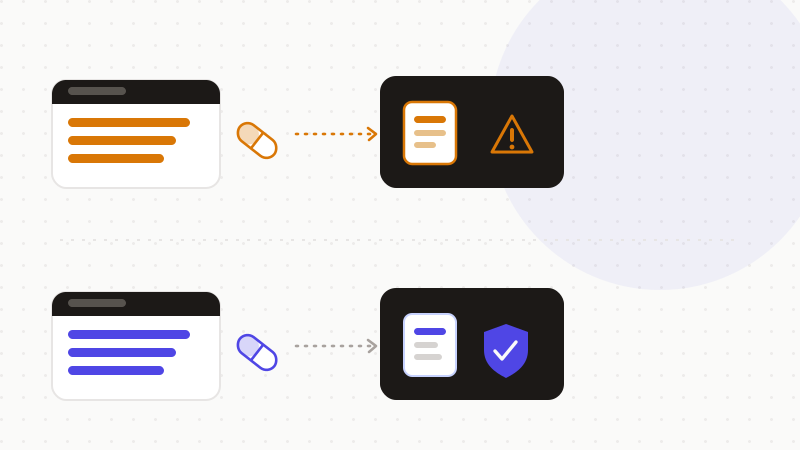
When you really must include a concrete case, anonymise it first. Replace each identifier with a token. The AI reasons about the shape of the record, without ever seeing the real values. You restore the real values afterwards, locally. And only use an AI tool on real data under a signed BAA (US) or a DPA with health-data terms (EU/UK).
- 1Spot the identifiers: name, medication, condition, insurance.
- 2Replace them with reversible tokens, in the browser.
- 3Send only the anonymized text to the AI.
- 4Restore the real values in the reply, locally.
That's what ONYRI Sanitize is for. The engine detects sensitive data — name, medication, condition, insurance number — and replaces it with reversible tokens before sending. Detection and the mapping stay in your browser. Only anonymized text reaches the model. The AI finds only tokens, never real PHI. You get the help, without the unauthorised disclosure that HIPAA and the GDPR ask you to rule out.
Frequently asked questions
- Is it safe to use AI for pharmacies?
- Yes for general tasks, no with a patient record. AI can reword a message or help with inventory using no real data. But never paste a prescription, a patient name, a medication or insurance data into a consumer ChatGPT. A pharmacy is a HIPAA covered entity, and a prescription is health data under the GDPR. Anonymise the identifiers before you send.
- Is a consumer AI a HIPAA business associate?
- No. A vendor only becomes a HIPAA business associate under a written, signed Business Associate Agreement (BAA). A consumer AI chatbot has signed no BAA. It does not become one just because it handles your data. Pasting PHI into it is an unauthorised disclosure. Only use tools covered by a signed BAA (US) or a DPA with health-data terms (EU/UK).
- Why is a medication name sensitive?
- Because it often reveals the condition. An HIV therapy, a mental-health drug, a contraceptive or an addiction treatment give away the diagnosis. The ICO confirms a drug name can amount to health data about an identifiable person. Under GDPR Article 9, it is special category data, protected by default.
Sources & references
- 45 CFR 160.103 — HIPAA definitions of covered entity, business associate and protected health information — US Government — eCFR (Office of the Federal Register / GPO)
- Regulation (EU) 2016/679 (GDPR) — Article 9, processing of special categories of personal data including health — EUR-Lex (Publications Office of the European Union)
- What is special category data? (health data under UK GDPR Article 9) — Information Commissioner's Office (ICO)
Keep your sensitive data in your browser
ONYRI Sanitize detects and masks your sensitive data before it reaches the AI, then restores the answer — from names to API keys.