Is It Safe to Use AI for Personal Finance?
Yes for learning, no with your identifiers: never paste a bank statement, IBAN or card number into a consumer AI. Here is the safe way to ask for help.
Yes, AI can help you understand your money. No, you should not give it your bank statement. A statement is not a list of numbers. It is a map of your life: your address, your commute, your pharmacy, your subscriptions, your salary. Your account number, IBAN and card details are exactly what a fraudster wants. The Federal Trade Commission (FTC), the US consumer-protection authority, tells you to guard those identifiers. US financial regulators also warn that a chatbot is not an adviser. There is a clean method: talk in rounded figures, strip your identifiers, and never paste a full statement.
A bank statement is a map of your life
You think you are sharing numbers. You are sharing far more. Each line points to a place, a habit or a person. Put together, those lines draw a portrait.
- Where you live and where you work.
- Your commute, your supermarket, your gym.
- Your pharmacy, your doctor, your lab.
- Your subscriptions, your donations, your dues.
- Your salary, your loans, your overdrafts.
- The people you split expenses with.
European law has a word for this. The GDPR, Regulation (EU) 2016/679, treats bank data as personal data (Article 4). Some lines go further. A pharmacy payment can reveal a health condition. A donation to a place of worship can reveal a religion. A union payment can reveal trade-union membership. Those are the “special categories” protected by Article 9. A statement does not label them as such. But it lets anyone infer them. That is the gap between a spreadsheet and a portrait.
Financial identifiers: the line you never cross
Account number. IBAN. Sort code. Card number. None of this helps the AI reason about your budget. It only points to an account. That is precisely what a fraudster is hunting for.
The FTC explains why your personal information has value: criminals want it. With enough of it, an identity thief can drain a bank account. They can damage your credit. They can take over your accounts. The FTC's advice comes down to three moves. Guard your identifiers. Do not hand them over on request. Lock down accounts with strong passwords and two-factor authentication.
A chatbot is not a financial adviser
On 25 January 2024, three US authorities issued a joint alert. The SEC's Office of Investor Education and Advocacy, FINRA and NASAA. Their message has two parts.
First: do not base an investment decision on what a chatbot tells you. These systems can produce inaccurate or made-up information. Always check it against independent sources.
Second: AI also works for the scammers. The regulators quote pitches like “our AI trading system can't lose”. High returns with little or no risk remain a classic red flag. Many AI-branded platforms are simply not registered. Check that registration before you send a single dollar.
The same regulators flag AI-enabled impersonation. Cloned voices, fabricated video, a fake relative or a fake executive. The goal is always the same: move money out of an account.
The scale of the problem is worth knowing. In April 2026, the FTC published a consumer alert. It reported more than $7.9 billion in losses to investment scams in 2025. The median reported loss was above $10,000. These are reported losses, across investment scams in general. The figure is not about AI alone. It simply shows what a bad money decision can cost.
A consumer AI is not registered, not authorised, and not accountable to any regulator. Not to the SEC in the US, and not to the Financial Conduct Authority (FCA) in the UK. It can be confidently wrong. Treat it as a teacher, never as an adviser.
Screenshots and files: the cropping trap
A cropped screenshot is still a screenshot. An image of a banking app usually shows the account holder's name. It shows balances. It shows a fragment of the account number. It shows merchants and dates. Files can also carry metadata. Cropping is not redaction.
What happens to your prompt
Start from a cautious assumption. Your conversations are stored. Humans may review them, for safety and abuse reasons. They may be used to improve models, unless you have changed the setting. Those settings move and get renamed often. Check your provider's own data-controls page. Do not trust a screenshot you found on a blog.
| What you think you are pasting | What it actually reveals |
|---|---|
| A pharmacy payment line | A health signal — data protected by Article 9 of the GDPR |
| Your subscriptions and grocery runs | Where you live, what you buy, the rhythm of your life |
| Your account number or IBAN | An identifier a fraudster can reuse, by the FTC's own logic |
| A “cropped” screenshot | Your name, your balances, an account fragment, sometimes metadata |
| Your payslip | Salary, employer, national ID, address — an identity thief's starter kit |
The fix: use AI as a teacher
AI is genuinely useful for your money. It explains concepts very well. The difference between the avalanche and the snowball method. How compound interest works. The logic of a monthly budget. For all of that, it needs none of your data.
- 1Strip the identifiers: account number, IBAN, sort code, card number, national ID.
- 2Strip names and addresses, yours and those of the people around you.
- 3Replace exact amounts with rounded figures: “rent around 1,200 a month, groceries around 400”.
- 4Never upload a full statement, a payslip or a photo of a card.
- 5Ask concept questions, not decision questions.
- 6Have any actionable money decision checked by a regulated professional.
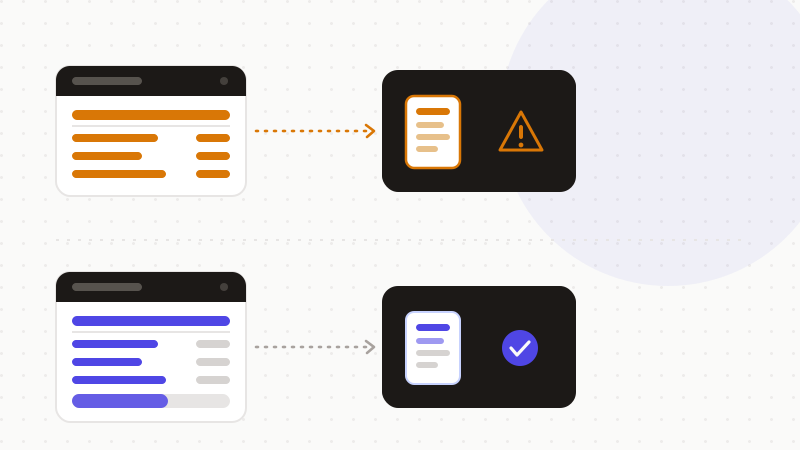
One rule sums it up. Describe your situation in rounded figures, never in statement lines. The AI reasons just as well on approximate numbers. And it learns nothing about you.
That is what ONYRI Sanitize is for. The engine detects sensitive data and replaces it with reversible tokens before sending. Detection and the mapping stay in your browser. Only anonymized text reaches the model. The AI sees the shape of your budget, never your account number. You get the help, without handing a stranger the map of your life.
Frequently asked questions
- Is it safe to use AI for personal finance?
- Yes for learning, no with your identifiers. AI explains budgets, payoff plans and compound interest very well. But never give it your account number, your IBAN, your card number or a full statement. The FTC warns that this information is gold to identity thieves. Talk in rounded figures, strip your identifiers, and have any real decision checked by a regulated professional.
- Can I paste my bank statement into ChatGPT?
- Better not to. A statement is not a list of numbers. It reveals where you live, where you shop, your pharmacy, your subscriptions and your salary. Under the GDPR, those lines can even reveal special categories of data, such as health or religion (Article 9). Describe your situation in rounded amounts instead, with no account number and no names.
- Can an AI recommend an investment?
- No. On 25 January 2024, the SEC's Office of Investor Education and Advocacy, FINRA and NASAA issued a joint alert. Do not base an investment decision on what a chatbot tells you: these systems can make things up. The regulators also warn about “AI-guaranteed” pitches and unregistered platforms. Always verify with independent sources.
Sources & references
- Investor Alert: Artificial Intelligence (AI) and Investment Fraud — joint alert by the SEC Office of Investor Education and Advocacy, NASAA and FINRA (25 January 2024) — U.S. Securities and Exchange Commission (Investor.gov), with FINRA and NASAA
- Protect Your Personal Information From Hackers and Scammers — FTC consumer advice (identity theft, drained accounts, two-factor authentication) — U.S. Federal Trade Commission (Consumer Advice)
- Regulation (EU) 2016/679 (GDPR) — personal data (Art. 4) and special categories of personal data (Art. 9) — EUR-Lex / Official Journal of the European Union
Keep your sensitive data in your browser
ONYRI Sanitize detects and masks your sensitive data before it reaches the AI, then restores the answer — from names to API keys.