Is It Safe to Use AI for Dating?
Yes for wording, no with real details: never paste a match's name, photo or messages into an AI. Anonymise before you send. Here is the safe method.
The answer fits in one line. AI can help you find the words, but do not hand it the real details. Writing a first message, polishing a profile, decoding a match's texts: all fine in general terms. The risk begins when you paste a real chat. You then share another person's words, without their consent. Your prompts also reveal your most intimate data: orientation, intentions, location. In Europe, sex life and orientation are a special category of data (GDPR, Article 9). The safe method: keep names, photos and locations out of the prompt.
Pasting a chat shares someone else's privacy
This is the most overlooked point. When you paste a match's messages into an AI, you do not just share your words. You share theirs too. Their first name. Their workplace. Their confidences. That person never gave consent. It is their privacy, not only yours.
The right habit is simple. Treat the AI as a wording helper, never as a confidant. Keep the other person's identity out of the prompt. Do not paste their name, their handle, or their photo. Ask for general advice instead: how to reply politely to a message proposing a date. You do not need the real chat for that.
Your prompts reveal your most intimate data
A dating prompt says a lot about you. It reveals your orientation. Your intentions. Your movement patterns. Your feelings. That is highly sensitive information. In Europe, the law confirms it. Under Article 9 of the General Data Protection Regulation (GDPR), sex life and sexual orientation form a special category of data. They sit alongside health and religious beliefs.
The GDPR goes further. It also protects inferences. Deducing someone's orientation by cross-referencing ordinary details counts as processing that protected category. Even if no single detail states it outright. That is exactly what an AI does when you feed it a whole dating chat to interpret. It infers. This framework is European, but the signal holds everywhere: this data deserves maximum caution.
Photos, profile and location: the real risk
Uploading your photo or profile to an AI is not harmless. You hand over data close to biometric. Details that identify you. Dating apps already know this well. According to Mozilla Foundation's *Privacy Not Included review, this sector is more data-hungry than ever.
Mozilla's figures are striking. Of 25 dating apps reviewed, 22 earned its worst warning label, 'Privacy Not Included'. Around 80% of them may share or sell your personal data for advertising. Mozilla also notes these apps collect very intimate details: sexuality, religion, race, political views, sometimes even health status.
One last detail matters. About a quarter of the apps Mozilla reviewed harvest the metadata hidden in your photos. The date. The place a shot was taken. Add what people write in the clear: where they live, where they work, where they plan to meet. The privacy issue then becomes a very real safety issue.
| What you paste | What it really exposes |
|---|---|
| A match's messages | Another person's words, shared without their consent |
| Your dating prompt | Orientation, intentions, feelings — special category (GDPR Art. 9) |
| Your photo or profile | Data close to biometric, plus hidden metadata (place, date) |
| Where you live or will meet | A real safety risk, not just a privacy one |
Romance scams: beware the too-perfect match
AI also serves the scammers. It now powers fake profiles and polished romance scams. The Federal Trade Commission (FTC), the US consumer protection authority, describes the classic mechanics. A scammer builds a fake profile on an app or a social network. They earn your trust over days or weeks. Then they invent a reason they can never meet in person.
The ending is always the same. They eventually ask for money. Often by wire transfer, gift cards or crypto. These methods are hard to reverse. The FTC's rules are simple and non-judgemental.
- Never send money or gifts to a love interest you have not met in person.
- Be wary of anyone who always has an excuse not to meet.
- Keep a trusted friend or relative in the loop, so they can flag warning signs.
- Faced with a too-perfect match, slow down and verify before you open up.
The fix: anonymise before you send
Good news: AI is still useful for dating. It can suggest a tone, fix a sentence, propose a reply. For that, it needs no real detail. Ask the question in general terms. Keep names, handles, workplaces and addresses out of the prompt. Do not upload your face or an ID.
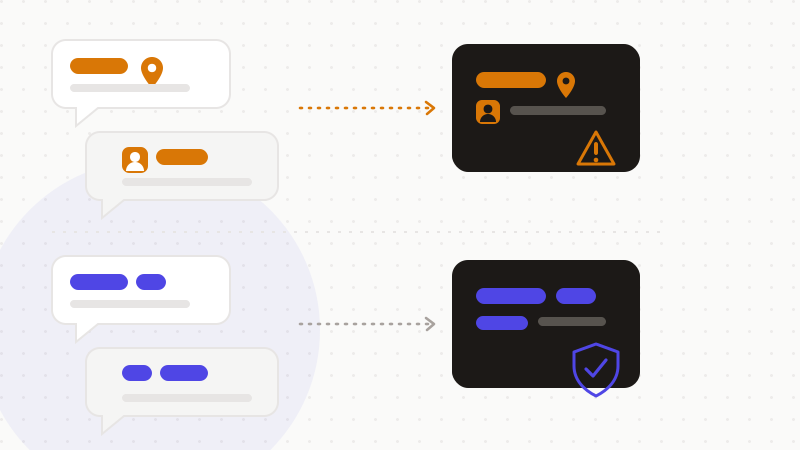
When you really must include a real excerpt, anonymise it first. Replace each identifying detail with a token. The AI reasons about the shape of your exchange, without ever seeing the real values. You restore the real values afterwards, locally.
- 1Spot the sensitive details: names, handles, locations, employer, photos.
- 2Replace them with reversible tokens, in the browser.
- 3Send only the anonymized text to the AI.
- 4Restore the real values in the reply, locally.
That's what ONYRI Sanitize is for. The engine detects sensitive data — names, handles, addresses, locations — and replaces it with reversible tokens before sending. Detection and the mapping stay in your browser. Only anonymized text reaches the model. The AI finds only tokens, never your match's identity or your own. You get the help, without exposing someone else's privacy or your most intimate data.
Frequently asked questions
- Is it safe to use AI for dating?
- Yes for wording, no with real details. AI can suggest a tone, fix a sentence or propose a reply in general terms. But do not paste a match's messages, their name, their photo or where you live. You would share someone else's privacy without consent, and your prompts reveal highly intimate data. Anonymise before you send.
- Is it a big deal to paste my match's messages into an AI?
- Yes, because those are not only your words. You also share theirs, their first name and their confidences, without them agreeing to it. That is their privacy. Treat the AI as a wording helper, not a confidant. Ask for general advice rather than pasting the real chat, or replace each identifying detail with a token before you send.
- How do I spot an AI-boosted romance scam?
- The FTC describes a constant pattern. The scammer builds a fake profile, earns your trust, then always has an excuse not to meet. They eventually ask for money, often by wire transfer, gift cards or crypto. The rule: never send money to a love interest you have not met, be wary of a too-perfect match, and keep a trusted person in the loop.
Sources & references
- What To Know About Romance Scams (romance-scam mechanics and safety rules) — US Federal Trade Commission (consumer.ftc.gov)
- Regulation (EU) 2016/679 (GDPR), Article 9 — special categories of personal data — EUR-Lex (Publications Office of the European Union)
- Data-Hungry Dating Apps Are Worse Than Ever for Your Privacy (*Privacy Not Included, 25 apps reviewed) — Mozilla Foundation
Keep your sensitive data in your browser
ONYRI Sanitize detects and masks your sensitive data before it reaches the AI, then restores the answer — from names to API keys.