Is It Safe to Use AI for Content Creators?
Yes for drafting and editing, no with your secrets: never paste an unreleased script, a brand-deal rate or a fan DM into a consumer AI.
The short answer: yes for the form, no for your secrets. AI can help you write a script, cut a video, draft captions or reply to messages. But do not hand it your sensitive data. A creator handles high-value information. An unreleased script. A video idea. A brand contract and its rate. Private fan messages. Audience exports. Pasted into a consumer ChatGPT, these leave your control. They can be retained, reviewed, even reused to improve the models. There is a clean method: anonymise names, rates and unreleased specifics before you send. The AI still helps you on a de-identified draft.
Your unreleased content is your business
A script that hasn't shipped is your edge. So is a video idea or an unpublished thumbnail. These are valuable precisely because they are not yet public. WIPO (the World Intellectual Property Organization) makes a key point. Almost any confidential business information that gives a competitive edge can be a trade secret. That covers a strategy, a product roadmap, a customer list. For a creator, it can cover an unreleased script or a sponsor rate.
But this protection is not automatic. WIPO sets a core condition. The holder must take reasonable steps to keep the information secret. A confidentiality agreement, for example. Pasting an unreleased script into a consumer AI works against that. The information is disclosed to a third party, outside your control. And once secrecy is lost, the protection can be lost with it. WIPO adds that acquiring or disclosing secret information against honest commercial practices is treated as unfair.
Brand deals are often confidential
A paid partnership often carries a confidentiality clause. The contract, its terms, its rate: none of that is meant to leak. An NDA (non-disclosure agreement) is exactly a contract. One party agrees to keep information secret and not disclose it. WIPO describes such agreements as the standard tool to protect a trade secret with partners. So pasting the contract terms or the rate into a public AI can amount to disclosure. And that disclosure can breach the agreement.
Not every brand imposes an NDA, and clauses vary. Hence the simple rule: check each contract's confidentiality clause first. The FTC (the US competition authority) also notes that a brand relationship is regulated. Any material connection — money, a gift, anything of value — must be disclosed to your audience clearly. This shows the terms of a deal are treated as sensitive. The rule applies to YouTubers, streamers and bloggers, not only classic 'influencers'.
Before you paste anything from a partnership into an AI, run this short list.
- The confidentiality clause: does the contract forbid sharing the terms or the rate?
- The rate and pay tiers, almost always confidential.
- The release schedule and anything still under embargo.
- Brand briefs, passwords and access the sponsor shared with you.
Fan DMs and audience data aren't yours to paste
A private fan message belongs to the fan. Pasting it into an AI shares their words and data without consent. And a share of your audience may be minors. Subscriber exports and analytics tied to identifiable people are also personal data. Under the GDPR (Regulation (EU) 2016/679), a creator processing them for their own purposes can act as a controller. The controller is the party that decides the purposes and means of the processing.
That status carries weight. The GDPR makes the controller responsible for compliance. It must be able to demonstrate it. Using a third party does not remove that responsibility. So feeding a fan DM or an audience export to a consumer AI does not transfer the risk away. You remain accountable for that personal data. One note: the GDPR applies to data of EU and UK residents; it is the reference regime whenever such data is involved.
| You assume | The reality |
|---|---|
| “My unreleased script is just a draft” | It can be a trade secret — if it stays secret (WIPO) |
| “Pasting the deal rate costs nothing” | The contract may carry an NDA; disclosure can breach it |
| “A fan DM is mine to share” | It's someone else's private message, maybe a minor's, without consent |
| “The AI takes responsibility for my data” | Under the GDPR, the controller stays accountable for it |
The fix: anonymise before you send
Good news: AI is still a great copilot. It can structure a script, tighten an edit, suggest captions, reword a reply. For that, it doesn't need the real values. Replace names, rates and unreleased specifics with tokens. The AI works on the shape of your draft. It never sees the real content.
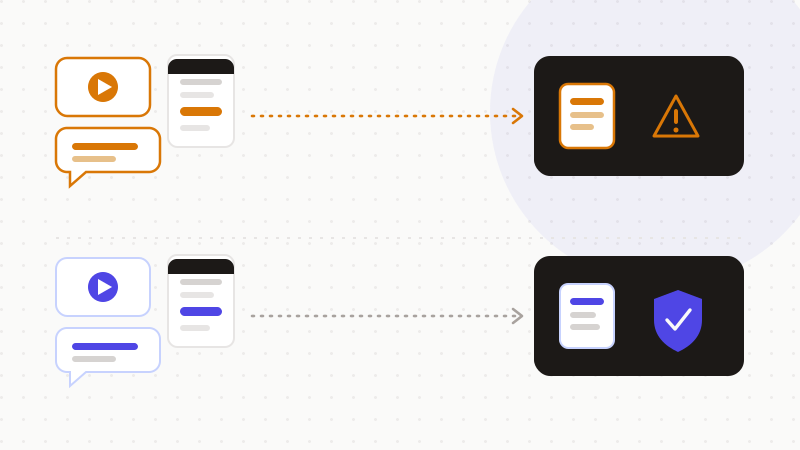
Keep one ground rule in mind. Do not paste an NDA or a fan DM into a consumer AI. Check each contract's confidentiality clause. Use vetted tools, with clear terms. And keep your unreleased content off consumer AI. When you must include a concrete case, anonymise it first.
- 1Spot the sensitive parts: names, rates, release dates, unreleased specifics, fan messages.
- 2Replace each with a reversible token, in the browser.
- 3Send only the anonymized draft to the AI.
- 4Restore the real values in the reply, locally.
That's what ONYRI Sanitize is for. The engine detects sensitive data — names, rates, unreleased specifics, messages — and replaces it with reversible tokens before sending. Detection and the mapping stay in your browser. Only anonymized text reaches the model. The AI finds only tokens, never your unreleased script or your partnership's rate. You get the help, without exposing what gives you the edge.
Frequently asked questions
- Is it safe to use AI for content creators?
- Yes for drafting and editing, no with your secrets. AI can structure a script, tighten an edit or reword a reply with no sensitive data at all. But don't paste an unreleased script, a partnership rate or a private fan message into a consumer AI. These can be a trade secret, fall under a confidentiality clause, or be personal data under the GDPR. Anonymise them before you send.
- Can I paste a brand contract or its rate into ChatGPT?
- Better to avoid it. A partnership often carries a confidentiality clause, and an NDA is a contract that forbids disclosing the terms. Pasting the rate or the contract into a public AI can amount to disclosure and breach the agreement. Check each deal's confidentiality clause first. If you must describe the case, replace the sensitive terms with tokens.
- Can I ask AI to reply to fan messages?
- Yes, but not by pasting the real messages. A fan DM is a private message, sometimes a minor's, shared without consent. Under the GDPR you can act as a controller of that personal data, and that responsibility does not transfer to the AI. Anonymise or reword the need, then let the AI draft a reply template.
Sources & references
- Frequently Asked Questions on Trade Secrets (confidential business information, reasonable steps to keep secret, confidentiality agreements) — World Intellectual Property Organization (WIPO)
- Regulation (EU) 2016/679 (GDPR) — controller definition and accountability — EUR-Lex, Publications Office of the European Union
- Disclosures 101 for Social Media Influencers (material connection to a brand must be disclosed) — US Federal Trade Commission (FTC)
Keep your sensitive data in your browser
ONYRI Sanitize detects and masks your sensitive data before it reaches the AI, then restores the answer — from names to API keys.