Is It Safe for Accountants in France to Use AI?
Pasting client data into a consumer AI exposes a French accountant to a breach of professional secrecy. The fix: anonymise before the prompt.
You use ChatGPT or Copilot to move faster. You paste a balance-sheet extract, a payslip, a tax return. The time saved is real. But this data belongs to your clients. Passing it to a consumer AI means handing it to an unauthorised third party. And the French accountant is bound by professional secrecy. So should you give up on AI? No. You just need to anonymise the data before sending it. Here is how.
The problem: the firm pastes client data into the AI
The reflex is understandable. A generative AI writes fast. It summarises a ledger, explains an entry, rewrites a note. So the firm feeds it real material. The material is the problem. A client file concentrates highly sensitive data.
- The annual accounts, the balance sheet and the operating margins.
- Payroll: salaries, bonuses, employees' social security numbers.
- The company's VAT returns and full tax filings.
- The director's contact details and third parties' personal data.
Pasted into a consumer AI, this information leaves the workstation. It can be retained, reviewed or reused. The firm loses control over what it sent. That is where the risk begins.
The stake: professional secrecy and the GDPR
The accountant is not just any professional. They are bound by professional secrecy. Article 21 of ordinance no. 45-2138 of 19 September 1945 binds them to this duty. It applies « in the conditions and under the penalties set by Article 226-13 of the Criminal Code ». This secrecy does not only cover confidences. It covers all information gathered during the engagement: accounts, financial data, tax and payroll elements.
Article 226-13 of the Criminal Code punishes disclosing secret information. It targets the person who holds it through their profession. The penalty runs to one year in prison and a 15,000-euro fine. The text assumes, in principle, a conscious disclosure. Pasting a file into an AI is therefore not an automatic conviction. But it is a real risk of breach, because a consumer AI provider is an unauthorised third party.
The GDPR adds to the secrecy duty. For a client's data, the firm decides the purposes and means of processing. It is the data controller. That imposes data security and data minimisation. The CNIL, France's data protection authority, is clear. An AI system built on personal data does not escape the GDPR. The principles of Article 5 apply fully, including minimisation.
On minimisation, the CNIL's stance is useful. Processing must be strictly necessary for its purpose. And if anonymised data allows a comparable result, it should be preferred. That is exactly what anonymising before the prompt achieves.
| Assumption | The reality |
|---|---|
| “What I paste into the AI stays between us” | It is a disclosure to an unauthorised third party, a risk of secrecy breach |
| “The GDPR doesn't apply to AI” | The CNIL states an AI system on personal data stays subject to the GDPR |
| “Anonymising makes me compliant” | Anonymising reduces risk and supports minimisation, but doesn't alone lift secrecy or the GDPR |
| “Giving up on AI is the only safe option” | Anonymising keeps AI's benefit without exposing secrecy-protected data |
The solution: anonymise before the prompt
The principle is simple. Data that never reaches the model can neither leak nor be passed to the provider. So anonymising upstream keeps AI's benefit. You work on a de-identified file. The AI reasons about the structure, not your clients' identity.
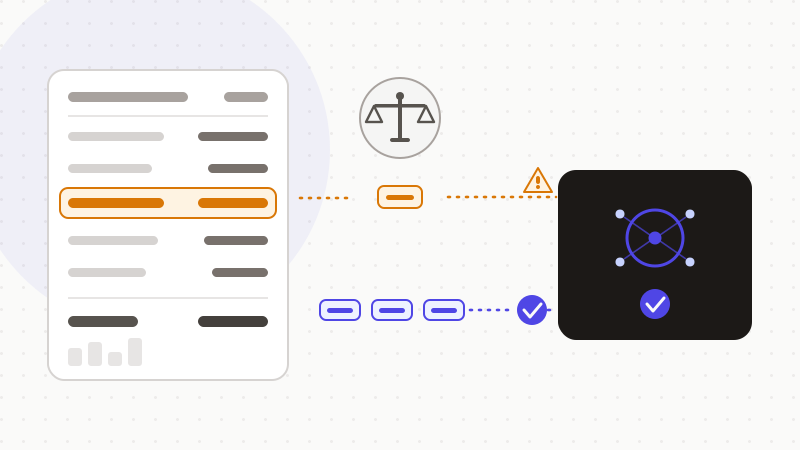
In practice, each identifying element is replaced by a token. The client's name becomes a token. The sensitive amount becomes a token. The AI sees only tokens, never the real values. Here is the method, step by step.
- 1Spot the secrecy-protected data: names, amounts, numbers, contact details.
- 2Replace them with reversible tokens, in the browser.
- 3Send only the anonymised text to the AI.
- 4Restore the real values in the reply, locally, on your machine.
Let us be honest about what this method does. Anonymising before the prompt reduces the risk. It supports the minimisation the GDPR calls for. But it does not make the firm “compliant” on its own. And it does not lift your duty of secrecy. It is a useful control, not a blank cheque. Compliance stays a broader whole, which this step strengthens without replacing.
That is what ONYRI Sanitize is for. The engine detects sensitive data — names, contact details, amounts, numbers — and replaces it with reversible tokens before sending. Detection and the mapping stay in your browser. The real values never leave your machine. Only anonymised text reaches the model. You keep AI's help, while reducing the exposure of the data that professional secrecy asks you to protect.
Frequently asked questions
- Is it safe for accountants in France to use AI?
- Not if you paste client data into a consumer AI. That provider is an unauthorised third party, and the accountant is bound by professional secrecy. Article 21 of ordinance no. 45-2138 of 19 September 1945 refers to the penalties of Article 226-13 of the Criminal Code. That penalty is one year in prison and a 15,000-euro fine. The fix is simple: anonymise the data before any prompt.
- Can I paste a balance sheet or a payslip into ChatGPT?
- Better to avoid it as is. This data is covered by professional secrecy and falls under the GDPR. The CNIL states an AI system on personal data stays subject to the GDPR, minimisation included. If you must describe a case, first replace each sensitive value with a token, then restore the real values locally.
- Should the firm give up on AI?
- No. The CNIL does not ban AI; it recommends preferring anonymised data when it gives a comparable result. Anonymising before the prompt keeps AI's benefit without exposing your clients. One caveat, though: this step reduces risk and supports minimisation, but it does not make you compliant on its own and does not lift your professional secrecy.
Sources & references
- Developing AI systems: the CNIL's recommendations to comply with the GDPR (minimisation, prefer anonymised data) — CNIL
- Article 226-13 of the French Criminal Code — breach of professional secrecy (annotated legislation sheet) — SECRETPRO
- Regulation (EU) 2016/679 (GDPR) — consolidated text (Article 5, data minimisation) — EUR-Lex (European Union)
Keep your sensitive data in your browser
ONYRI Sanitize detects and masks your sensitive data before it reaches the AI, then restores the answer — from names to API keys.