Can You Put Your Business Plan in ChatGPT?
Yes, AI helps structure a business plan. But it holds your strategy and figures. Anonymize them before the prompt.
Yes, an AI is very useful for structuring a business plan. It proofreads, rephrases and improves the form. But your business plan holds your most confidential material. Your strategy, your forecast figures, your financial projections. Often names of partners, clients or associates too. And sometimes your competitive edge or trade secret. This isn't just a matter of personal data. It's your project's business secret. The simple rule: anonymize the sensitive parts before pasting the text.
What a business plan really contains
A business plan concentrates a project's most strategic information. Gathered in one place, you find:
- Your forecast figures and your financial projections.
- Your competitive edge, sometimes a trade secret.
- People's names: partners, clients, suppliers, prospective hires.
- Your business model and your detailed action plan.
Each line, taken alone, looks harmless. Together, they map out your whole position. That's exactly what gives the document its value. And what makes it sensitive to expose.
The problem: two layers of confidentiality
A business plan blends two kinds of information to protect. First, personal data. The names of partners, clients or associates count as such. As a result, they fall under the GDPR, the European data protection regulation. Second, strategic information. Your figures and competitive edge aren't personal data. But they fall under business secrecy. Pasting the whole document into an AI exposes both layers at once.
The stake: what your plan becomes inside the AI
Once pasted, your business plan enters the AI provider's processing. It can be kept for a while. Depending on the offering, it may also help improve the model. You lose control over its lifespan and its spread. Yet the GDPR sets a simple principle: minimization. According to the CNIL, France's data protection authority, it means circulating only the data strictly needed for the goal. Pasting a whole document just to polish its form goes beyond that strict need.
| Business plan element | Type of information | Reflex before the AI |
|---|---|---|
| Names of partners, clients, suppliers | Personal data (GDPR) | Replace with tokens |
| Forecast figures, projections | Business secret | Neutralize or work on the form |
| Competitive edge, trade secret | Business secret | Do not send in the clear |
| Structure, outline, pitch | Form, not sensitive | Can be submitted as is |
The fix: anonymize or work on the form
Good news: you can keep the AI's help while greatly reducing exposure. Two approaches combine well. First: anonymize upstream. Replace names, key amounts and trade-secret elements with reversible tokens. Second: have the AI work on the structure, not on your real figures. A neutralized version is enough to improve the plan and the writing. Here's how to do it, step by step:
- 1Spot the identifying and sensitive elements: names, key amounts, trade secrets.
- 2Replace them with tokens before pasting the text into the AI.
- 3Ask the AI to work on the structure, executive summary and pitch.
- 4Take back the improved version, then re-inject your real values on your side.
You get real help on the form. And your strategic information stays with you.
« I just want to improve my executive summary »
It's a common request, and a fair question. An executive summary is above all about form. Clarity, the order of ideas, the hook. And the AI improves the form on a neutralized version just as well as on the original. It doesn't need your real figures to tighten a paragraph. Replace the amounts with tokens, keep the outline, and let the AI work. You re-inject the real values afterward. The gain is the same, minus the exposure.
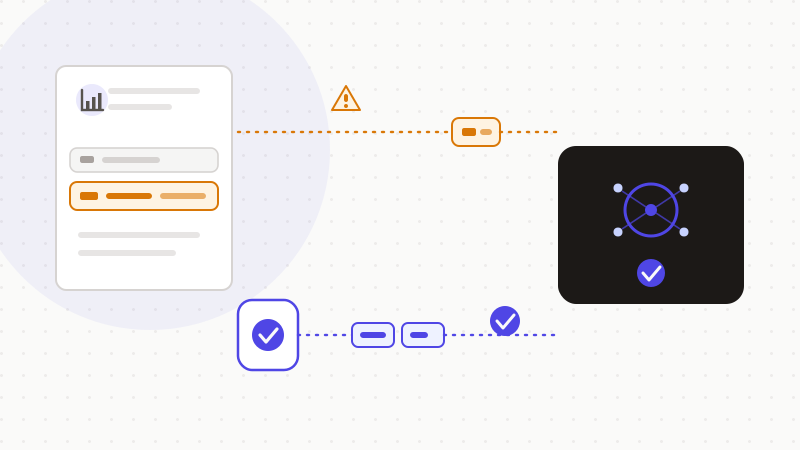
That's what ONYRI Sanitize does. The engine detects names and key figures, then replaces them with reversible tokens before sending. Detection and the token↔value mapping stay in your browser. Only anonymized text reaches the AI. This pseudonymization reduces exposure: it doesn't by itself make a use « 100% safe » or « without any risk ». But it keeps you in control of what matters most — your strategy and your real figures.
Frequently asked questions
- Can you put your business plan in ChatGPT?
- Yes, AI is very useful for structuring and proofreading a business plan. But this document holds your most strategic information: forecast figures, projections, competitive edge, and often names of partners or clients. The safe reflex: anonymize the sensitive elements before the prompt, or have the AI work on a neutralized version, then re-inject the real values.
- Is a business plan protected by business secrecy?
- Yes, under three conditions. First, the information must not be known to the public. Second, it must have commercial value because it is secret. Third, its holder must take reasonable protection measures. That is the definition of a trade secret. Voluntarily sharing the content with a third-party service can weaken that last condition.
- How can AI improve my executive summary without exposing everything?
- An executive summary is mainly a matter of form. AI improves it just as well on a neutralized version as on the original. Replace key amounts and names with tokens, let the AI tighten the text, then re-inject your real values. You keep the writing gain while reducing your data's exposure.
Sources & references
- Data minimization — definition (process only the strictly necessary data) — CNIL
- General Data Protection Regulation (GDPR) — art. 5, principles (including minimization) — EUR-Lex (European Union)
- Business secrecy — definition and protection criteria — Bpifrance Création
Keep your sensitive data in your browser
ONYRI Sanitize detects and masks your sensitive data before it reaches the AI, then restores the answer — from names to API keys.