Are Local AI Models More Private Than the Cloud?
Local AI is more private for inference — your prompt stays on the machine. But it's often less capable. Anonymise sensitive parts, then use the cloud.
Are local AI models more private than the cloud? For the inference step, the answer is yes. A model that runs fully on your own machine never sends your prompt to a vendor's server. So there is no server-side retention, no human review, and no training on your text. That part is genuinely more private. But local is not automatically safer overall. Local models are usually smaller and less capable. You still have to secure the machine itself. And some apps that run locally still phone home. So local wins on privacy, but cloud often wins on capability. For the common case, you can get both. Anonymise the sensitive parts before you send.
Local inference: genuinely more private
Tools like Ollama and LM Studio run open-weight models on your own hardware. On-device models do the same thing. The prompt is processed right there, on your machine. It never travels to a vendor's API for the inference step. Nothing is stored on a server you do not control. No staff can review it. And it cannot be reused to train a future model. For that step, this is a real privacy gain.
The win is specific to inference. That is the moment your prompt meets the model. Keep that moment on your device. The most sensitive step then stays private. It is the strongest version of the data never leaves.
The tradeoffs are real
Local is the most private option, but not without tradeoffs. The biggest one is capability. Locally-run and open-weight models are usually smaller. For hard or specialised tasks, the frontier cloud models still lead. So many people reach for the cloud even when they care about privacy.
- Capability gap: local models are usually smaller and less capable than frontier cloud models.
- Your own security still matters: the data sits on disk, in backups, and next to other apps.
- Runs locally is not sends nothing: the app can still send telemetry, crash reports, or updates.
- Practical cost: a capable model needs real RAM and GPU, and local inference can be slower than a hosted API.
That third point deserves care. The model can run offline while the surrounding app still talks to a server. It might check a licence, report a crash, or download an update. So verify what each app sends. Do not assume silence just because the model runs on your machine.
What the rules say: data minimisation
A legal principle sits behind all of this. It is called data minimisation. The UK GDPR and EU GDPR set it out in Article 5(1)(c). Personal data must be adequate, relevant, and limited to what is necessary. The ICO (Information Commissioner's Office, the UK regulator) frames it simply. Process only what you need, and be ready to justify that need.
The ICO also applies this to AI directly. Its AI guidance treats local, on-device processing as one way to minimise data during inference. It also points to data masking and anonymisation. Those techniques replace or hide identifying details. So the AI system only sees what it needs. The two approaches are complementary, not rivals.
| Approach | Privacy for the data | Capability |
|---|---|---|
| Full local model | Highest — prompt stays on device | Usually lower than frontier cloud |
| Raw prompt to the cloud | Lowest — all the data leaves | Highest — frontier models |
| Anonymise, then cloud | High — sensitive parts never leave | Highest — frontier models |
The practical middle ground
Most people still want a capable cloud model. That is a reasonable choice for hard work. You do not have to give up privacy to get it. The fix is to anonymise the sensitive parts first. Send the shape of your problem, not the raw identifiers. The cloud model reasons on tokens. You restore the real values locally, in your browser.
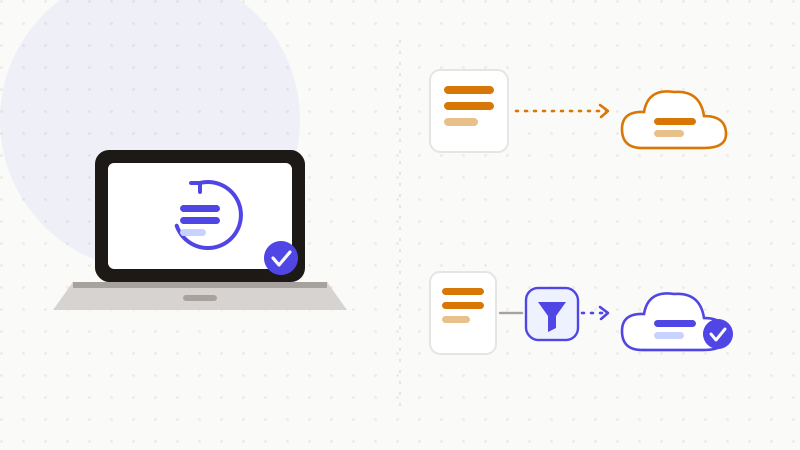
This mirrors the ICO's own pairing. On-device processing and data masking both minimise what the AI sees. On-device AI from big vendors is another middle ground. It can be a legitimate option. But the same rule holds: verify what actually leaves.
- 1Decide the minimum data the task really needs.
- 2For full privacy on simple tasks, run a local model.
- 3For hard tasks, anonymise the sensitive parts first.
- 4Send only the anonymised text to the cloud model.
- 5Restore the real values in the reply, locally.
That is the idea behind ONYRI Sanitize. The engine runs fully in your browser. It finds sensitive data — names, numbers, keys, addresses — and swaps it for reversible tokens. The detection and the mapping never leave your device. Only anonymised text reaches the model. You get frontier capability, with local-grade privacy for the data that matters. It is the ICO's own pairing, made practical.
Frequently asked questions
- Are local AI models more private than the cloud?
- For the inference step, yes. A model running on your own machine never sends your prompt to a vendor's server. No retention, no human review, no training on your text. But local is often less capable, and you still have to secure the machine. For hard tasks, anonymise the sensitive parts, then use a cloud model.
- Does 'runs locally' mean nothing is sent?
- No, not automatically. The model can do inference on-device while the app still sends telemetry, crash reports, or updates. Runs locally describes where the model computes, not what the app transmits. Check each tool's settings and privacy documentation before trusting it with sensitive data.
- How do I keep cloud capability without exposing my data?
- Anonymise the sensitive parts before you send. Replace identifiers with reversible tokens in the browser. The cloud model reasons on tokens, then you restore the real values locally. This is the pairing the ICO recommends: minimised processing plus data masking. You keep frontier capability and privacy for what matters.
Sources & references
- Principle (c): Data minimisation (process only what is necessary, be able to justify it) — Information Commissioner's Office (ICO)
- Regulation (EU) 2016/679 (GDPR) — Article 5, principles relating to processing of personal data — EUR-Lex, European Union
- How should we assess security and data minimisation in AI? (on-device processing and masking as minimisation techniques) — Information Commissioner's Office (ICO)
Keep your sensitive data in your browser
ONYRI Sanitize detects and masks your sensitive data before it reaches the AI, then restores the answer — from names to API keys.