AI now models the brain: why data minimization matters
Meta's TRIBE model predicts human brain responses to stimuli. As AI models ever more intimate signals, one principle grows in value: data minimization.
AI no longer just handles text: it now models brain activity. Meta's TRIBE model predicts human brain responses — measured by functional MRI — to videos, sounds and text, drawing on hundreds of hours of recordings from hundreds of people. It's an impressive research advance, and a useful reminder: as AI learns to model ever more intimate signals, the reflex that protects best stays the simplest — hand over only what's strictly necessary, and remove the sensitive data before it leaves.
What TRIBE shows (and what it doesn't do)
Let's be precise, to avoid the sci-fi trap: TRIBE doesn't “read” your thoughts. It's an encoding model — a “digital twin” of neural activity — that predicts how a brain would respond to a given stimulus, in order to run neuroscience experiments “in silico.” Meta says it trained it on more than 500 hours of functional MRI from over 700 people, and released it with a demo and code. The point isn't that it guesses your secrets, but that it illustrates a trajectory: AI is modeling ever deeper human data.
Why it changes the frame
As long as AI handled “only” text, you could believe the risk was limited. But the same logic applies to every layer: what you entrust to a system can be processed, retained, cross-referenced, and one day used in a way you didn't anticipate. Capability grows faster than guardrails. Against that, you can't track every change from every provider — but you can reduce what you expose.
| What you hand over | Why minimize it |
|---|---|
| An identifier, a name, a case file | The more identifying it is, the costlier an exposure |
| Content “just this once” | You control neither the duration nor future use |
| More context than needed | The surplus doesn't help the task, but worsens the risk |
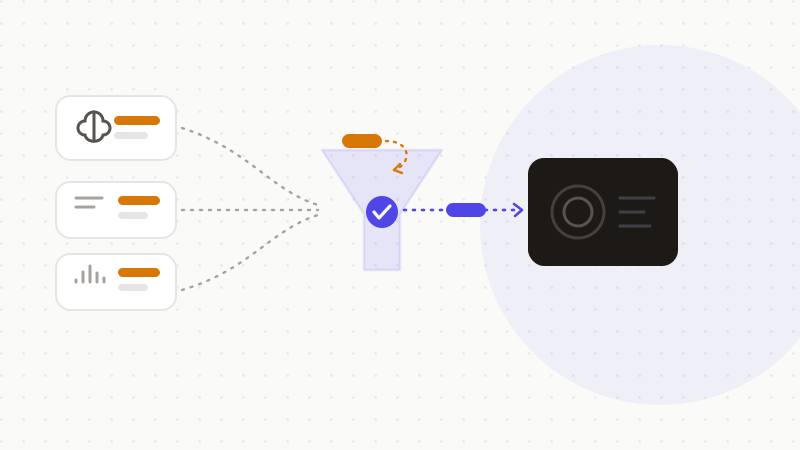
The principle that doesn't age: minimization
Data minimization — collecting and transmitting only what's necessary — is a pillar of privacy precisely because it doesn't depend on any particular technology. It holds for text today as for more intimate signals tomorrow:
- the less you transmit, the less a leak, retention or reuse can cost you;
- the sensitive surplus almost never improves the AI's answer;
- what you don't give can't be memorized, indexed, or produced in court.
Putting it into practice
Minimizing doesn't mean giving up AI: it means giving it the task without giving it the identities. Concretely:
- 1Before each send, ask which data is truly necessary for the task.
- 2Remove the sensitive data — names, identifiers, secrets — before sending.
- 3Keep the token↔value mapping local to reconstruct the answer.
ONYRI Sanitize makes minimization an automatic gesture: the engine detects sensitive data in your text and replaces it with reversible tokens before sending; detection and the mapping stay in your browser, and only the strict necessary — anonymized — reaches the AI. Whatever models do next, what you didn't transmit stays out of their reach.
Frequently asked questions
- Does Meta's TRIBE model read minds?
- No. TRIBE is an encoding model that predicts how the brain would respond to a stimulus (video, sound, text), to run simulated neuroscience experiments. It doesn't decode your thoughts; it shows that AI is modeling ever deeper human data.
- What is data minimization?
- It's the principle of collecting and transmitting only what's strictly necessary for a task. Applied to AI, it means giving the useful context without giving identities and secrets — to reduce what can leak or be retained.
- How do I minimize what I send to an AI?
- By removing the sensitive data before sending. An anonymization engine replaces names, identifiers and secrets with reversible tokens; the model gets what the task needs, never the real information.
Sources & references
- “Meta Releases TRIBE v2: A Brain Encoding Model That Predicts fMRI Responses” — MarkTechPost
- “Meta's TRIBE AI: A New Foundation Model Decoding Human Brain Activity” — Neuroscience News
- TRIBE v2 — interactive demo — Meta AI
Keep your sensitive data in your browser
ONYRI Sanitize detects and masks your sensitive data before it reaches the AI, then restores the answer — from names to API keys.