Can AI Clone Your Voice? What You Need to Know
Yes: modern AI can clone a recognizable voice from seconds of audio. What the FTC says about the scams, and the simple steps that protect you.
Yes, AI can clone a recognizable voice. And it takes very little. Recent models reproduce a person's voice from just seconds of audio. That audio is often already public: a video, a voicemail, a podcast. These clones power real scams. The FTC (Federal Trade Commission, the US consumer protection agency) has warned about this more than once. Your voice is also personal data. Under the GDPR, it can become sensitive data when it is used to identify you. The good news: the best defenses are simple and low-tech.
How little voice does a clone need?
Very little. Research has shown this in dramatic fashion. Microsoft's VALL-E model cloned a voice from a clip of about three seconds. It even reproduced the emotional tone and the acoustic ambiance. Its own researchers flagged the misuse risks. For example, spoofing a voice-based identity check, or impersonating a specific speaker.
One important nuance here. VALL-E is a research model, not a consumer product. Don't imagine a fixed threshold that holds for every tool. Hold on to the principle instead: a few seconds can be enough. The more your voice circulates online, the easier a convincing clone becomes.
The scam wave: what the FTC says
The FTC has repeatedly warned consumers. Criminals use AI voice cloning for two scams in particular. First, the 'family emergency': a cloned relative claims to be in trouble and needs money fast. Second, executive-impersonation fraud: a fake boss's voice orders an urgent transfer.
The FTC's advice is simple. Hang up. Call the person back on a number you know is theirs. Report any fraud at ReportFraud.ftc.gov. To spotlight the threat, the FTC even ran a Voice Cloning Challenge, announced in November 2023. It invited ideas to detect or prevent malicious voice cloning. That is a clear official signal: the regulator treats this risk as real, not hypothetical.
Your voice is data: what the GDPR says
A voiceprint is personal data. Under the GDPR framework (UK and EU), biometric data becomes 'special category' data. It then gets extra protection. But mind the exact nuance. That status applies when the data is processed to uniquely identify or verify a person.
In other words, an ordinary audio recording is not automatically sensitive data. It becomes so when it is technically processed to identify you: that is the voiceprint. This is the position of the ICO (Information Commissioner's Office, the UK regulator) on Article 9 of the GDPR. So don't over-claim: not all voice audio is 'special category' data.
There is a practical stake, not just a legal one. A cloned voice can fool voice-authentication systems. A convincing clone can therefore defeat a bank's phone 'voice ID' style check. Treating your voice as sensitive data makes concrete sense.
Where clones come from
The raw material for a clone is often already online. You don't need to be a celebrity to be exposed. Plenty of ordinary sources are enough.
- A voicemail greeting.
- A podcast, an interview, or a recorded webinar.
- A social video or a story.
- A voice memo or audio note handed to a consumer tool.
The logic is simple. The more of your voice is public, the easier a clone. This doesn't mean you should go silent. It means staying clear-eyed about what you post, and avoiding handing private recordings to tools you don't control.
The fix: simple, human, effective
The best defenses are low-tech. They need no technology at all. They rest on a habit and a little skepticism.
- 1Agree a family or team 'safe word' to confirm an urgent request.
- 2Stay skeptical of pressure and secrecy, even when the voice sounds familiar.
- 3Always verify through a second channel: call back a known number.
- 4Limit how much of your voice you post publicly, where that's reasonable.
- 5Don't feed private recordings to consumer AI tools you don't control.
| The assumption | The reality |
|---|---|
| “You need hours of audio to clone a voice” | Research cloned a voice from a clip of about three seconds |
| “If it's their voice, the call is real” | A clone mimics the voice; the FTC advises calling back a known number |
| “My voice isn't protected data” | A voiceprint is personal data, sensitive when it's used to identify you |
| “My bank's voice ID keeps me safe” | A convincing clone can fool voice authentication |
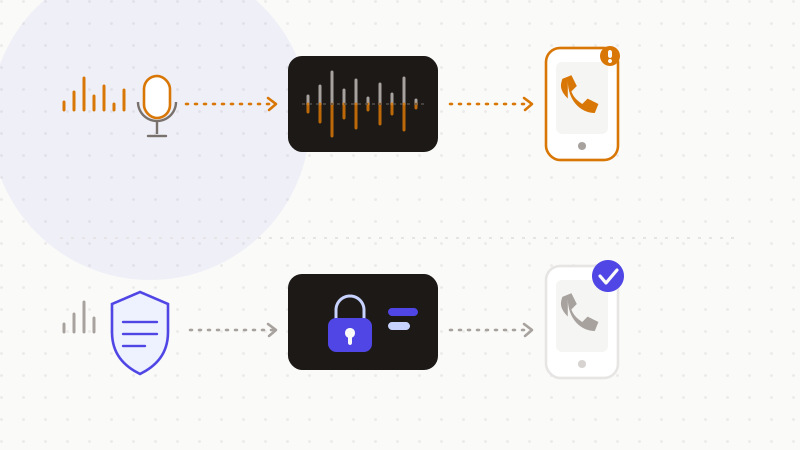
Voice cloning points to a larger truth: your voice, like your identifiers, is data to protect. That's the idea behind ONYRI Sanitize. The engine detects sensitive data in your prompts — names, contact details, numbers, secrets — and replaces it with reversible tokens before sending. Detection and the mapping stay in your browser. Only anonymized text reaches the model. You get AI's help, without exposing what identifies you.
Frequently asked questions
- Can AI really clone your voice?
- Yes, and with very little material. Recent models reproduce a recognizable voice from just seconds of audio. Microsoft's VALL-E research cloned a voice from a clip of about three seconds, emotional tone included. That audio is often already public: a video, a voicemail, a podcast. The more your voice circulates online, the easier a convincing clone becomes.
- How do I protect against a voice-cloning scam?
- The defenses are simple. Agree a family safe word to confirm an urgent request. Stay skeptical of pressure, even when the voice sounds familiar. Always verify through a second channel: hang up and call back a known number. The FTC also advises reporting any fraud at ReportFraud.ftc.gov.
- Is a voice personal data under the GDPR?
- Yes, a voiceprint is personal data. Under the GDPR, biometric data becomes special category data when it is used to uniquely identify a person. An ordinary audio recording is not automatically sensitive; it becomes so when it is processed to identify you. This is the ICO's position on Article 9.
Sources & references
- Fighting back against harmful voice cloning (voice-cloning scams, call back a known number, report fraud) — U.S. Federal Trade Commission (FTC)
- What is special category data? (biometric data = special category when used to identify, GDPR Art. 9) — Information Commissioner's Office (ICO), UK
- Microsoft's new AI needs just 3 seconds of audio to clone a voice (VALL-E research) — Freethink
Keep your sensitive data in your browser
ONYRI Sanitize detects and masks your sensitive data before it reaches the AI, then restores the answer — from names to API keys.