Which AI Chatbot Is Most Private? ChatGPT vs Claude vs Gemini
No AI chatbot is universally “most private”: ChatGPT, Claude and Gemini all train on your chats by default unless you opt out. The setting-by-setting comparison.
There is no universally “most private” AI chatbot: privacy depends as much on the tier (consumer or enterprise) and the settings you've enabled as on the tool itself. On standard consumer accounts, ChatGPT, Claude and Gemini all use your conversations by default to improve their models unless you turn it off. An honest comparison therefore reasons setting by setting, not brand by brand — and the only guarantee that depends on neither the tool nor its options is to remove sensitive data before sending.
The right instinct: compare settings, not brands
The question “which chatbot is most private?” assumes one brand is inherently safer. In practice, the same provider applies radically different rules depending on whether you're on a personal account or an enterprise contract. On consumer plans, default training and occasional human review are the shared norm; on enterprise plans, exclusion from training becomes the default. Tier and opt-out often matter more than the logo.
Three families of variables genuinely count: what is done with your chats by default (training, human review), how long they're kept, and under which jurisdiction. We walk through them for ChatGPT, Claude and Gemini, then for two tools often searched alongside — DeepSeek and Perplexity, which we cover in detail in our “Is DeepSeek safe?” and “Is Perplexity safe?” analyses.
ChatGPT, Claude and Gemini on consumer tiers
ChatGPT (OpenAI): on personal Free, Plus and Pro accounts, the “Improve the model for everyone” setting is on by default — so your conversations feed training unless you opt out via Settings → Data Controls (see the OpenAI Help Center, Data Controls FAQ). The opt-out is forward-looking only: data already trained on isn't pulled back. And even after opting out, OpenAI keeps data for about 30 days by default to monitor abuse.
Claude (Anthropic): since the 2025 consumer terms update, Free, Pro and Max plans train the models on conversations unless you've declined via the privacy setting — a choice you can make at sign-up or change at any time. The key retention consequence: leaving training on extends retention to 5 years, while declining keeps it at 30 days. Existing users had to decide by an announced deadline (October 8, 2025).
Gemini (Google): with “Gemini Apps Activity” on (the default state), your conversations are used to provide and improve the services, including model training. Google explicitly warns against entering confidential information: a subset of conversations is read by human reviewers, and those reviewed chats can be kept for up to 3 years — they are not deleted even when you clear your activity (default auto-delete is 18 months, adjustable). You turn it off at myaccount.google.com → Data & privacy → Gemini Apps Activity (see the Gemini Apps Privacy Hub).
The comparison table
Here are the main privacy dimensions, tool by tool, for standard consumer accounts (enterprise plans change these rows, see below):
| Tool | Trains by default | Opt-out | Retention | Jurisdiction |
|---|---|---|---|---|
| ChatGPT (OpenAI) | Yes (Free/Plus/Pro) | Yes (forward-looking) | ~30 days for abuse monitoring, even after opt-out | United States |
| Claude (Anthropic) | Yes (Free/Pro/Max) | Yes (at sign-up or later) | 5 years if training on, 30 days if declined | United States |
| Gemini (Google) | Yes (Apps Activity ON) | Yes (forward-looking) | Up to 3 years for reviewed chats; 18-month auto-delete | United States |
| DeepSeek | Yes (no clear opt-out) | Not visible on consumer tier | Inputs retained; servers in mainland China | China |
| Perplexity | Yes (signed-in users) | Yes if signed in (forward-looking) | Per “AI data retention” setting | United States |
DeepSeek and Perplexity come up in the same search. DeepSeek's privacy policy says it stores data on servers in mainland China, subject to Chinese law; inputs can be retained and used for training with no clear consumer opt-out — practices that triggered regulatory action, including a measure from Italy's authority (the Garante) in early 2025 over cross-border transfers. Perplexity turns training on by default for signed-in Free, Pro or Max users, toggleable via an “AI data retention” setting (a signed-out user can't opt out); the opt-out is forward-looking only. We cover each in “Is DeepSeek safe with your data?” and “Is Perplexity safe with your data?”, and human review on ChatGPT/Gemini in our “Do humans review your… chats” articles.
Enterprise, BAA and jurisdiction: the real switch
Enterprise plans change the picture. By default, OpenAI does not train its models on inputs/outputs from ChatGPT Enterprise, Business, Edu, ChatGPT for Healthcare or the API (see OpenAI Enterprise privacy); Anthropic excludes from training the services under Commercial Terms (Claude for Work, Government, Education and the API, including via Amazon Bedrock and Google Cloud Vertex AI); Google Workspace subjects Gemini app content to neither human review nor training without authorization. HIPAA BAAs and zero data retention exist — but through a negotiated enterprise contract, not on standard consumer or pay-as-you-go plans.
- Jurisdiction: OpenAI, Anthropic and Google are U.S. companies subject to U.S. law.
- EU data residency: none offers it as a standard consumer option — it's negotiable only at the enterprise level.
- Concrete legal risk: a May 2025 order in the New York Times v. OpenAI litigation forced OpenAI to preserve logs that would normally have been deleted (see OpenAI's note on the New York Times' data demands) — consumer-side “deletion” can be suspended by a legal obligation.
In other words, even the best consumer setting remains hostage to factors outside your control: the provider's jurisdiction and the possibility that a court order freezes data that was supposed to disappear. A personal account, whatever the tool, does not shield you from that.
The only content-level guarantee
At the level of the content itself, the only guarantee that's independent of the tool and its settings is to remove sensitive data before sending. Opt-out, short retention and enterprise exclusion reduce exposure, but they prevent neither occasional human review, nor retention imposed by a legal obligation, nor incorporation already done into a trained model. Anonymizing the prompt upstream neutralizes these variables, whatever chatbot you choose.
- 1Pick the right tool and tier, then opt out of training: that's good basic hygiene.
- 2Prefer an enterprise plan if you handle sensitive data at scale (training exclusion, BAA, negotiated retention).
- 3But for truly sensitive data, remove it from the prompt before sending — that's the only measure that holds whatever the tool.
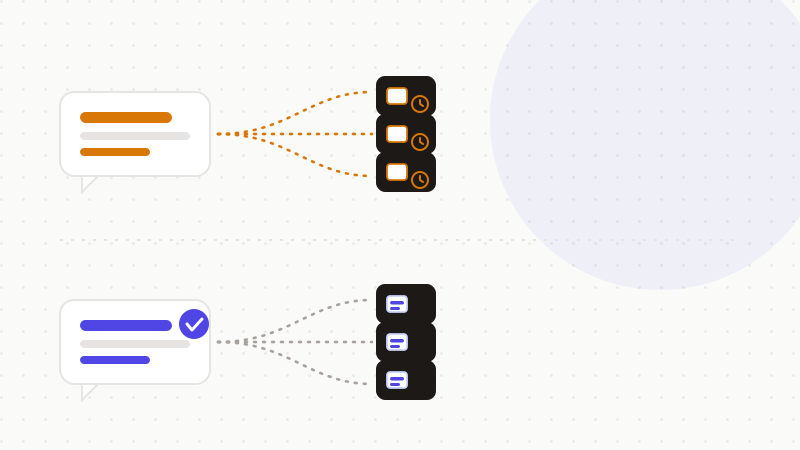
That's exactly what ONYRI Sanitize is for: the engine replaces sensitive data with reversible tokens before sending; detection and the token↔value mapping stay in your browser, and only anonymized text reaches the model. Whether you choose ChatGPT, Claude, Gemini or another, the chatbot only finds tokens — not your real information.
Frequently asked questions
- Which AI chatbot is most private?
- None is universally “most private”: privacy depends on the tier (consumer or enterprise) and enabled settings as much as on the brand. ChatGPT, Claude and Gemini all train by default on consumer accounts unless you opt out, and all remain U.S. companies. The only constant guarantee is to remove sensitive data from the prompt before sending.
- Do ChatGPT, Claude or Gemini train on my conversations by default?
- Yes, on consumer accounts: ChatGPT (Free/Plus/Pro), Claude (Free/Pro/Max) and Gemini (Apps Activity on) all use your chats by default to improve their models unless you opt out. Enterprise plans exclude training by default, but the consumer opt-out is forward-looking only.
- Does an enterprise plan make a chatbot truly private?
- It helps a lot: OpenAI, Anthropic and Google exclude training by default on their enterprise/API services, and HIPAA BAAs or zero data retention are negotiable. But jurisdiction stays U.S. and a legal obligation can freeze data; for truly sensitive data, anonymizing it before sending remains the safest measure.
Sources & references
- ChatGPT, Gemini, Claude and Perplexity privacy comparison (default training, retention, opt-out) — Tom's Guide
- Updates to Claude consumer terms: default training, opt-out, 30-day vs 5-year retention, covered/excluded plans — Anthropic
- AI privacy policy evaluation: ChatGPT vs Gemini vs Claude (human review, certifications, opt-out) — NetFriends
Keep your sensitive data in your browser
ONYRI Sanitize detects and masks your sensitive data before it reaches the AI, then restores the answer — from names to API keys.