Does an enterprise AI plan keep your data private?
Partly. Enterprise AI plans don't train on your data by default and add encryption and certifications. What those commitments cover — and what they don't.
Partly. Enterprise AI plans offer genuine commitments: generally, your data isn't used to train the models by default, you keep ownership of your content, and they add encryption, security certifications and retention controls. That's a clear step up from consumer accounts. But those guarantees concern what the provider does with the data — not whether it leaves your environment. The data still goes out, you depend on a promise, and some risks stay out of scope. The strongest protection remains not transmitting the sensitive data in the clear.
What these plans really cover
Serious enterprise offerings share a baseline of commitments, and it's real: no model training on your content by default, ownership of your inputs and outputs that stays yours, encryption in transit and at rest, recognized security certifications, alignment with data-protection frameworks, and configurable retention periods. For a team, that's the difference between governed use and blind use — it deserves credit.
What they don't cover
A no-training commitment doesn't make the data invisible. The text is still transmitted, processed, and often logged for a time on the provider's side. So a contractual promise leaves out: exposure through a misconfigured share, retention imposed by a legal obligation, human review of samples for abuse prevention, and the simple fact that you can't verify from the outside that settings are correctly applied.
| Covered by an enterprise plan | Out of scope |
|---|---|
| No training on your data by default | The data still leaves your environment |
| Encryption, certifications, content ownership | Exposure through a misconfigured share |
| Configurable retention period | Retention imposed by a legal obligation |
| Contractual commitments | Real, external verification that they're applied |
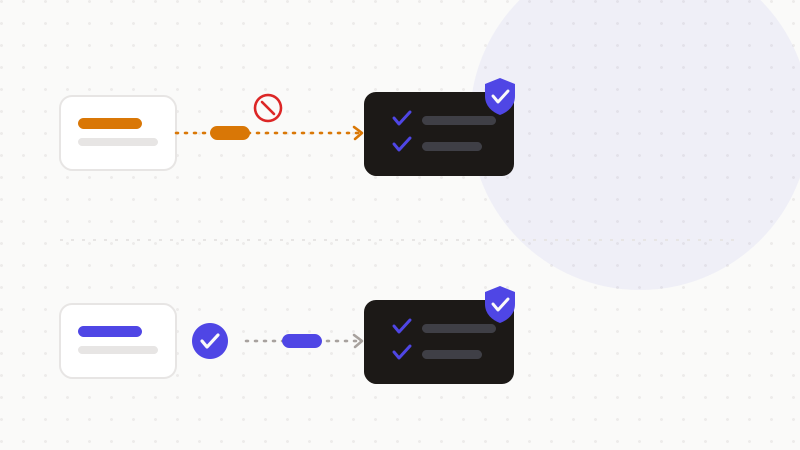
“No training” doesn't mean “invisible”
The nuance is essential. “Your data isn't used to train the model” concerns one specific use; it doesn't mean the data is neither transmitted, processed nor temporarily retained. For truly sensitive information, the right reflex isn't to choose between trust and distrust of the provider — it's to reduce what they receive in the first place.
- The data transits and is processed, even without training.
- Technical logs may exist, for as long as it takes to operate.
- A legal obligation can suspend your retention settings.
The complement: anonymize upstream
An enterprise plan and anonymization aren't opposites: they complement each other. The plan governs what becomes of the data at the provider; anonymization ensures the sensitive data never arrives there in the clear. The second closes the gap the first leaves open by design.
- 1Keep your enterprise plan and its commitments — they're useful.
- 2Remove the sensitive data before sending, instead of betting everything on the promise.
- 3Keep the token↔value mapping local, out of the provider's reach.
That's exactly what ONYRI Sanitize does: the engine detects sensitive data and replaces it with reversible tokens before sending; detection and the token↔value mapping stay in your browser, and only anonymized text reaches the AI. Your enterprise commitments still apply — but on content that no longer reveals anything.
Frequently asked questions
- Does an enterprise AI plan prevent training on my data?
- Generally yes: serious enterprise offerings don't reuse your content to train models by default, and add encryption, certifications and retention controls. That's real progress — but it doesn't cover the whole path of the data.
- If they don't train on my data, am I protected?
- Not entirely. The data is still transmitted, processed and often logged for a time. A misconfigured share, a legal retention obligation or human abuse review remain outside the scope of a no-training commitment.
- Should I drop enterprise plans in favor of anonymization?
- No: the two complement each other. The plan governs provider-side use of the data; anonymization keeps the sensitive data from arriving there in the clear. Together, they close the gap.
Sources & references
Keep your sensitive data in your browser
ONYRI Sanitize detects and masks your sensitive data before it reaches the AI, then restores the answer — from names to API keys.