DeepSeek and Your Data: Should You Anonymize First?
Per DeepSeek, data is stored in China and used for training. Anonymizing first reduces what you expose, right in your browser.
Should you anonymize your data before using DeepSeek? Direct answer: it's recommended. DeepSeek is a third-party service that processes your prompt. Per its privacy policy, updated on 10 February 2026, user data is stored in China. Also per DeepSeek, your inputs serve to train its models. Data stored in China falls under local law. For a European user, that's a real transfer-outside-the-EU concern. Anonymizing before you send strips identifiers from the text, whatever the jurisdiction. ONYRI Sanitize does it in your browser.
What DeepSeek's policy says
Let's start with the attributed facts. Per DeepSeek's privacy policy (updated 10 February 2026), the company « collects, processes and stores your personal data » directly in the People's Republic of China. Per that same policy, your inputs serve « to improve and develop the Services and to train » its machine learning models and algorithms. In plain terms, your prompts can feed training, absent action on your part.
An objection right exists, and it deserves credit. Per DeepSeek, you have the « right to object to the use of your personal data to train its models ». That right is exercised by contact, at privacy@deepseek.com. It isn't a setting enabled by default in the app. So it takes an explicit step on your part.
- Per DeepSeek, users' personal data is stored in the People's Republic of China.
- Per DeepSeek, inputs serve to develop the Services and to train its models and algorithms.
- Per DeepSeek, an objection right (opt-out) to that training exists, exercised by contact — not an in-app toggle enabled by default.
One distinction is due, in fairness. This policy covers the app and API hosted by DeepSeek. An open-weight model you run on your own infrastructure is a different case. In that case, your data doesn't leave for DeepSeek's servers. This article targets the hosted service, not an in-house deployment.
Why jurisdiction matters for the GDPR
Where data is stored isn't a detail. China doesn't benefit from a European Commission adequacy decision. Per the CNIL, a transfer of data outside the EU without adequacy must be framed by appropriate safeguards. Those safeguards are, for example, standard contractual clauses, BCRs, a code of conduct or a certification.
And pasting a prompt is already a transfer. Per the CNIL, a transfer is « any communication, copy or movement of personal data » to a third party outside the EU. Pasting text containing personal data into a service whose servers are outside the EU falls under this definition. So the topic isn't theoretical. Separately, several administrations have, per widely reported accounts, restricted DeepSeek on their public devices.
Anonymizing first, the control you keep
A compliant transfer framework is still needed on the company side. But at your level, anonymizing before you send keeps its value. Here's why, even with DeepSeek.
- 1DeepSeek receives and processes your prompt: the fewer real values it sees, the better.
- 2Storage in China and local law don't depend on you: stripping identifiers reduces what you expose.
- 3A policy can change: defense in depth doesn't rest on the vendor's goodwill alone.
- 4Anonymizing before sending is a measure you control end to end, whatever the service's setting.
The table below recaps what DeepSeek says, as of 8 August 2026, and what ONYRI adds on top.
| Point | What DeepSeek says (as of 2026-08-08) | What ONYRI changes |
|---|---|---|
| Storage location | Data stored in the People's Republic of China | The prompt leaves already pseudonymized |
| Training | Inputs used to train the models; opt-out by contact | Your real values stay on your device |
| GDPR transfer | China without EU adequacy; transfer framework required, per the CNIL | Reduces exposed identifiers, without being a legal basis |
How ONYRI does it
The ONYRI extension grafts directly onto DeepSeek's chat site. It acts in your browser, before you send. The flow takes four steps.
- 1You write your prompt on DeepSeek as usual.
- 2In the browser, the extension detects sensitive data and replaces it with reversible tokens.
- 3The already-pseudonymized prompt goes to DeepSeek; the token ↔ value mapping stays in the tab, on your device.
- 4The answer comes back, and your real values are restored on screen, in the browser.
A point on the boundary, and on the limits. The real values and the token ↔ value mapping never leave your browser. DeepSeek only receives already-pseudonymized text, whatever its policy. The extension acts on AI chat sites, not on a code editor's autocomplete nor on another tool's internal AI calls. Detection stays heuristic: it strongly reduces exposure, without promising zero risk. A Free tier serves as an entry point; advanced features belong to the paid plans.
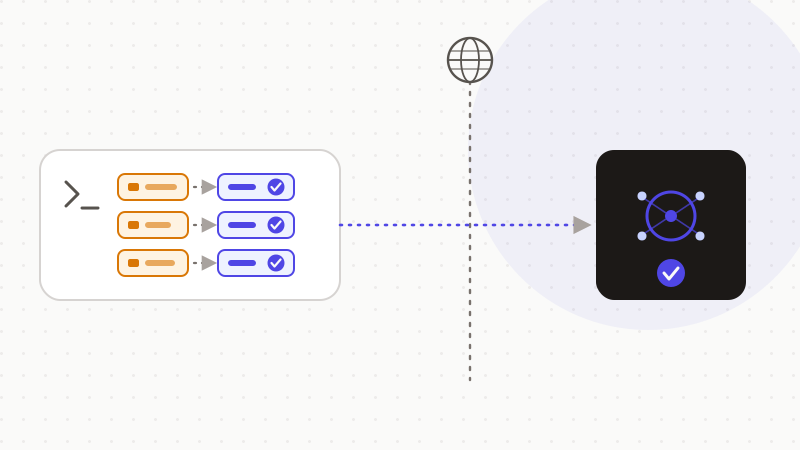
In short, DeepSeek stores data in China and uses it for training, per its policy. An objection right exists, but you request it by contact. And data outside the EU raises a real GDPR transfer concern. Anonymizing before you send stays a measure you keep under control. ONYRI detects, replaces with reversible tokens, then restores the answer in your browser. This approach reduces your data's exposure. It doesn't make it « anonymous under the GDPR »: reversible tokens are still pseudonymization.
Frequently asked questions
- Should you anonymize your data before using DeepSeek?
- Yes, it's recommended. Per DeepSeek's policy (updated 10 February 2026), data is stored in China and serves to train its models. Anonymizing before you send strips identifiers from the text, whatever the jurisdiction. This measure reduces your data's exposure and stays under your control.
- Does DeepSeek train its models on my conversations?
- Per DeepSeek, inputs serve to develop the Services and to train its models and algorithms. An objection right (opt-out) exists, exercised by contact (privacy@deepseek.com), not via a setting enabled by default. Always check the policy in force, since it can evolve.
- Is sending a prompt to DeepSeek a transfer of data outside the EU?
- Per the CNIL, a transfer is any communication or copy of personal data to a third party outside the EU. Pasting text containing personal data into a service whose servers are outside the EU falls under this definition. Since China lacks EU adequacy, a transfer framework is required, per the CNIL.
Sources & references
- DeepSeek Privacy Policy (updated 10 February 2026: storage in the People's Republic of China, use for training, objection right) — DeepSeek
- Transfers of data outside the EU: the general framework under the GDPR (adequacy, appropriate safeguards) — CNIL
- Transferring data outside the EU (definition of a transfer, compliance tools) — CNIL
Keep your sensitive data in your browser
ONYRI Sanitize detects and masks your sensitive data before it reaches the AI, then restores the answer — from names to API keys.