Top 5 AI Privacy Myths, Debunked
No — a VPN, a paid plan or deleting a chat won't make ChatGPT private. Here we debunk the 5 most common AI privacy myths, with the facts behind each one.
No. A VPN, a paid plan or a “delete” button won't make ChatGPT private. These are stubborn myths. AI privacy rests on one reliable thing: what leaves your screen. Here are the 5 most common myths, debunked one by one. And the only fix that truly holds: remove sensitive data before you send.
The Top 5 myths at a glance
Each myth rests on a reassuring hunch. And each hunch runs into a hard fact. The ranking runs from most dangerous (#1) to most technical (#5). The same thread ties them all together.
- 1#1 — “I have nothing to hide, it won't happen to me.” This is the costliest fallacy. Privacy is not an admission of guilt. The only reliable fix: remove sensitive data before sending, which is what ONYRI does.
- 2#2 — “If I pay, my data is private.” False. Paid consumer plans often train on your chats by default.
- 3#3 — “I delete the chat, so it's all erased.” False. A court order can freeze chats you already deleted.
- 4#4 — “Temporary chat is invisible.” False. OpenAI may keep a copy for up to 30 days.
- 5#5 — “A VPN makes ChatGPT private.” False. A VPN hides your IP address, not what you type.
| Rank | The myth | The reality |
|---|---|---|
| 1 | “I have nothing to hide” | A recognized fallacy; harm flows from aggregation, not only from guilty secrets. Fix: anonymize before sending (ONYRI). |
| 2 | “Paying makes it private” | Free, Plus and Pro train by default; you must switch the setting off yourself. |
| 3 | “Deleting erases everything” | A court order forced OpenAI to keep deleted chats. |
| 4 | “Temporary chat is invisible” | Not used for training, but kept up to 30 days for safety. |
| 5 | “A VPN makes ChatGPT private” | A VPN masks the IP, not the content; ChatGPT has no end-to-end encryption. |
A closer look at the two costliest: paying and deleting
Many people think a subscription buys privacy. That's false for consumer plans. On ChatGPT Free, Plus and Pro, your conversations train future models by default. To decline, you must switch off “Improve the model for everyone” yourself, under Settings then Data Controls. Per the OpenAI Help Center, only Business, Enterprise and Education accounts are excluded from training by default. We break down this trap in “Do paid AI plans train on your data?”.
Deleting a chat empties your visible history. But it doesn't guarantee erasure. Look at the New York Times v. OpenAI litigation. A preservation order on May 13, 2025 forced OpenAI to retain its output log data. That includes deleted chats and API content normally purged within about 30 days. Judge Sidney Stein affirmed the order on June 26, 2025. In November 2025, the court ordered OpenAI to produce roughly 20 million “de-identified” conversations. The order spared Enterprise and Education customers, plus API users with zero data retention. In other words, guaranteed erasure was the exception, not the consumer default. More detail in “Deleting a chat does not erase it”.
The most dangerous myth: “nothing to hide”
This myth disarms all the others. If nothing matters, why protect anything? But “nothing to hide” is a recognized fallacy. Privacy is a fundamental right, unrelated to wrongdoing. Everyone keeps lawful things private. And harm flows from the aggregation, error and misuse of ordinary data. Not only from a guilty secret. We expand on this in “The 'nothing to hide' privacy fallacy”.
The flip side of the myth is “it won't happen to me.” In 2023, according to Forbes, Samsung engineers pasted internal data into ChatGPT. Across three incidents, semiconductor source code and meeting notes leaked out. All within about 20 days of allowing the tool. Samsung then banned ChatGPT company-wide. “It only happens to others” carries a very real cost.
How to use this: anonymize before you send
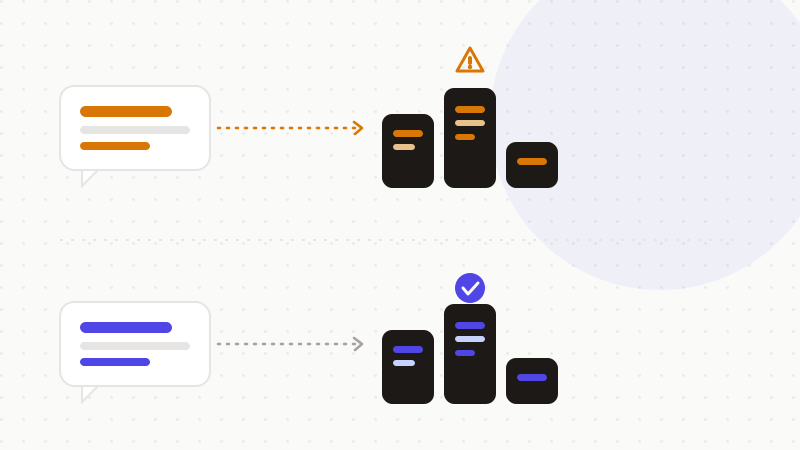
The lesson from the 5 myths is simple. No trick protects the content you send. A VPN, a subscription or a deletion all act beside the point. The only reliable measure acts on the text itself. Remove sensitive data before it leaves your screen.
- Opt out of training: it's good hygiene, not a guarantee.
- Don't rely on a VPN, temporary chat, or the “delete” button.
- Remove names, emails, identifiers and secrets before sending.
- For truly sensitive data, anonymize it at the source.
That's what ONYRI Sanitize is for. The engine replaces sensitive data with reversible tokens before sending. Detection and the token↔value mapping stay in your browser. Only anonymized text reaches the model. Whatever myth you believed, the chatbot finds only tokens — not your real information.
Frequently asked questions
- What are the biggest AI privacy myths?
- Five come up again and again. A VPN makes ChatGPT private (it hides the IP, not the content). Paying protects your data (consumer plans train by default). Deleting erases everything (a court order can prevent it). Temporary chat is invisible (kept up to 30 days). And “I have nothing to hide” (a recognized fallacy). The only reliable fix: anonymize before you send.
- Does a VPN make ChatGPT private?
- No. A VPN masks your IP address and encrypts your connection in transit. But ChatGPT has no end-to-end encryption. So the content of your prompts stays visible to OpenAI, VPN on or off. A VPN hides your location, not what you type.
- Does paying for ChatGPT make my data private?
- No, not by default. On consumer Free, Plus and Pro plans, your conversations are used by default to train future models. You must switch off the “Improve the model for everyone” setting yourself. Only Business, Enterprise and Education accounts are excluded by default.
Sources & references
- A VPN encrypts your traffic and hides your IP, but ChatGPT has no end-to-end encryption so OpenAI can still see your prompts — Surfshark
- Your ChatGPT data automatically trains its AI models — unless you turn off this setting (Free and Plus train by default) — TechRadar
- You May Have “Nothing to Hide” But You Still Have Something to Fear — American Civil Liberties Union (ACLU)
Keep your sensitive data in your browser
ONYRI Sanitize detects and masks your sensitive data before it reaches the AI, then restores the answer — from names to API keys.