Can You Put Your Medical Records in ChatGPT?
Technically yes, but these are your health data, among the most sensitive there are. Anonymize them first just to understand a term.
Technically, yes: nothing stops you from pasting a lab result, a report or a prescription into ChatGPT. But these are your health data. They are among the most sensitive data there are. A consumer AI is not a care setting. It is not a doctor either. It can get things wrong. The right approach is simple. To understand a term, anonymize first. For real advice, consult a professional.
The short answer
No one will stop you as you paste your blood test. The tool will answer. But the question isn't « is it doable ». It is « is it wise ». Your health data are a category apart. Handing them to a consumer AI takes them out of the care setting. Yet for most needs, you don't have to reveal your identity. Understanding a word doesn't depend on who you are.
The problem: health data isn't data like any other
A medical report mixes several kinds of information. Some are neutral. Others identify you directly. Here is what a health document often contains:
- Your identity: name, first name, date of birth.
- Numbers: social security, patient file, laboratory identifier.
- The practitioner's name and the care facility.
- The medical content itself: results, diagnosis, treatment.
That last point is the heart of the matter. The medical content reveals your state of health. That is exactly what the law protects most. And a consumer AI needs none of these details to explain a term to you.
The stakes: where your health data goes once pasted
Once sent, your document enters the AI provider's processing. It can be kept for some time. Depending on the offering, it may also help improve the model. You lose control over its lifespan. None of this falls under medical confidentiality. That framework protects the exchange between you and your carer. It doesn't follow your text into an AI.
There is a second stake, even more concrete. A consumer AI is not a health professional. It produces a plausible answer, not a reliable diagnosis. It can get things wrong, downplay or dramatize. To understand a word, it is a useful tool. To decide on a treatment, no.
| Criterion | Record with your doctor | Record pasted into a consumer AI |
|---|---|---|
| Setting | Medical confidentiality | Third-party processing, outside care |
| Purpose | Care, precise | Vague, often just explaining text |
| Reuse | Framed by law | Varies by offering (training possible) |
| Reliability of the advice | Health professional | Plausible answer, not a diagnosis |
« I just want to understand my results »
That is a legitimate wish, and the answer is yes. You can ask an AI what a term means. But on an anonymized version. Explaining a word doesn't depend on your name. It depends neither on your date of birth, nor on your file number. Remove these details, keep the medical question, and you get the same explanation. Without exposing who you are.
The fix: anonymize first, consult next
The steps come down to a few simple reflexes. They greatly reduce your data's exposure, without cutting you off from AI.
- 1Remove what identifies you: name, first name, date of birth.
- 2Remove the numbers: social security, patient file, laboratory identifier.
- 3Remove the practitioner's and the facility's name.
- 4Keep only the term or result you want to understand.
- 5For any decision, consult a health professional: only they make a diagnosis.
A tool can do this sorting for you. That is what ONYRI Sanitize is for. The engine spots the identifying data and replaces it with tokens before sending.
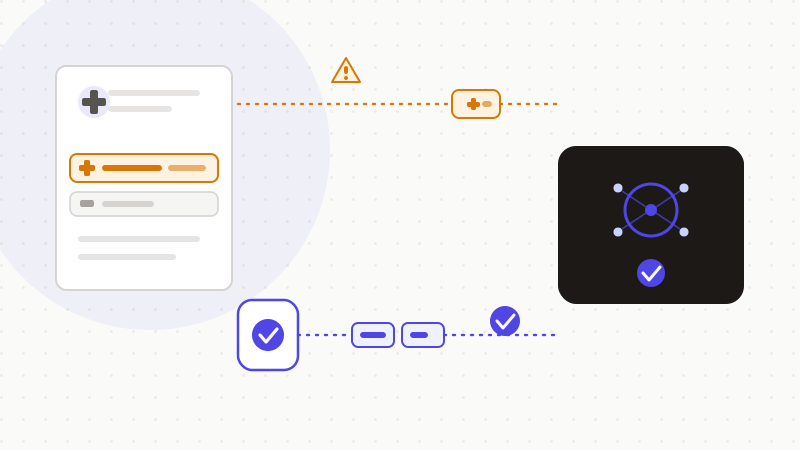
The engine detects the identifying data and replaces it with a reversible token before sending. Detection and the token↔value mapping stay in your browser. Only anonymized text reaches the AI. This minimization lowers the risk: it doesn't make a use « 100% safe », and it never replaces a doctor's advice. But it lets you understand a term while keeping control of what matters — your identity and your state of health.
Frequently asked questions
- Can you put your medical records in ChatGPT?
- Technically yes, but these are your health data, among the most sensitive there are. According to the CNIL, they form a special category under the GDPR (Article 9). A consumer AI is neither a care setting nor a doctor. To understand a term, anonymize the document first. For real advice, consult a health professional.
- Can I just ask an AI to explain my results?
- Yes, but on an anonymized version. Explaining a medical term doesn't depend on your identity. Remove the name, date of birth, numbers and the practitioner's name. Keep the medical question. You get the same explanation without exposing who you are. For any decision, a professional's advice remains necessary.
- Why are health data so heavily protected?
- The CNIL classes health data among sensitive data, alongside political opinions, religious beliefs or biometric data. The GDPR makes it a special category (Article 9). Its processing is prohibited in principle, save for limited exceptions such as explicit consent. That is why it is best not to hand it to a consumer AI.
Sources & references
Keep your sensitive data in your browser
ONYRI Sanitize detects and masks your sensitive data before it reaches the AI, then restores the answer — from names to API keys.