Can You Put Your Resume in ChatGPT?
Yes, but a resume packs your personal data: name, contacts, career history. Anonymize the identifiers before pasting it into an AI.
Yes, you can paste your resume into ChatGPT: nothing stops you technically. But a resume is a condensed set of personal data. It gathers your name, your address, your email and your phone number. It maps out your whole career. Sometimes it adds a birth date or a photo. Pasting it as is exposes all of that at once. Two situations come up. Either it's your resume, and it's your data. Or you're screening a candidate's resume, and you become a data controller. In both cases, one simple fix exists: anonymize the identifiers before the prompt.
What a resume really contains
A resume looks harmless. In reality, it's a full identity sheet. Under the GDPR, this information is personal data. Here it is, gathered on a single page:
- Your first and last name, in the clear at the top of the page.
- Your contact details: postal address, email and phone number.
- Your career: employers, dates, degrees and skills.
- Sometimes a birth date, a photo or a family situation.
Pasted as is, this block leaves for the AI in one go. You aren't sending a sentence to reword. You're sending your entire identity.
Two cases: your resume or a candidate's
The risk isn't the same depending on your role. Let's separate the two cases. First case: it's your resume. It's your data, and you use it freely. But it still enters the AI provider's processing. Depending on the offering, the content can be stored. It may also help improve the model. You lose control over its lifespan.
Second case: you're a recruiter screening resumes. Here, you handle someone else's data. You become a data controller under the GDPR. The CNIL then stresses minimization. In recruitment, you only process data useful to the role. It even served formal notice on a company that collected unjustified candidate data. Pasting a whole resume into an AI goes the other way. You transmit far more than needed.
| Criterion | Your own resume | A candidate's resume (recruiter) |
|---|---|---|
| Who decides | You, for your own data | You, as a GDPR data controller |
| Exposed data | Your identifiers | A third party's identifiers |
| Key risk | Retention and reuse by the AI | Automated decision (GDPR Art. 22) |
| Reflex | Anonymize before the prompt | Anonymize + keep the human deciding |
« I just want to improve the wording »
That's the most common use, and it's legitimate. You want the AI to correct, translate or tailor your resume to an offer. Good news: it does that very well on an anonymized resume. Form, style and structure don't depend on your name. Nor on your phone number. The AI improves the phrasing without seeing your identity. You keep the benefit, without the needless exposure.
The fix: anonymize the identifiers before the prompt
The fix comes down to one idea. Replace the identifiers with tokens before sending. The AI then works on a neutralized resume. You keep the mapping on your side. Here is the process to follow:
- 1Spot the name, address, email and phone number on the resume.
- 2Replace each identifier with a neutral, consistent token.
- 3Send the anonymized resume to the AI, then ask for your improvement.
- 4Put your real contact details back into the final version, at home.
- 5If you're hiring, let a human make the final decision.
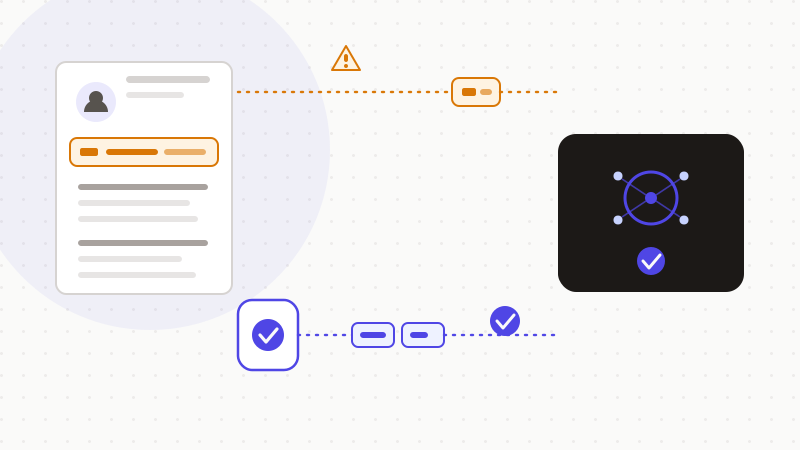
That's what ONYRI Sanitize does. The engine spots the name and contact details, then replaces them with reversible tokens before sending. Detection and the token↔value mapping stay in your browser. Only an anonymized resume reaches the AI. This minimization reduces your data's exposure. It doesn't by itself make a use « 100% compliant » or « without any risk ». For recruiters, it doesn't replace your data-controller obligations. But it keeps you in control of what matters: people's real identity.
Frequently asked questions
- Can you put your resume in ChatGPT?
- Yes, technically. But a resume is a condensed set of personal data: name, contacts, career history, sometimes a birth date and photo. Pasting it as is exposes all of that to the AI's processing. The safe reflex: anonymize the name and contact details before the prompt. The AI then improves the form without seeing your identity.
- Can a recruiter screen resumes with an AI?
- Yes, but with safeguards. By screening resumes, the recruiter becomes a data controller under the GDPR. According to the CNIL, Article 22 grants the right not to be subject to a solely automated decision. A human must be able to review the situation. The rule: keep a human in the decision and minimize the data you transmit.
- How do I improve my resume with AI without exposing my data?
- By anonymizing the identifiers before sending. Replace the name, address, email and phone number with tokens. The AI corrects, translates or tailors the form on that neutralized resume. You then put your real contact details back into the final version, at home. The wording doesn't depend on your identity.
Sources & references
- Profiling and fully automated decisions: the right not to be subject to a solely automated decision (GDPR Art. 22) and human intervention — CNIL
- Recruitment: the CNIL serves formal notice on a company to minimize the collection of candidate personal data — CNIL
- General Data Protection Regulation (GDPR) — consolidated text (Art. 5 minimization, Art. 22 automated decisions) — EUR-Lex (European Union)
Keep your sensitive data in your browser
ONYRI Sanitize detects and masks your sensitive data before it reaches the AI, then restores the answer — from names to API keys.