Reversible Anonymization: Use AI While Reducing Your Data's Exposure
Reversible anonymization swaps your sensitive data for tokens before the AI, then restores the real values on your side. The model never sees them.
Reversible anonymization replaces each sensitive value with a unique token before it reaches the AI. The mapping between the token and the real value stays on your side. After the model answers, you restore the real values. The result: the AI keeps its full meaning, but the real values don't leave. You keep the tool's usefulness. And you greatly reduce your data's exposure.
Reversible anonymization, in plain terms
The idea has three steps. One: we spot the sensitive data in your text. Two: we replace each value with a neutral token, for example [CLIENT_1]. Three: we keep a token↔value mapping. That table lives on your side, never with the AI provider. You send the text with tokens. The model replies with those same tokens. You swap them back for the real values on arrival. It's reversible: nothing is lost.
Why this beats deleting
The first instinct is often to erase. You cross out the name. You delete the number. But this method breaks the meaning. The AI no longer knows what you're talking about. A text full of holes gives a vague answer.
The reversible token avoids that trap. Let's compare the two approaches:
- Deleting breaks the thread: the AI loses context and answers off the mark.
- Deleting is final: the removed value can't come back into the answer.
- A token keeps consistency: the same client keeps the same token across the text.
- A token can be restored: you bring the real values back in the final answer.
The GDPR nuance, in full honesty
Let's be precise about the words. According to the CNIL, anonymization makes identification impossible, and in an irreversible way. Truly anonymous data then falls outside the scope of the GDPR. But a reversible token keeps a mapping. So you can go back to the real value. In strict GDPR terms, this is pseudonymization, not anonymization.
The difference matters. Pseudonymization (identifiers replaced by aliases, but reversible) remains personal data. It stays subject to the GDPR. So we will never say your data becomes « anonymous under the GDPR ». That would be false.
| Approach | Reversible? | GDPR status | AI keeps the meaning? |
|---|---|---|---|
| True anonymization | No, irreversible | Falls outside the GDPR (CNIL) | Often no, everything is stripped |
| Reversible token (pseudonymization) | Yes, mapping on your side | Remains personal data | Yes, consistency is kept |
| Manual deletion | No, the data is lost | Depends on what remains | No, the text has holes |
How ONYRI applies reversible anonymization
ONYRI Sanitize does this work in your browser. The engine spots the sensitive data, then replaces it with reversible tokens. The mapping stays in memory, client-side. Here's the flow:
- 1The engine detects the sensitive data: built-in detectors plus your custom rules.
- 2Each value is replaced with a token that's unique and consistent across the text.
- 3You send the tokenized text to the AI, via the web app (Text, Tables, Chat) or the browser extension.
- 4On the answer, ONYRI de-tokenizes client-side: the tokens become your real values again.
The mapping table never reaches any ONYRI server. A Free plan serves as an entry point to test the product. The Pro and Team plans add custom rules and volumes. To clarify the terms, read our comparison of anonymization, pseudonymization and tokenization.
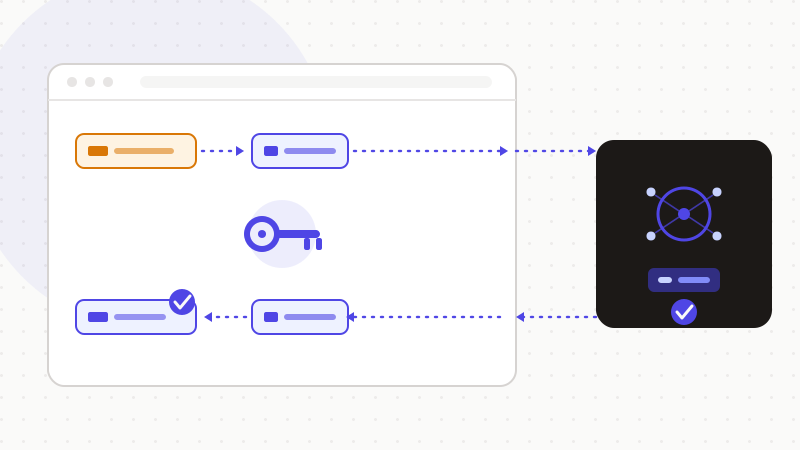
Reversible anonymization offers a real balance. You keep the AI's usefulness. You keep your real values close at hand. Let's state the limit, in full honesty: this method is pseudonymization, not anonymization in the strict sense. It greatly reduces exposure, without making it zero. But it hands you control over what matters: your real data, which stays in your browser.
Frequently asked questions
- What is reversible anonymization for using AI?
- It's a method that replaces each sensitive value with a unique token before sending your text to the AI. The token↔value mapping stays on your side. You get the model's answer back, then you restore the real values. The AI keeps the meaning of the text, but it only ever sees tokens. This greatly reduces your data's exposure.
- Does a reversible token make my data anonymous under the GDPR?
- No, and it's important to be honest here. According to the CNIL, anonymization is irreversible: once anonymous, data falls outside the GDPR. A reversible token keeps a mapping, so you can go back to the real value. In strict terms, this is pseudonymization, which remains personal data subject to the GDPR. The real benefit isn't the word: it's that the real values never reach the model.
- Why not simply delete the sensitive data?
- Because deleting breaks the meaning. The AI loses context and answers off the mark. Deletion is also final: the removed value can't come back into the answer. A reversible token, by contrast, keeps the text consistent and lets you put everything back afterwards. You keep the AI's usefulness without handing it your real values.
Sources & references
Keep your sensitive data in your browser
ONYRI Sanitize detects and masks your sensitive data before it reaches the AI, then restores the answer — from names to API keys.
Anonymize my prompt