Can You Put a Payslip in an AI Tool?
Technically yes, but it's risky: a payslip is one of the most identifying documents. Anonymize the name, social security number and address first.
Technically, yes: nothing stops you from pasting a payslip into an AI tool. But it's one of the most identifying documents there is. On a single page, it gathers your name, your address, your salary, your taxable net pay, and most often your social security number. Sometimes even an IBAN (bank account identifier). Pasting it as-is into a consumer AI exposes that whole block at once. The good practice: remove your identifiers first, then ask your question.
What a payslip really contains
Many people think a payslip is “just harmless numbers.” That's wrong. It's a concentrate of personal data. In France, according to service-public.gouv.fr (fact sheet F559), several items are mandatory. You find the employee's name and job, the employer's name and address, and the SIRET number. Then come the gross pay, the net payable, the net before tax and the amount of income tax withheld at source.
On top of those items sits what makes the document so sensitive. Nearly every real payslip carries the social security number (the NIR), and often the employee's address. One document, several identities crossed together.
- The employee's name and job (mandatory item).
- The employer's name and address, plus the SIRET number (mandatory item).
- Gross pay, net payable, taxable net and the tax withheld.
- In practice, the NIR (social security number) and often the employee's address.
- Sometimes an IBAN (bank account identifier) for the transfer.
Why the NIR changes everything
The NIR (social security number) is not an identifier like any other. It's a unique number that identifies a person with certainty. On that basis, France's CNIL notes that its use is strictly regulated. It may only take place in very specific cases, most often tied to social protection.
To record and use the NIR, an organization must be authorized by a specific legal text. Employers are among the few actors allowed to do so, precisely for payroll and the calculation of social contributions. That's why the NIR appears on your payslip. Mind the nuance: the NIR is not a “mandatory legal item” of the payslip. It's an authorized, common use, not a display obligation imposed by law.
Salary itself is personal data in its own right. The CNIL confirms it: pay data falls under the GDPR and the French Data Protection Act. In other words, that whole block — identity, address, NIR, salary — is protected.
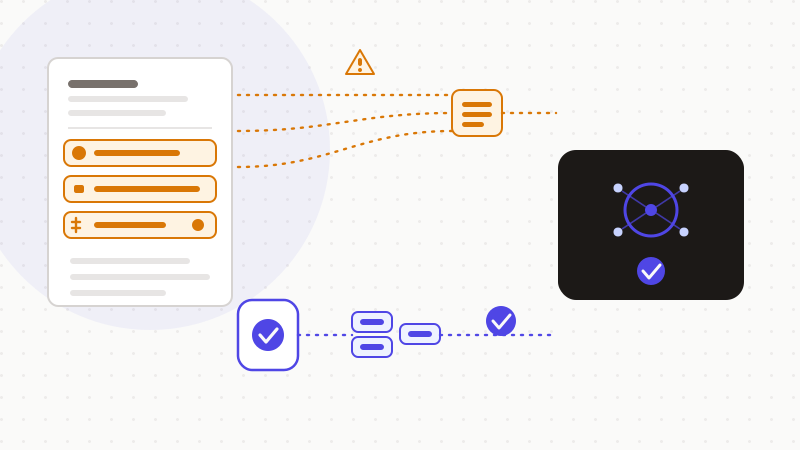
The real problem when you paste the raw payslip
When you paste a raw payslip into a consumer AI, that whole identifying block goes to the model's provider. It enters their processing, out of your control. You no longer decide what becomes of it. It isn't a fine that threatens you first: it's the exposure. Your most personal data leaves your environment for a third-party service.
Yet the useful information you're after doesn't depend on your identity. Understanding a contribution line or checking a taxable net pay needs neither your name, nor your NIR, nor your address. Those identifiers add nothing to the answer. They only increase the risk.
The fix: anonymize before the prompt
You don't have to give up AI to understand your payslip. The solution takes one step: remove the identifiers before you send the text. Here's the order to follow.
- 1Spot the identifiers: name, NIR (social security number), address, IBAN (bank account identifier).
- 2Replace them with neutral tokens, on the browser side, before any send.
- 3Send the AI the anonymized text: it only sees tokens, never your real values.
- 4Read the answer: the explanation stays useful, because it never depended on your identity.
That's the role of ONYRI Sanitize. The engine detects the name, the NIR, the address and the IBAN, then replaces them with reversible tokens. Detection and the token↔value mapping stay in your browser. Only anonymized text reaches the AI. An honest caveat: anonymizing lowers the risk and supports data minimisation. It is not on its own a “100% compliant” label or “zero risk.” It's a solid control, not a legal verdict.
| Approach | What the AI sees | Exposure level |
|---|---|---|
| Payslip pasted raw | Name, NIR, address, salary | High — it all goes at once |
| Name only deleted | NIR and address still readable | Still re-identifying |
| Anonymized before sending | Neutral tokens | Lowered — identity protected |
In practice, ONYRI lets you use the leading models on your everyday documents while keeping the real values on your device. Your payslip stays your business: the AI works on tokens, you get the explanation back, and your most sensitive data never leaves the browser.
Frequently asked questions
- Can you put a payslip in an AI tool?
- Technically yes, but it's risky. A payslip is one of the most identifying documents: name, address, salary, taxable net and most often the NIR (social security number). Pasting it raw exposes it all at once to the model's provider. The good practice is to anonymize those identifiers first, then ask your question.
- Is deleting my name enough to protect my payslip?
- No. The NIR (social security number) and the address re-identify you on their own. The NIR is a unique number that designates a person with certainty; the CNIL notes its use is strictly regulated. So you must mask the name, but also the NIR, the address and the IBAN if it appears on the payslip.
- Can the AI still explain my taxable net pay if I anonymize?
- Yes. Explaining a taxable net pay or a contribution line doesn't depend on your identity. You mask the name, the NIR and the address, then ask for the explanation: the answer stays just as useful. Anonymizing lowers the risk and supports data minimisation, without degrading the help you get.
Sources & references
Keep your sensitive data in your browser
ONYRI Sanitize detects and masks your sensitive data before it reaches the AI, then restores the answer — from names to API keys.
Anonymize my prompt