Is Meta AI Safe? What It Does With Your Data
Meta AI trains its models on public content from its platforms and on what you ask the assistant; your encrypted private messages stay excluded in principle.
Is Meta AI safe? For the most part, yes — provided you understand one distinction. Meta trains its models on the public content adults share on its platforms (public posts, comments, photos and captions) as well as on your interactions with the Meta AI assistant itself: the questions and requests you send it. Your end-to-end encrypted private messages — on WhatsApp in particular — are in principle neither readable nor used. So the tool isn't inherently dangerous; the risk comes from what you entrust to it. As long as you anonymize what you type, you stay in control.
What Meta AI actually is
Meta AI is Meta's AI assistant, built directly into WhatsApp, Instagram, Facebook and Messenger, plus a standalone app launched in April 2025. It's not a niche product: it appears in apps used daily by billions of people. That ubiquity changes the nature of the risk — many users meet the assistant without seeking it out, and the line between “messaging a friend” and “asking an AI” can blur inside the same interface.
That's exactly why vigilance helps. A private conversation and a request to the assistant aren't treated the same way, yet they live in the same place.
What Meta does with your data
Meta trains its AI models on adults' public content — public posts, comments, photos and captions — and on interactions with the assistant. In the EU, Meta announced on April 14, 2025 (“Making AI Work Harder for Europeans”) that it would resume this training on European adults' public content, after a pause decided in 2024 amid objections from regulators; training began the week of May 27, 2025. Meta relies on “legitimate interest” (Art. 6 GDPR) rather than explicit opt-in consent, citing Opinion 28/2024 of the European Data Protection Board (EDPB), issued in December 2024.
People in the EU can object to this use via an objection form (the link was sent by in-app notification and email). But the mechanism is disputed: the Austrian group noyb (founded by Max Schrems) calls it a “hidden and misleading” opt-out form, has filed complaints in 11 European countries and sent Meta a cease-and-desist letter, arguing that the GDPR requires opt-in consent rather than an objection you have to supply yourself.
The concrete risk: the “Discover” feed incident
In June 2025, the “Discover” feed in the standalone Meta AI app made public conversations that users believed were private — medical questions, legal troubles, tax matters, sensitive work emails. According to Meta, chats stay private unless you follow a multi-step process to share them; the problem was a confusing interface (a “Share” then “Post” button with a faint warning) that led many users to publish without realizing it. It wasn't a technical breach but a UX flaw — and that's precisely what makes it instructive: the data didn't leak through a hack, but because the line between private and public was poorly signposted.
Retention adds to this. The Meta AI app has a “Memory” feature that automatically extracts and stores information from conversations. Meta also says it receives device, connection and usage data, and in some countries may combine information across linked accounts in the Accounts Center (interests, age, location, profiles) to personalize responses. Yet users don't always know how long this data is kept or how it's reused.
| You assume | The reality |
|---|---|
| “Everything I type to Meta AI stays private” | Your requests to the assistant are processed and can be retained and feed the models |
| “Meta trains on my private messages” | Encrypted messages are excluded in principle; public content and assistant requests aren't |
| “The objection form settles everything” | noyb calls it hard to find; it's forward-looking only and the legal debate is open |
| “My Meta AI chats never become public” | The Discover feed made some public through a UX flaw (June 2025) |
The fix: anonymize before sending
The robust defense depends on neither an objection form you have to track down, nor a setting to switch on, nor the sometimes-blurry line between private and public: it's anonymizing sensitive data BEFORE pasting it into a consumer assistant like Meta AI. You replace names, emails, numbers, identifiers and secrets with tokens, then restore the values after the response.
- Don't treat a request to the assistant like a private message: what you send to Meta AI can be retained and used.
- Don't rely on the opt-out alone: it only covers the future and remains contested.
- Remove identities, identifiers and secrets before sending — that's the only measure that holds whatever the setting.
- 1Do the objection setting if you're in the EU: it's good basic hygiene.
- 2Before sharing, check you aren't publishing a chat (Discover feed) instead of keeping it private.
- 3For truly sensitive data, anonymize it in the prompt before it reaches the assistant.
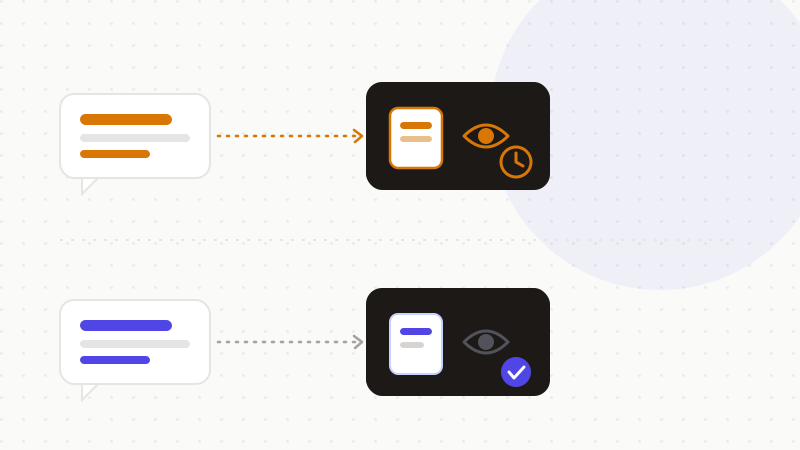
That's exactly what ONYRI Sanitize is for: the engine replaces sensitive data with reversible tokens before sending; detection and the token↔value mapping stay in your browser, and only anonymized text reaches the assistant. Whether Meta trains on the request, keeps it in memory, or an interface exposes it by accident, it only finds tokens — not your real information.
Frequently asked questions
- Is Meta AI safe with your data?
- Broadly yes, provided you understand what it processes: Meta trains its models on the public content of its platforms and on your requests to the Meta AI assistant, but in principle not on your end-to-end encrypted private messages. So the risk comes from what you type to the assistant. The reliable fix is to anonymize sensitive data before sending.
- Does Meta use my private WhatsApp messages to train its AI?
- In principle no: end-to-end encrypted messages are neither readable nor used for training — unless you explicitly mention @Meta AI or share messages with the assistant. In that case it's no longer a private conversation but a request processed by Meta, which can be retained.
- How do I stop Meta AI from using my data?
- In the EU, you can object to training on your public data via the objection form (a mechanism noyb calls hard to find, and which only applies to the future). But the safest measure, independent of any setting, is to anonymize sensitive information before sending it to the assistant.
Sources & references
- noyb — pourquoi l'entraînement de l'IA de Meta sur les données publiques des Européens enfreindrait le RGPD (intérêt légitime vs opt-in, formulaire d'objection jugé trompeur) — noyb (None of Your Business)
- TechCrunch — l'application Meta AI a publiquement exposé des conversations personnelles via son fil Discover (« privacy disaster ») — TechCrunch
- The Register — noyb adresse une mise en demeure à Meta sur l'entraînement IA des données UE (intérêt légitime, posts publics des 20 dernières années, avis EDPB déc. 2024) — The Register
Keep your sensitive data in your browser
ONYRI Sanitize detects and masks your sensitive data before it reaches the AI, then restores the answer — from names to API keys.