Is It Safe to Use AI for Legal Advice in the UK? (SRA)
Use AI to get oriented, never as a solicitor: it invents case law and your secrets get no legal privilege. Anonymise the facts before you describe your case.
Yes, but with two guardrails. Use AI to get oriented, never as your lawyer. The first risk is reliability. AI invents law. English courts have sanctioned lawyers for fake, AI-generated citations. The second risk is confidentiality. A consumer chatbot gives you no legal privilege. What you type is stored, sometimes reviewed, and can be demanded in court. The fix is one habit: anonymise the facts before you describe your situation.
AI invents law — and English judges have sanctioned it
In June 2025, the High Court ruled on two joined cases. They are Ayinde v London Borough of Haringey and Al-Haroun v Qatar National Bank. The Divisional Court handed down its judgment on 6 June 2025. It was led by Dame Victoria Sharp, President of the King's Bench Division, sitting with Mr Justice Johnson. The issue: lawyers had put fake, AI-fabricated case law before the court.
The numbers are stark. In the Al-Haroun matter, of forty-five citations, eighteen referred to cases that did not exist. In the Ayinde matter, a barrister advanced five non-existent cases. None of these authorities came from a genuine law report. The court was blunt about the tool. A generative model like ChatGPT cannot conduct reliable legal research. Its answers look coherent and plausible. They can still be entirely incorrect. It makes confident assertions that are simply untrue.
What the SRA and the Law Society expect from you
The regulator for solicitors, the SRA, published a Risk Outlook report on AI in the legal market. Its explanation is simple. A language model predicts the text that should follow your input. It has no concept of reality. That produces hallucination: the system generates a highly plausible but incorrect result. The SRA cites the exact example of AI drafting legal arguments filled with non-existent cases.
Accountability does not transfer. The SRA is firm: the solicitor stays responsible and accountable for the outputs of the AI they use. They cannot delegate that accountability to an IT team or an outside provider. The Law Society of England and Wales says the same. Solicitors and barristers remain fully accountable for AI-generated content. They face regulatory sanction if they fail to verify its accuracy. Human oversight is an ongoing duty, not a one-off check. This warning is aimed above all at small and medium-sized firms.
| You assume | The reality |
|---|---|
| “AI does my legal research” | It can invent cases that do not exist |
| “If it's wrong, that's the tool's fault” | The solicitor stays responsible — not IT, not the provider |
| “One read-through is enough” | Human oversight is an ongoing duty, not a one-off |
| “My chat with the AI is confidential” | No legal privilege covers a consumer chatbot |
A consumer chatbot won't protect your secrets
In England and Wales, a lawyer's confidentiality has a name: legal professional privilege. It protects confidential communications between a client and their lawyer. But it does not attach to what you type into a consumer chatbot. The reason is simple. The AI provider is a third party. It keeps your conversations on its servers. And under legal process, that data can be compelled to be disclosed.
The SRA flags confidentiality risks specific to AI. Staff paste client matters into public tools like ChatGPT. Confidential data is exposed when it is transferred to a provider for training. An AI can even surface one client's details in a response meant for another. The regulator's message is plain: a firm must protect sensitive information.
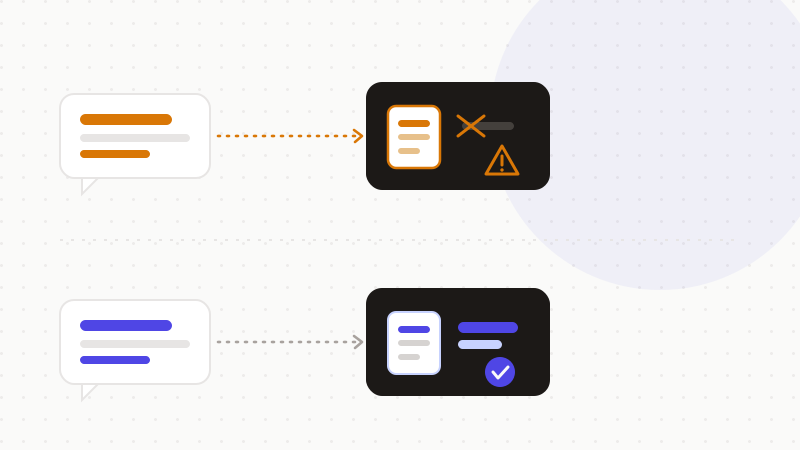
- AI can orient a question; it does not replace a solicitor.
- Check every case and quoted text against an official source.
- Your chats with a chatbot can end up in court — treat them as not confidential.
- The risk isn't only British: AI legal advice calls for the same caution everywhere.
The fix: anonymise the facts before you describe your case
You can keep AI as a useful first step. Just cut down what you hand it. Remove the identities and facts that could point to you or your file. Describe the situation in neutral terms. The AI then helps you grasp the framework. After that, a real solicitor checks the whole thing. Anonymising doesn't make the advice reliable; it only limits what leaks.
- 1Spot the identities and sensitive details in your text.
- 2Replace them with reversible tokens, in the browser.
- 3Send only the anonymized version to the AI.
- 4Have a solicitor confirm the answer before you act.
That's what ONYRI Sanitize is for. The engine detects sensitive data and replaces it with reversible tokens before sending. Detection and the mapping stay in your browser. Only anonymized text reaches the model. The AI sees only tokens — not the names, nor the facts that identify your file. You keep a useful tool for getting oriented, without handing your secrets to a third party.
Frequently asked questions
- Is it safe to use AI for legal advice in the UK?
- Not without precautions. AI can invent law: in 2025, the High Court sanctioned lawyers over fake, AI-generated citations. And a consumer chatbot offers no legal privilege. Use it to get oriented, anonymise the facts, then have a solicitor verify everything.
- Can AI cite fake court cases?
- Yes. In the Al-Haroun matter, of forty-five citations, eighteen did not exist; in the Ayinde matter, five were fictitious. The SRA calls this hallucination: the model produces a highly plausible but incorrect result. Check every citation against an official source.
- Are my ChatGPT chats covered by legal professional privilege?
- No. Legal professional privilege protects communications between a client and their lawyer, not what you type into a consumer chatbot. The provider is a third party, it stores your conversations, and legal process can compel their disclosure.
Sources & references
- Ayinde v London Borough of Haringey, and Al-Haroun v Qatar National Bank ([2025] EWHC 1383 (Admin), 6 June 2025) — Courts and Tribunals Judiciary (Judiciary of England and Wales)
- Risk Outlook report: The use of artificial intelligence in the legal market — Solicitors Regulation Authority (SRA)
- Generative AI - the essentials — The Law Society of England and Wales
Keep your sensitive data in your browser
ONYRI Sanitize detects and masks your sensitive data before it reaches the AI, then restores the answer — from names to API keys.