Is It Safe to Use AI for Restaurants?
Yes, with guardrails. A reservation is personal data (GDPR), sometimes health data; a card number falls under PCI DSS. Anonymise before the prompt.
The short answer: yes, with guardrails. AI can write your menus, your review replies and your schedules. But do not hand it your customer or staff data. A reservation ties a name to a phone, an email and a visit history. Under the GDPR (the General Data Protection Regulation), that is personal data. An allergy or dietary note can even touch on health, a protected category. A card number falls under PCI DSS. The right method is three habits. Anonymise identifiers before the prompt. Never paste a card number. Keep health notes to a minimum.
A reservation is personal data — and sometimes health data
Under the GDPR, personal data is any information tied to an identifiable person. A reservation record ticks that box. It joins a name, a phone number, an email. Often a visit history too. The business that holds it becomes the “controller”. Protecting it is the controller's job.
Some notes go further. Article 9 of the GDPR protects “special categories” of data. It covers health and religious or philosophical beliefs, among others. An allergy note reveals health data. A medical dietary restriction does too. A religious diet noted against a name can reveal a belief. This data gets heightened protection. Its processing is prohibited, unless a specific Article 9 condition applies.
Be careful not to overreach. “No onions” is an ordinary preference, not health data. The red line is what the note reveals. An allergy, a medical diet, a religious practice: there, the caution goes up a notch.
- A name and one or more contact points (phone, email).
- A history of visits and habits.
- Sometimes an allergy or medical dietary note — potentially health data.
- Sometimes a religious diet — potentially a protected belief.
Card numbers have their own rulebook: PCI DSS
Card data follows a separate framework. PCI DSS (the Payment Card Industry Data Security Standard) is not a law. It is not the GDPR either. It is a standard created by the major card brands. Visa, Mastercard, American Express, Discover and JCB. It is maintained by the PCI Security Standards Council.
PCI DSS governs how card data is protected. The card number, the cardholder name, the expiry date. Its 12 core requirements apply wherever that data is stored, transmitted or processed. They apply to any merchant that accepts cards, whatever its size. A small café that takes card payments is in scope.
Your staff and supplier data count too
The risk does not stop at customers. Your team's schedules, wages and contact details identify your employees. So they are personal data. The same controller duties apply to your staff information.
Your supplier deals deserve the same caution. A negotiated price is commercially sensitive information. Pasted into a consumer AI, it leaves your control. Keep those figures out of the prompt, or anonymise them.
Small team, consumer tools, no DPA: the risky mix
Many restaurants run with a small team. They use consumer AI tools. Often with no data processing agreement. That is a risky mix.
The ICO, the UK's data protection regulator, is clear. The law applies to organisations of any size. Sole traders and small businesses are included. There is no small-business exemption. The moment you hold personal data, you are accountable for it.
The controller carries the highest level of accountability. It decides how and why data is used. It must be able to demonstrate compliance. That covers customers and staff alike.
| What you paste | The rule that applies |
|---|---|
| A reservation list (name + contact) | Personal data under the GDPR — you are the controller |
| An allergy or medical or religious dietary note | Special category (GDPR, Article 9), heightened protection |
| A payment card number | PCI DSS — never paste it into an AI |
| An employee schedule or wage | Personal data about your team — same duties |
| A negotiated supplier price | Commercially sensitive information — keep it private |
The fix: anonymise before the prompt
Good news: AI stays useful day to day. It drafts a menu, replies to a review, shapes a schedule. For that, it needs none of the real identities. It works fine on anonymised text. The menu, the reply or the schedule logic stay correct.
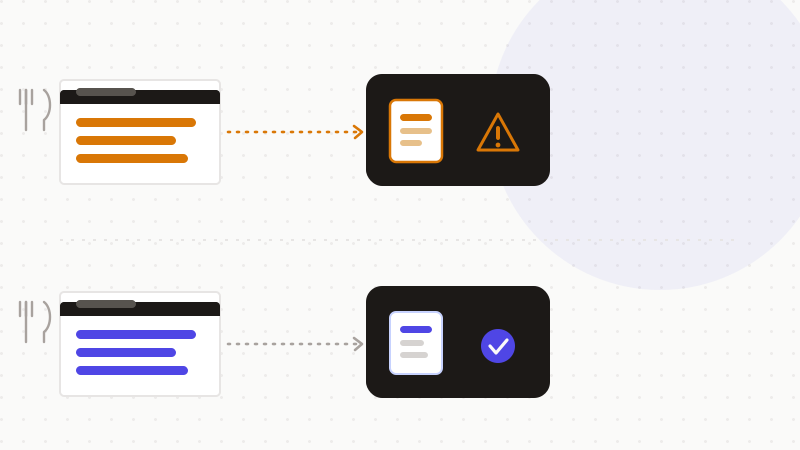
When you must include a concrete case, anonymise it first. Replace each identifier with a token. The AI reasons about the shape of your need, without seeing the real values. You restore the real values afterwards, locally.
- 1Spot the identifiers: customer names, contacts, health notes, staff data.
- 2Replace them with reversible tokens, in the browser.
- 3Never paste a card number, anywhere.
- 4Keep allergy or dietary notes to the strict minimum.
- 5Send only the anonymised text, and prefer tools covered by a DPA (data processing agreement).
That's what ONYRI Sanitize is for. The engine detects sensitive data — customer names, contacts, health notes, schedules, wages — and replaces it with reversible tokens before sending. Detection and the mapping stay in your browser. Only anonymised text reaches the model. The AI finds only tokens, never your customers' or your team's identities. You get the help, without exposing the data that the GDPR and PCI DSS ask you to protect.
Frequently asked questions
- Is it safe to use AI for restaurants?
- Yes, with guardrails. AI can write a menu, reply to a review or shape a schedule with no personal data at all. But do not paste your reservation lists, allergy notes, card numbers or staff data into a consumer chatbot. A reservation is personal data under the GDPR, sometimes health data. A card number falls under PCI DSS. Anonymise before you send.
- Is an allergy or dietary note sensitive data?
- Often, yes. Article 9 of the GDPR protects health and religious beliefs. An allergy note or a medical dietary restriction reveals health data. A religious diet noted against a name can reveal a belief. This data gets heightened protection. A plain preference like “no onions” stays ordinary personal data.
- Can I paste a card number into an AI?
- No. Card data falls under PCI DSS, the payment-card security standard. It protects the card number, the cardholder name and the expiry date wherever they travel. A consumer chatbot is not a safe place for that data. Never paste a card number into an AI, or anywhere else without protection.
Sources & references
- Regulation (EU) 2016/679 (GDPR) — full text, including Article 9 on special categories of personal data (health, beliefs) — EUR-Lex (Publications Office of the European Union)
- PCI DSS — protecting payment card data (12 requirements, any merchant regardless of size) — PCI Security Standards Council
- Advice for small organisations — data protection applies to organisations of any size, with no small-business exemption — Information Commissioner's Office (ICO), UK
Keep your sensitive data in your browser
ONYRI Sanitize detects and masks your sensitive data before it reaches the AI, then restores the answer — from names to API keys.