Is It Safe to Use AI for Libraries?
Yes for cataloguing and a general answer, no with patron records: never paste borrowing history or reference questions into a consumer AI. Anonymise first.
The short answer fits in one line. AI can help a library, but never hand it your patrons' data. It can catalogue a book or draft a general reference answer. For that, it needs no name, no borrowing history, no personal question. What a person reads is a matter of intellectual freedom. In the United States, these records are confidential by law and by professional ethic. Pasting a borrowing history or a reference question into a consumer ChatGPT cuts against that principle. There is a clean method: anonymise before you write the prompt.
What a patron record lays bare
A library handles deeply personal data. The patron's name. Their contact. Their borrowing and reading history. Their interests. And their reference questions, often intimate. A person may be researching a diagnosis, a legal crisis, or resources on abuse they suffered. That question is sensitive the moment it is asked.
One detail changes everything. Many patrons are minors. The ALA (American Library Association) is clear on this point. Minors have the same privacy rights as adults. Yet the pressure of service pushes staff to seek help fast. Sometimes from an AI, with the full record in hand.
Reading records are confidential: law and ethic
In the United States, protection rests on two pillars. First, state law. According to the ALA, 48 states plus the District of Columbia have laws that protect the confidentiality of library records. In the two remaining states, the attorney general has issued an opinion recognising that privacy. There is no single federal statute: this is a state-law right, backed by a professional ethic.
These protected records are broad. They are not limited to the list of books checked out. According to the ALA, they also cover:
- Online search histories.
- Database search records.
- Circulation records from the integrated library system (ILS).
- Interlibrary loan records.
The ethic points the same way. The ALA Code of Ethics protects a user's privacy over the “information sought or received, and resources consulted, borrowed, acquired or transmitted.” The ALA reads that line as covering reference questions, circulation records and digital interactions. The association has recognised a patron's right to privacy since 1939. This is a long-standing principle, not a passing trend.
What a reading history reveals
A borrowing history is not a plain list of titles. It can imply a person's health, their faith, their politics or their sexuality. These are highly sensitive inferences. That is also why the ALA insists: privacy must never be limited by age, religion, ethnicity, sexual orientation, gender identity, immigration status or housing status.
Data protection law reaches the same conclusion. The ICO (Information Commissioner's Office, the UK data regulator) defines “special category data.” It is sensitive data needing extra protection. That covers racial or ethnic origin, political opinions, religious or philosophical beliefs, and trade union membership. It also covers genetic, biometric and health data, and data about a person's sex life or sexual orientation.
The ICO adds a key point. An inference can itself be special category data. If you deliberately infer someone's religion, health or sexuality, that conclusion attracts the heightened protections. And that is exactly what a reading history can let you infer. This is why what a person reads is so sensitive.
| You assume | The reality |
|---|---|
| “Borrowing history is just a list” | It can reveal health, faith, politics or sexuality |
| “Library records aren't protected” | 48 states + DC have confidentiality laws (the other two via opinions) |
| “A reference question is harmless” | It is sensitive the moment it is asked (diagnosis, crisis, abuse) |
| “Minors have fewer privacy rights” | The ALA states they have the same rights as adults |
The fix: anonymise before the prompt
Good news: AI is still useful in a library. It can catalogue a book. It can suggest a general reference answer. It can help design a programme. For all of that, it needs no identifying data. Never paste a patron's name alongside their borrowing history or reference question. Treat reading records as confidential, by law and by ethic. Use vetted tools. And collect the least data possible.
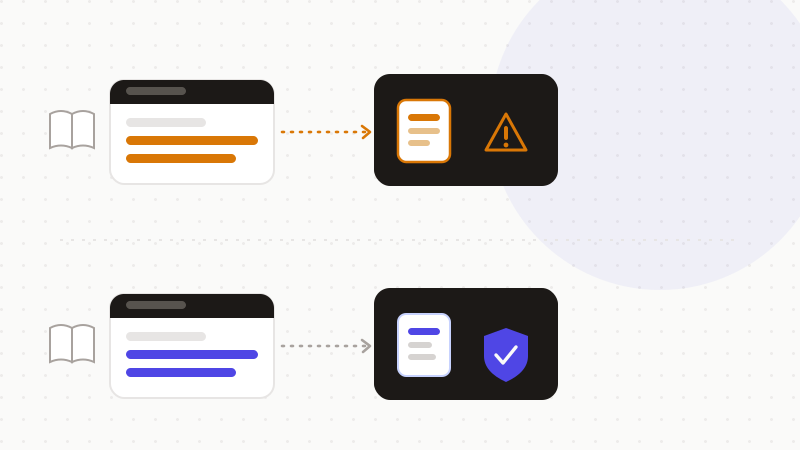
When you really must include a concrete case, anonymise it first. Replace each sensitive item with a token. The AI reasons about the shape of the request, without ever seeing the real values. You restore the real values afterwards, locally.
- 1Spot the sensitive data: name, contact, borrowing history, reference question.
- 2Replace it with reversible tokens, in the browser.
- 3Send only the anonymized text to the AI.
- 4Restore the real values in the reply, locally.
That's what ONYRI Sanitize is for. The engine detects sensitive data — patron name, contact, borrowing history, reference question — and replaces it with reversible tokens before sending. Detection and the mapping stay in your browser. Only anonymized text reaches the model. The AI finds only tokens, never the real reading records. You get the help, while keeping the confidentiality that the law and the ALA ask you to hold.
Frequently asked questions
- Is it safe to use AI for libraries?
- Yes for cataloguing and a general reference answer, no with your patrons' data. AI can help on de-identified text, with no name or history at all. But never paste a borrowing history, a reference question or a patron's contact into a consumer AI. In the United States, these records are confidential by law and by the ALA's ethic. Anonymise before the prompt.
- Why is a borrowing history so sensitive?
- Because it can imply a person's health, their faith, their politics or their sexuality. The ICO notes that a deliberate inference on those topics counts as special category data, the most protected kind. The ALA has also protected reading privacy since 1939, as a foundation of intellectual freedom.
- Are library records protected by law?
- In the United States, yes, but at the state level, not federal. According to the ALA, 48 states plus the District of Columbia have laws on the confidentiality of library records; in the other two, the attorney general has issued an opinion to that effect. These records are broad: search histories, circulation, interlibrary loan. On top of that sits the ALA Code of Ethics.
Sources & references
- State Privacy Laws Regarding Library Records (48 states + DC; records covered: online search, ILS, interlibrary loan) — American Library Association
- Privacy: An Interpretation of the Library Bill of Rights (patron right since 1939, minors, intellectual freedom) — American Library Association
- What is special category data? (sensitive data, extra protection, inference counting as special category) — UK Information Commissioner's Office (ICO)
Keep your sensitive data in your browser
ONYRI Sanitize detects and masks your sensitive data before it reaches the AI, then restores the answer — from names to API keys.