Is It Safe to Use AI for Event Planning?
AI is safe for event planning only if the raw guest list stays out of it: dietary and accessibility notes can be special-category data under the GDPR.
Using AI for event planning is safe only if you keep the raw guest list out of it. AI can build a schedule, draft vendor emails or plan seating. It does not need real names to do that. But a guest list holds more than names. It carries contact details, and often dietary and accessibility notes. Under the GDPR, a note like halal or a nut allergy can reveal religion or health. That is special-category data. Anonymise the names before you prompt, and never paste a card number.
A guest list holds more than names
Open any event guest list. You find names next to contact details. Phone numbers. Email addresses. Sometimes a home address for the invitation. On its own, that is already personal data. The GDPR protects it. You are handling other people's information, not your own.
Then come the notes. A column for meals. A column for access needs. A wheelchair space. A quiet room. A sign-language interpreter. These small notes make the list far more sensitive than it looks.
- Names and contact details — phone, email, sometimes a home address.
- Dietary notes — an allergy, or a halal, kosher or medical diet.
- Accessibility and reasonable-adjustment needs — step-free access, a quiet room, an interpreter.
- Sometimes minors — children attend weddings and family events, and their data gets extra protection.
Why dietary and access notes are sensitive
This is the part planners miss. Under GDPR Article 9, some data gets extra protection. It includes data revealing religious or philosophical beliefs. It also includes data about health. A dietary or access note can point straight at those categories.
The UK's ICO (Information Commissioner's Office) spells this out. A choice like halal or kosher can reveal a person's religion. A note about health or a disability is health data. So a guest list with allergy or access notes can hold special-category data.
The scope has limits, and that matters. A plain “vegetarian” note is weaker. Halal or kosher points to belief. “Coeliac” or “nut allergy” points to health. Special-category data needs more than a normal lawful basis. It needs a separate Article 9 condition too. Pasting the whole list into a consumer chatbot is not that.
Card numbers and deposits: a different rulebook
Events involve money. Deposits, vendor payments, refunds. So card numbers float around your inbox. Card data has its own rulebook. It is called PCI DSS (the Payment Card Industry Data Security Standard). The PCI Security Standards Council runs it, founded by American Express, Discover, JCB, Mastercard and Visa.
PCI DSS is strict about card data. You may keep it only for a genuine business or legal reason. A stored card number must be made unreadable. Sensitive authentication data — the full stripe or the security code — must never be kept after authorisation. Display is capped at the first six or last four digits for anyone without a real need.
Line that up with a chatbot prompt. Typing a full deposit card number into an AI tool breaks those rules at once. PCI DSS does not ban AI. It does forbid handling a full card number this way. The rule is simple: never paste a card number into a prompt.
| What you paste | Why it's risky | Safer move |
|---|---|---|
| Guest names + allergy or halal notes | Can be special-category data under GDPR Article 9 | Anonymise names; keep the note as an unlinked total |
| Accessibility / access needs | Health data — extra protection under the GDPR | Send counts, not named individuals |
| A deposit card number | Breaks PCI DSS rules on card data | Never paste it; handle it in your payment tool |
| Vendor or client contract terms | Commercially sensitive and often confidential | Strip names and rates before prompting |
Many hands, one event — and you are the controller
Events run on many hands. Freelancers. Temporary staff. A day-of coordinator. Mix that with consumer AI tools, and the guest list can spread fast. Here is the key point. When you collect a guest list for a client, you decide how it is used. Under the GDPR, that makes you the controller.
The responsibility sits with you, not the attendee or the client. That includes whether the list ever reaches a third-party AI. It is your call, and your accountability. Some events also include minors, whose data gets extra protection. All the more reason to keep the raw list out of the prompt.
The fix: anonymise before you prompt
You do not have to give up AI. You have to change the order. Anonymise first, then prompt. The model still builds the schedule and the seating logic. It just works on tokens instead of real names.
- 1Replace attendee names and identifiers with reversible tokens, in your browser.
- 2Keep any dietary or access detail minimal, and unlinked from real names.
- 3Send only the de-identified text to the AI.
- 4Never paste card numbers; handle deposits in your payment tool.
- 5Use vetted tools covered by a data processing agreement (DPA).
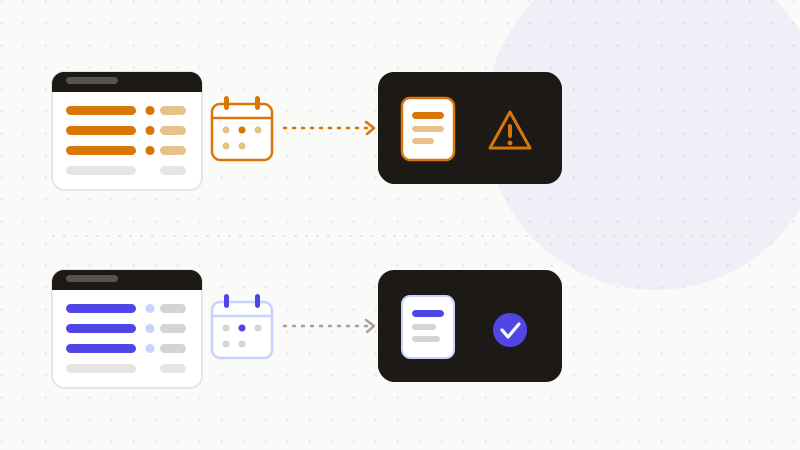
That is what ONYRI Sanitize does. The engine finds sensitive data — names, contacts, and more — and replaces it with reversible tokens before anything is sent. Detection and the mapping stay in your browser. Only anonymized text reaches the model. The AI builds your schedule or seating plan from tokens, never from a real guest list. You get the help, and your attendees keep their privacy.
Frequently asked questions
- Is it safe to use AI for event planning?
- Yes, if you keep your raw guest list out of it. AI can build schedules, draft vendor emails and plan seating from de-identified text. But a guest list carries contact details and often dietary or accessibility notes. Under the GDPR, those notes can be special-category data. Anonymise names before you prompt, and never paste a card number.
- Why is a dietary note sensitive?
- Because it can reveal protected information. Under GDPR Article 9, data about religion or health gets extra protection. A halal or kosher note can reveal religion. An allergy note can reveal health. The ICO treats such details as capable of being special-category data, so handle them with care.
- Can I paste a deposit card number into AI to sort payments?
- No. Card data is governed by PCI DSS, the payment-card security standard. It forbids keeping or freely displaying a full card number. Typing one into a chatbot prompt breaks those rules. Handle deposits in your payment tool, and keep card numbers out of any AI prompt.
Sources & references
- Regulation (EU) 2016/679 (GDPR) — Article 9, special categories of personal data (health, religious or philosophical beliefs) — EUR-Lex (Publications Office of the European Union)
- What is special category data? (dietary choices revealing religion; health and accessibility data) — Information Commissioner's Office (ICO)
- PCI DSS — Data Storage Do's and Don'ts (cardholder data, PAN, sensitive authentication data) — PCI Security Standards Council
Keep your sensitive data in your browser
ONYRI Sanitize detects and masks your sensitive data before it reaches the AI, then restores the answer — from names to API keys.