Is It Safe to Use AI for Immigration Paperwork?
Handle with care: never paste a passport, a case number, or an asylum narrative into a consumer AI. Anonymise identifying details first.
Handle this with care. Never paste a passport, a case number, or an asylum narrative into a consumer AI. AI can help you understand a rule or polish an anonymised draft. But an immigration file holds some of the most sensitive data there is. Your nationality, your status, a persecution narrative. Here, a leak is not mere embarrassment. It can threaten someone's safety. An asylum narrative is 'special category data' (Article 9 of the GDPR), the most protected class. The safe method: anonymise every identifying detail, then verify each fact against an official source like USCIS or GOV.UK.
Why this data is some of the most sensitive
Immigration is unlike other topics. Status, nationality, and especially an asylum claim touch a person's safety. A leak can expose someone to deportation risk. Or to reprisals back home. This is not an embarrassment to manage. Sometimes it is a matter of life or death.
These documents also name other people. Family members. Sponsors. Witnesses. So a careless prompt can expose intimate details about people who never agreed to it. The risk always spills beyond the person filing the case.
Special category data (Article 9)
The law sets some data apart. Under Article 9 of the GDPR, information revealing racial or ethnic origin, political opinions, religious beliefs, health, or sexual orientation is 'special category data'. It is the most protected class. An asylum narrative often bundles several of these at once.
The Information Commissioner's Office (ICO), the UK's data protection regulator, explains why. This data is singled out because a leak can create serious risks to a person's rights and freedoms, including discrimination. Handling it lawfully therefore requires extra safeguards. Pasting it into a public chatbot bypasses all of them.
AI invents law — and that is dangerous
A chatbot can fabricate legal content. It sometimes invents case citations, rules, or requirements that sound authoritative but do not exist. Courts have repeatedly sanctioned lawyers for such 'hallucinated' citations. In one Oregon federal case, two lawyers were fined 110,000 dollars. They had submitted 23 fabricated citations and eight invented quotations.
Immigration is unforgiving. A single wrong 'fact' from an AI can damage a case. A rule that does not exist. A misremembered deadline. So treat AI as a wording aid on already anonymised text. Never as a source of legal truth. Verify each point against the official source.
| What you paste | The real risk |
|---|---|
| Passport or case number (A-number in the US) | Identity and status exposed; risk of impersonation and tracking |
| Asylum or persecution narrative | Special category data (Art. 9); a risk to someone's safety |
| Names of family, sponsors, or witnesses | Exposes third parties who never gave their consent |
| A legal 'fact' produced by the AI | May be invented; one error can sink a case |
A chatbot is not a regulated adviser
A general-purpose AI is not a regulated immigration adviser. In several countries, giving immigration advice is itself a regulated activity. A chatbot's output carries no professional accountability and no confidentiality. For anything consequential, a qualified, regulated adviser is the right route. Use the official channels too.
Before any prompt, remove the details that identify a person.
- Passport, visa, case number, or A-number (the alien number in the US).
- Names, dates of birth, and nationalities — yours and those of your relatives.
- The persecution or asylum narrative, and any medical, religious, or political detail.
- Addresses, biometric identifiers, and the contact details of witnesses or sponsors.
The fix: anonymise, then verify
AI is still useful, if you frame it well. It can explain a rule in general terms. It can tighten the wording of an already anonymised draft. For that, it needs no real detail. Keep the names, the dates, and the identifiers out of the prompt.
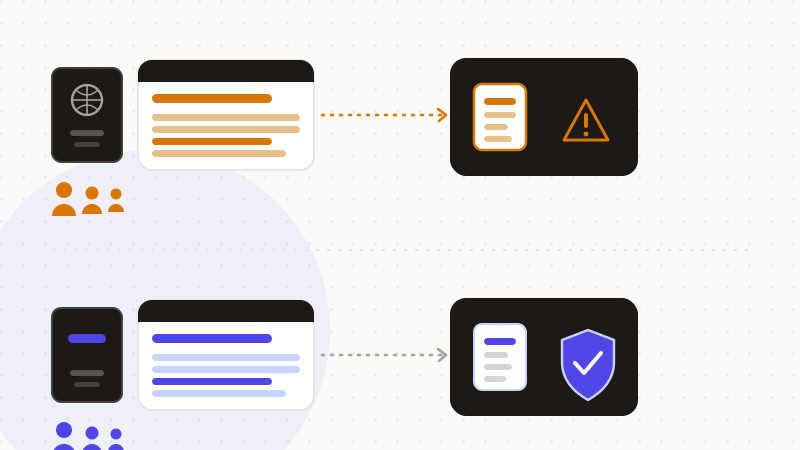
When you must include a concrete case, anonymise it first. Replace each identifier with a token. The AI reasons about the shape of the situation, without ever seeing the real values. You restore the real values afterwards, locally. Then you verify each fact at the source.
- 1Spot the sensitive data: passport, case number, names, narrative.
- 2Replace it with reversible tokens, in the browser.
- 3Send only the anonymized text to the AI.
- 4Verify each legal fact against the official source (USCIS, GOV.UK).
- 5For anything consequential, consult a regulated adviser.
That's what ONYRI Sanitize is for. The engine detects sensitive data — passport, case number, names, nationalities, narrative — and replaces it with reversible tokens before sending. Detection and the mapping stay in your browser. Only anonymized text reaches the model. It finds only tokens, never a person's real identity. For anything consequential, ONYRI does not replace a regulated adviser or verification with USCIS or GOV.UK. It simply keeps the most sensitive substance out of the prompt.
Frequently asked questions
- Is it safe to use AI for immigration paperwork?
- Only with great care. AI can explain a rule in general terms or improve an already anonymised draft. But never paste a passport, a case number (A-number), or an asylum narrative into a consumer AI. This data touches a person's safety. Anonymise every identifying detail, verify each fact against an official source like USCIS or GOV.UK, and see a regulated adviser for anything consequential.
- Can I paste an asylum narrative into ChatGPT?
- No. An asylum narrative often bundles special category data under Article 9 of the GDPR: ethnicity, religion, political opinion, health, sexual orientation. The ICO notes this is the most protected class of data. A leak can expose a person to real danger. Describe the situation in anonymised terms, without the names or identifying details.
- Can AI get an immigration rule wrong?
- Yes, and that is dangerous. A chatbot can invent rules, deadlines, or case citations that sound authoritative but do not exist. Courts have sanctioned lawyers for such fabricated citations. Immigration is unforgiving: a single wrong fact can damage a case. Always verify at the official source and consult a regulated adviser.
Sources & references
- Special category data — guidance on Article 9 data (racial/ethnic origin, religion, political opinion, health, sexual orientation) — Information Commissioner's Office (ICO)
- Claim asylum in the UK — official eligibility grounds and process (persecution based on race, religion, nationality, political opinion or social group) — GOV.UK (UK Government)
- Why lawyers keep citing fake cases invented by AI — courts have sanctioned lawyers for hallucinated citations — Scientific American
Keep your sensitive data in your browser
ONYRI Sanitize detects and masks your sensitive data before it reaches the AI, then restores the answer — from names to API keys.