Is It Safe to Use AI for Hotels and Hospitality?
Yes for drafting and replies, no with the guest record. Never paste a passport, card number or health request into a consumer AI chatbot.
The answer fits in one line. AI can help you write and reply, but never hand it the raw guest record. A hotel booking is identity and location data. It ties a name to a passport or an ID. It adds a payment method. And it shows which room, which nights. Pasted into a consumer ChatGPT, that record can be retained, reviewed or reused. A card number sits under its own standard, PCI DSS. A passport is the identity-theft jackpot. The fix exists: anonymise names and identifiers before the prompt.
What a guest record lays bare
A booking record is one of the most concentrated pieces of data there is. It pulls identity, an official document, a payment and a location into one place. The guest's name. Their passport or ID. Their payment card. Their room and stay dates. Taken together, these lines say who sleeps where, and on which nights.
Hotels hold a lot of it. Many countries require you to collect ID at check-in. So the hotelier builds up scans of passports and identity cards. That is exactly what fraudsters want. Hospitality is also a known target: guest data leaks are common and costly.
AI is tempting for speed. Draft a welcome message. Reply to an online review. Write a promo. Sort special requests. The reflex is to paste the whole record. That is where the risk starts.
Passport and ID: the identity-theft jackpot
A passport or national ID number links a real person to official documents. That is precisely what is used to commit identity theft. The Federal Trade Commission (FTC, the US consumer protection agency) runs IdentityTheft.gov. It is the federal one-stop resource to report identity theft and recover from it.
Because many countries require hotels to collect ID at check-in, the hotel stores exactly the identifiers criminals want. Never paste a scan or an ID number into a consumer AI. That move pulls the document out of a controlled setting. It exposes it to retention and review beyond your control.
Payment card data: PCI DSS applies
Card data follows its own rules. PCI DSS (the Payment Card Industry Data Security Standard) is the security standard for payment card data. It is maintained by the PCI Security Standards Council. It sets baseline controls for any organisation that stores, processes or transmits card data. A hotel taking card payments is one of them.
Pasting a card number into a consumer chatbot moves that data out of the protected zone. PCI DSS calls that zone the cardholder-data environment. Outside it, the controls no longer apply. The rule is simple: a card number should never enter a general-purpose AI tool.
Special requests can reveal special-category data
Under the GDPR (the European Union's General Data Protection Regulation), a name, passport number, room, dates and payment method are personal data. Article 9 defines a stricter, 'special' category. It covers health, religious or philosophical beliefs, and racial or ethnic origin. Its processing is prohibited unless a specific exception applies, such as explicit consent.
A hotel special request can reveal this data without looking like it. A wheelchair-accessible room or a medical-diet note can indicate health data. A halal, kosher or Lenten meal can indicate a belief. An anniversary or honeymoon note can reveal family status. These signals deserve the higher protection.
Article 9 protection is cumulative. Processing it lawfully needs an Article 6 lawful basis, plus a separate Article 9 condition. Guidance from the ICO (the UK data protection authority) points the same way. Data that 'reveals' a belief or health, such as a diet tied to faith, is special category. The label attaches to what the data implies, not only to what it plainly says.
| Record field | The risk | The right move |
|---|---|---|
| Guest name | Ties everything else to a real person | Replace with a token before the prompt |
| Passport / ID | Identity-theft jackpot (FTC) | Never paste a scan or a number |
| Card number | Leaves the PCI DSS perimeter | Never enter it in a general AI |
| Special request | Can reveal health or belief (Article 9) | Keep minimal and unlinked from the name |
The fix: anonymise before you send
Good news: AI is still useful for a hotel. It can draft a welcome message. It can reply to a review. It can write a promo. For that, it needs no real identifier. It works fine on de-identified text. You keep the name, passport, card and room out of the prompt.
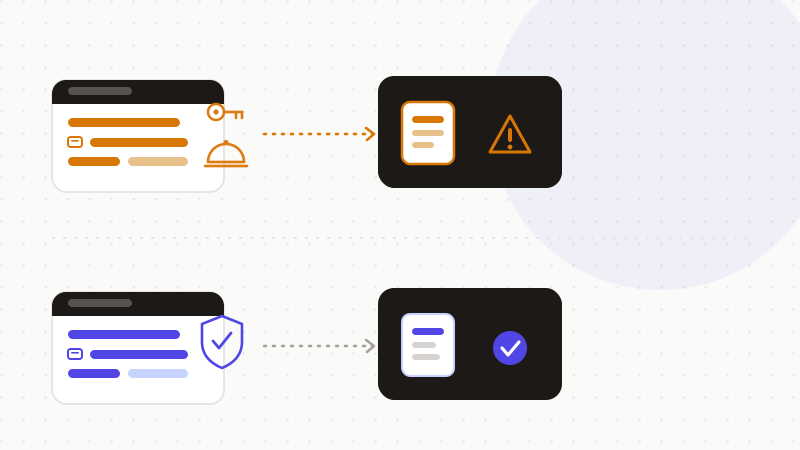
When a concrete case is truly needed, anonymise it first. Replace each identifier with a token. The AI reasons about the shape of the request, without seeing the real values. You restore the real values afterwards, locally.
- Anonymise guest names and identifiers before writing the prompt.
- Never paste a passport, an ID or a card number.
- Keep special-category requests minimal and unlinked from the name.
- Restrict real guest data to vetted tools covered by a data processing agreement (DPA).
- 1Spot the identifiers: name, passport, card, room, dates.
- 2Replace them with reversible tokens, in the browser.
- 3Send only the anonymized text to the AI.
- 4Restore the real values in the reply, locally.
That's what ONYRI Sanitize is for. The engine detects sensitive data — name, passport, card, room, dates — and replaces it with reversible tokens before sending. Detection and the mapping stay in your browser. Only anonymized text reaches the model. The AI finds only tokens, never your guests' real identity. You get the help, without the leak risk hospitality knows too well.
Frequently asked questions
- Is it safe to use AI for hotels and hospitality?
- Yes for drafting and replies, no with the raw guest record. AI can write a welcome message, answer a review or draft a promo with no real data at all. But never paste a name, a passport, a card number or a health request into a consumer AI. Card data falls under PCI DSS, a passport feeds identity theft, and a special request can reveal GDPR Article 9 data. Anonymise before you send.
- Can I paste a passport scan or a card number into ChatGPT?
- No. A passport or ID links a person to official documents; that is what fuels identity theft, as the FTC notes. A card number follows the PCI DSS standard and must stay in a controlled perimeter. These three must never enter a consumer chatbot. The AI does not need them to help you.
- Can a guest special request be sensitive data?
- Yes, sometimes. Under the GDPR, Article 9 protects data on health, belief or origin. An accessible room or a medical diet can reveal health. A halal, kosher or Lenten meal can reveal a belief. Keep such requests minimal, unlinked from the name, and out of a consumer AI.
Sources & references
- PCI DSS — Payment Card Industry Data Security Standard (official standard page) — PCI Security Standards Council
- Regulation (EU) 2016/679 (GDPR) — full text including Article 9 on special categories of personal data — EUR-Lex (Publications Office of the European Union)
- Identity Theft — how ID and document theft happens and how to recover — U.S. Federal Trade Commission (Consumer Advice)
Keep your sensitive data in your browser
ONYRI Sanitize detects and masks your sensitive data before it reaches the AI, then restores the answer — from names to API keys.