Is It Safe to Use AI for Funeral Homes?
Yes on de-identified text: AI can help word an obituary or letter, but never paste the family's names, finances or insurance into a consumer AI.
Here is the honest answer. AI can help you with the words. It should never see the family's private details. A funeral home handles uniquely sensitive data at a painful moment. The deceased's identity. The next-of-kin and family contacts. Financial and insurance arrangements. Religious or cultural wishes. Pasted into a consumer AI, these can be retained, reviewed or reused for training. There is a kind and safe method: de-identify names and identifiers first, and never paste financial or insurance records at all.
The data a funeral home holds
Bereavement paperwork gathers a lot in one place. You record the deceased's identity and death details. You collect the next-of-kin and family contacts. You note payment, insurance and estate arrangements. You capture religious or cultural wishes for the service. Each item is sensitive on its own. Together, they paint a full picture of a grieving family.
Most of this concerns living people. The next-of-kin. The relatives named in an obituary. The person paying the invoice. An obituary alone can reveal survivors' names, home town and family relationships. That is real personal data about the living.
The nuance on the deceased
Here the law is precise, so we will be too. The GDPR (General Data Protection Regulation) protects living people. The ICO (the UK's Information Commissioner's Office) says data protection law does not apply to the deceased. So the departed person generally sits outside the GDPR.
But two things keep the duty high. First, some EU member states add national rules that protect the deceased for a set period. Coverage varies by country. Second, the moment a relative or family contact is named, that living person's data is fully protected. Never assume a dead person's details are free to paste anywhere.
Belief data is special category
Religious or cultural wishes deserve extra care. Under the GDPR, religious or philosophical beliefs are 'special category' data. The ICO lists them among the categories the law singles out for stronger protection. This matters when a wish reveals a living relative's beliefs. A family's faith-based burial choice is special category data about them, not just a service note.
The special-category list is broader than religion alone. It also covers racial or ethnic origin, health data, and more. Bereavement paperwork can capture these by accident. A cause-of-death note may reveal health context. A cultural preference may reveal ethnic origin. Handle the whole file with that in mind.
| The data | Why it needs care |
|---|---|
| Names of surviving relatives | Living-person personal data, fully covered by the GDPR |
| Religious or cultural wishes | Special category when they reveal a living relative's beliefs |
| Bank, insurance or estate details | Ordinary personal data, and a classic identity-theft target |
| The deceased's own details | Largely outside the GDPR, but some countries add rules — treat with care |
Financial and insurance data is a fraud target
Grief and money make a dangerous pair. The information families hand you is exactly what identity thieves seek. The FTC (the US Federal Trade Commission) defines identity theft as someone using your personal or financial information without permission. Bereavement scams exist for this reason. Insurance and payment details attached to an estate are a direct target.
The FTC names what thieves go after.
- Names and addresses.
- Credit card and bank account numbers.
- Social Security numbers and similar national identifiers.
- Medical insurance account numbers.
Estate and insurance paperwork often holds several of these at once. A general AI tool is the wrong place to put any of them.
The fix: anonymise before you send
The good news brings some relief. AI can still help you serve families well. It can structure an obituary. It can shape the tone of a condolence letter. It can tidy an arrangement summary. For all of this, it works fine on de-identified text. Replace the names and identifiers with placeholders first.
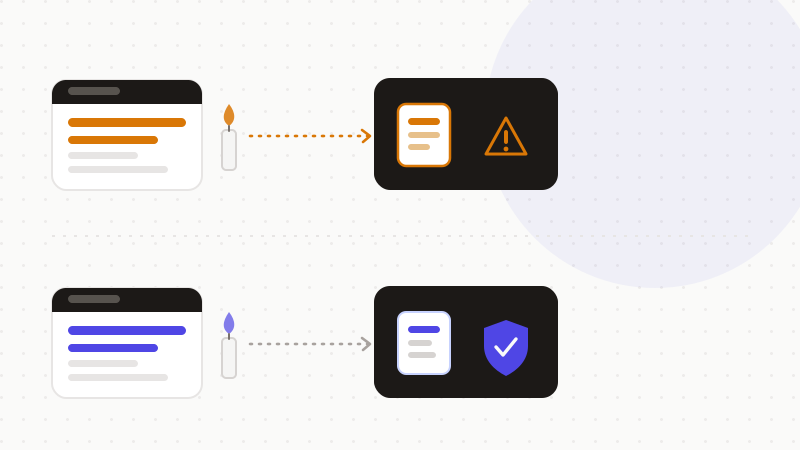
Two simple rules keep you safe. Anonymise the family's names and identifiers before the prompt. And never paste financial, insurance or bank records into a general AI tool at all. The deceased's details deserve consent and care too, even where the statute is quiet.
- 1Spot the sensitive items: family names, contacts, beliefs, financial and insurance details.
- 2Replace names and identifiers with reversible tokens, in the browser.
- 3Keep financial and insurance records out of the prompt entirely.
- 4Send only the de-identified text to the AI, then restore the real names locally.
That is what ONYRI Sanitize is for. The engine detects sensitive data — family names, contacts, beliefs, financial and insurance details — and replaces it with reversible tokens before sending. Detection and the mapping stay in your browser. Only de-identified text reaches the model. You get help with the wording, while the grieving family's data stays private. Care and confidentiality, kept together.
Frequently asked questions
- Is it safe to use AI for funeral homes?
- Yes for wording on de-identified text, no with the family's private details. AI can help structure an obituary, a condolence letter or an arrangement summary once names and identifiers are replaced with tokens. But never paste the family's names, financial or insurance records into a consumer AI. The living family is protected by the GDPR, belief data is special category, and estate details are a fraud target.
- Does the GDPR cover the deceased?
- Generally no. The GDPR protects living people, and the ICO confirms data protection law does not apply to the deceased. But two caveats matter: some EU member states add national rules that protect the deceased for a period, and every living relative named in an obituary or arrangement is fully protected. Treat the deceased's details with care regardless.
- Are a family's religious wishes special category data?
- Yes, when they concern the living. Under the GDPR, religious or philosophical beliefs are special category data, and the ICO lists them among the categories with stronger protection. A surviving relative's faith-based burial wish reveals their belief, so it needs extra care. Anonymise those details before any AI prompt.
Sources & references
- What is personal data? (see 'Is information about deceased individuals personal data?' — the law does not apply to the deceased) — Information Commissioner's Office (ICO)
- What is special category data? (religious or philosophical beliefs = special category) — Information Commissioner's Office (ICO)
- What To Know About Identity Theft (personal and financial information targeted by identity theft) — U.S. Federal Trade Commission (FTC)
Keep your sensitive data in your browser
ONYRI Sanitize detects and masks your sensitive data before it reaches the AI, then restores the answer — from names to API keys.