Is It Safe to Use AI for Churches and Faith Groups?
Yes on anonymised text, no with the member list: a faith group's roster reveals religion — special-category data under GDPR Article 9.
The short answer: yes, but only on anonymised text. AI can draft your newsletter, a sermon outline or an event plan. It should never see your raw member list. A congregation's membership list is, by its nature, a list of people's religion. Under the GDPR, religious belief is special-category data (Article 9), among the most protected there is. Pastoral notes go further still. They hold confessions, family crises and health details, shared in confidence. Paste any of it into a consumer AI, and you hand a third party your community's most sensitive data. The fix is simple: replace names and identifiers with tokens before you prompt, and keep confidential notes fully out.
A membership list reveals religion
This is the crux, and it is specific to faith groups. A membership list identifies people precisely by their belief. Under Article 9 of the GDPR, data revealing religious or philosophical beliefs is a special category. Its processing is prohibited by default. It is permitted only under narrow conditions. Paste that list into a consumer AI, and you hand protected information to a third party.
The ICO explains it plainly. The ICO (Information Commissioner's Office) is the UK's data protection regulator. Religious or philosophical belief is special-category data. It can be stated outright, in a membership record. It can also be inferred — from a name, an image, or a pattern. That is why an attendance list or a donation ledger can imply belief too.
In practice, here is what a faith group often pastes into an AI.
- Congregant and membership lists: names, contact details, attendance.
- Pastoral-care notes: confessions, family crises, health and mental-health struggles.
- Donation and giving records.
- Youth-ministry and Sunday-school records, meaning children's data.
Pastoral notes, health and children: the heaviest risk
Health is another special category under Article 9, alongside religion. And pastoral notes often hold health and mental-health details. So they combine two of the most protected categories at once. Here, a leak is not embarrassment. It can be devastating for the person. And it breaks pastoral confidentiality, the trust behind every private conversation.
Children add another layer of protection. Data about minors gets a higher bar. So Sunday-school and youth-ministry records — names, ages, contact details, safeguarding notes — warrant extra care before entering any AI. Donations, in turn, are financial data. And giving patterns can imply both belief and wealth.
The GDPR's two-layer test
Special-category data demands a double test. You need a lawful basis under Article 6. And you need a separate condition under Article 9. The two stack; one alone is never enough. For a faith group, two Article 9 conditions matter most. The person's explicit consent (Article 9(2)(a)). Or the not-for-profit body condition (Article 9(2)(d)), for a religious body and its own members, with safeguards.
That second condition is narrow. It generally covers members and regular contacts. It does not allow disclosing the data outside the body without consent. Pasting a member list into a third-party consumer AI may fall outside it — it looks a lot like external disclosure.
| You assume | The reality |
|---|---|
| “A member list is just names” | By its nature, it reveals each person's religion — special-category (Art. 9) |
| “Pasting my pastoral notes helps the AI” | They mix confidences and health, two of the most protected categories |
| “We're a religious body, so we're covered” | The Art. 9(2)(d) condition does not cover disclosure outside the body |
| “Donations are just numbers” | They are financial data; giving can imply belief and wealth |
The fix: anonymise before you prompt
Good news: AI is still useful to your community. It can draft the newsletter on anonymised text. It can shape a sermon outline or an event plan. For that, it needs no real names. Replace each name and identifier with a neutral token. The AI reasons about the structure, never about your members' identities.
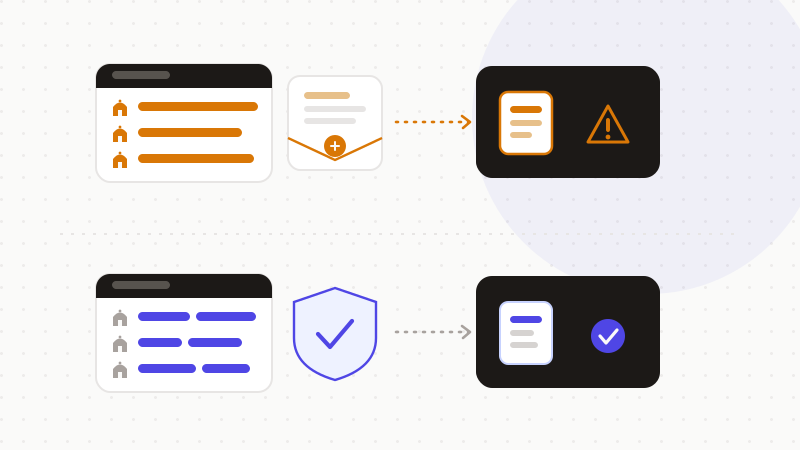
The rule fits in four moves. The principle: the AI works on the shape, you keep the substance.
- 1Replace members' names and identifiers with tokens, in the browser.
- 2Send only the anonymised text to the AI.
- 3Let it draft the newsletter, sermon outline or event plan.
- 4Restore the real names locally — and never paste pastoral or confidential notes.
That's exactly what ONYRI Sanitize is for. The engine detects sensitive data — member names, contact details, identifiers — and swaps it for reversible tokens before anything is sent. Detection and the mapping stay in your browser. Only anonymised text reaches the model. The AI drafts your newsletter or sermon outline on tokens, never on your congregation's real identities. Confidential pastoral notes stay fully out, where they belong. You keep the help, and the trust your community placed in you.
Frequently asked questions
- Is it safe to use AI for churches and faith groups?
- Yes on anonymised text, no with your raw data. AI can draft a newsletter, a sermon outline or an event plan with no real names at all. But never paste your membership list: it reveals each person's religion, special-category data under Article 9 of the GDPR. And never paste pastoral notes. Anonymise names and identifiers before you send.
- Why is a membership list sensitive data?
- Because it identifies people by their belief. Under Article 9 of the GDPR, religious or philosophical belief is special-category data, whose processing is prohibited by default. The ICO notes it can be stated outright or inferred — from a name, an image or a pattern. So an attendance list or a donation ledger can imply belief too.
- Does our religious-body status cover us?
- Not automatically for a third-party AI. The GDPR requires two things together: a lawful basis (Article 6) and a separate condition (Article 9). The not-for-profit body condition (Article 9(2)(d)) covers your own members, with safeguards, but does not allow disclosing the data outside the body without consent. Pasting a list into a consumer AI may fall outside it.
Sources & references
- Regulation (EU) 2016/679 (GDPR) — Article 9, processing of special categories of personal data (religious or philosophical beliefs, health) — EUR-Lex (Publications Office of the European Union)
- What is special category data? (religious or philosophical belief; special-category data stated or inferred) — Information Commissioner's Office (ICO)
- Special category data — guidance hub (Article 6 basis plus an Article 9 condition, explicit consent, not-for-profit body) — Information Commissioner's Office (ICO)
Keep your sensitive data in your browser
ONYRI Sanitize detects and masks your sensitive data before it reaches the AI, then restores the answer — from names to API keys.