Is It Safe to Use AI for Driving Instructors?
Yes to draft on anonymised text, no with a learner's data: never paste a name, licence number, medical fitness note or card number.
The answer fits in one line. AI can help you, but do not hand it your learners' data. It drafts a lesson plan, a reminder message or progress notes very well. For that, it does not need the learner's real name. Nor their date of birth. Nor their licence number. Yet a learner record holds all of this. Many learners are minors, so their data carries heightened protection. A medical fitness note is health data, the most protected tier. The right method: anonymise these details before every prompt.
What a learner record lays bare
An instructor juggles very concrete data. The learner's full name. Their date of birth. Their provisional licence number. Their address. Sometimes a note on their fitness to drive. And often a payment method. Each of these has value to a fraudster.
The topic comes up constantly. You schedule slots. You write posts to attract learners. You log progress after each lesson. You prep the theory test. AI helps with all of these tasks. The temptation is to paste the whole record to save time.
Many learners are children
This is the point most often forgotten. You can learn to drive very young. In the UK, a provisional licence is available from age 15 years and 9 months. So many records concern minors. And children's data carries heightened protection under the law.
The ICO (Information Commissioner's Office), the UK regulator, publishes the Children's Code. This code sets 15 standards for handling children's data. It rests on three clear principles. Data minimisation. High privacy by default. The best interests of the child first. In the US, the COPPA law protects under-13s in a similar spirit.
The Children's Code targets online services likely to be accessed by children first. But its principles show the standard expected. For a minor learner, the bar is higher. Pasting their data into a consumer chatbot runs against that spirit.
Licence plus date of birth = fraud material
A licence number is a strong identifier. In the UK and the EU, it even encodes parts of the name and date of birth. Combined with a name, a date of birth and an address, it forms the exact bundle a fraudster wants.
The FTC (Federal Trade Commission), the US consumer protection agency, warns clearly. Stolen personal information lets thieves open accounts in a victim's name. That is why these identifiers should never be pasted into an external tool. Never paste a licence number.
Medical fitness and payment: two red zones
Fitness to drive touches health. An eyesight result. A condition that affects driving. A medication that matters. Per the ICO, health data covers more than diagnosed conditions. It covers anything that reveals a person's health status. Examinations, test results and injuries included.
Under the GDPR (General Data Protection Regulation), health falls under Article 9. That is the special category, the most protected tier. Its processing is generally prohibited, save specific conditions and proper safeguards. A casual AI prompt does not meet that bar. A fitness note tied to a named learner should never go there.
Payment forms the second red zone. Card data falls under the PCI DSS standard (Payment Card Industry Data Security Standard). It governs any entity that stores, processes or transmits card data. A consumer chatbot sits outside that secure perimeter. Never paste a card number.
| Data pasted | Why it is risky | Framework cited |
|---|---|---|
| Licence number + date of birth | Ideal bundle to steal an identity | Identity theft (FTC) |
| Minor learner | Children's data, heightened protection | Children's Code / COPPA |
| Medical fitness note | Health data, special category | GDPR Article 9 |
| Payment card number | Outside the secure payment perimeter | PCI DSS |
The fix: anonymise before you send
Good news: AI stays a real asset. Data minimisation is a principle shared across all these frameworks. You expose only what is strictly needed. And AI drafts a lesson plan, a reminder or notes from anonymised text. The real name, the licence number and the date of birth are not useful to it for writing.
Remember the safeguarding side too. An instructor works one-to-one with the learner, sometimes a minor. Keeping their data tight is a duty of care, not just a compliance box.
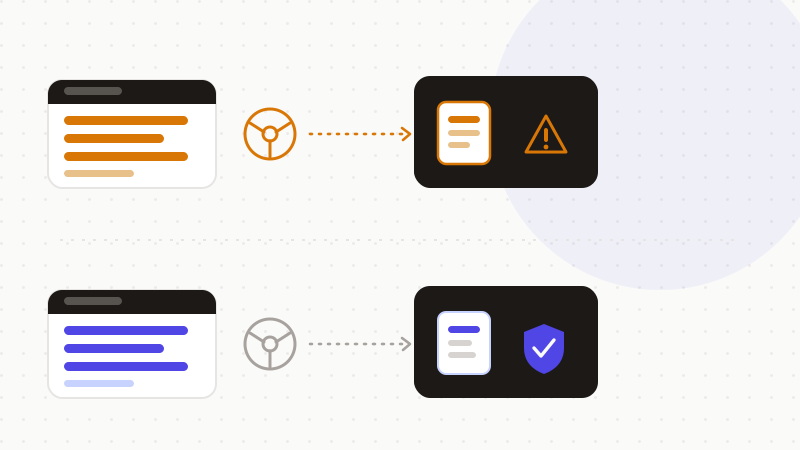
In practice, the method is four moves. You spot the sensitive data. You replace it with reversible tokens, in the browser. You send only the anonymised text. You restore the real values afterwards, locally.
- 1Spot the learner's data: name, date of birth, licence number, address.
- 2Replace it with reversible tokens, in the browser.
- 3Send only the anonymized text to the AI.
- 4Restore the real values in the reply, locally.
A few simple rules lock the rest.
- Never paste a licence number or a date of birth tied to a name.
- Never paste a medical fitness note tied to a learner.
- Never paste a payment card number.
- Treat minor learners as children's data, with extra caution.
That's what ONYRI Sanitize is for. The engine detects sensitive data — name, date of birth, licence number, address — and replaces it with reversible tokens before sending. Detection and the mapping stay in your browser. Only anonymized text reaches the model. The AI finds only tokens, never your learners' real data. You get the help, without the risk the law asks you to rule out.
Frequently asked questions
- Is it safe to use AI for driving instructors?
- Yes to draft, no with your learners' data. AI writes a lesson plan, a reminder or progress notes very well on anonymised text. But never paste a learner's name, date of birth, licence number or medical fitness note into a consumer chatbot. Many learners are minors, so their data is heightened. Anonymise before you send.
- Can I paste a learner's licence number into ChatGPT?
- No. A licence number is a strong identifier. Combined with a name, a date of birth and an address, it forms the bundle a fraudster wants. The FTC warns that stolen information is used to open accounts in a victim's name. If you must describe a case, replace the number with a token before you send.
- Can a medical fitness note go into an AI?
- No, not tied to a named learner. Eyesight, a condition or a medication that affects driving are health data. Under the GDPR, they fall under Article 9, the special category, whose processing is generally prohibited without specific safeguards. A casual AI prompt does not meet that bar.
Sources & references
- What is special category data? (health data, GDPR Article 9) — Information Commissioner's Office (ICO)
- Introduction to the Children's Code (Age Appropriate Design Code, children's data) — Information Commissioner's Office (ICO)
- PCI DSS — Protecting payment card data (payment card data) — PCI Security Standards Council
Keep your sensitive data in your browser
ONYRI Sanitize detects and masks your sensitive data before it reaches the AI, then restores the answer — from names to API keys.
Anonymize my prompt