Is It Safe to Use AI for Debt Collection?
Yes for drafting and summaries, no with debtor data: never tie a name to a debt or a medical note inside a consumer AI. Anonymise first, then let it work.
The answer fits in one line. AI can help you draft a letter or summarise an account, but never with the debtor's name or their data. A collection file is highly sensitive. It holds a name. An amount owed. Contact details. Often a note explaining the missed payment: job loss, illness, a hospital stay. Pasted into a consumer ChatGPT, these details go to a third party. In the US, the FDCPA (Fair Debt Collection Practices Act) tightly restricts that disclosure. There is a clean method: anonymise the debtor, then let the AI work on de-identified text.
Financial data that often reveals hardship
A collection file is never just a number. It links a real person to a sum they cannot pay. That is already sensitive financial data.
The debtor is often already under stress. Behind a missed payment, there is frequently a job loss, a separation, an illness. Account notes record those reasons. They reveal family or health circumstances.
The FDCPA explicitly covers medical bills, alongside credit cards, car loans and mortgages. So files often hold healthcare debts. A note like “payment missed due to a hospital stay” says a great deal about a person's health.
What the FDCPA says about third-party disclosure
The US rule is clear. Under the FDCPA, a debt collector cannot discuss a person's debt with anyone other than that person. The only exceptions are their spouse or their attorney. And it can never tell a third party that the person owes a debt.
The FDCPA also bars collectors from publicly revealing a person's debts. For example by printing the details on a postcard or an envelope. The FTC (Federal Trade Commission) and the CFPB (Consumer Financial Protection Bureau) enforce these rules.
Pasting a debtor's name and their account into a consumer AI is exactly what the law aims to restrain. It is a disclosure to a third party outside the permitted set. In the UK, the relevant regulator is the FCA (Financial Conduct Authority). How debtor information is handled and shared is a compliance question, not a minor detail.
Medical debt: health data under the GDPR
European law adds a layer for debtors in the EU and the UK. Under the GDPR and the UK GDPR, data about a person's health is “special category data”. That is the Article 9 category. It is treated as more sensitive and needs an extra condition to be processed. Hardship and medical-debt notes can fall into it.
The ICO (Information Commissioner's Office), the UK's data protection regulator, explains why. This data is singled out because a leak or misuse could create a more significant risk to a person's fundamental rights. For example, through discrimination.
That risk maps directly onto a vulnerable debtor. Exposed hardship or health details can compound the harm. One key point: not all collection data is health data. Only the parts tied to illness or hardship are.
| Data in the file | Why it is sensitive |
|---|---|
| Debtor name + amount owed | The FDCPA bars telling a third party that the person owes a debt |
| Contact details (address, phone) | A name tied to a debt plus a contact is enough for fraud or harassment |
| Note “missed payment due to illness” | Reveals health data, a special category under Article 9 |
| Medical bill in collection | Explicitly covered by the FDCPA; touches on health |
The concrete risk: fraud and harassment
Debtors are frequently people already under financial stress. A leak of their name tied to what they owe, with their contact details, hands an attacker a lot. It can be enough to set up identity theft or targeted harassment. The FTC warns consumers about these very real risks.
The fix: anonymise before you send
Good news: AI stays useful for collections. It can draft a letter. It can summarise the history of an account. It can rephrase a message with the right tone. For that, it needs no real identity. It works fine on de-identified text.
- Anonymise the debtor's name and identifiers before any prompt.
- Never paste an account, an amount or a hardship note tied to a real name.
- Stay within what the FDCPA (US) or the FCA (UK) allows to be disclosed.
- Use vetted tools covered by a data processing agreement (DPA).
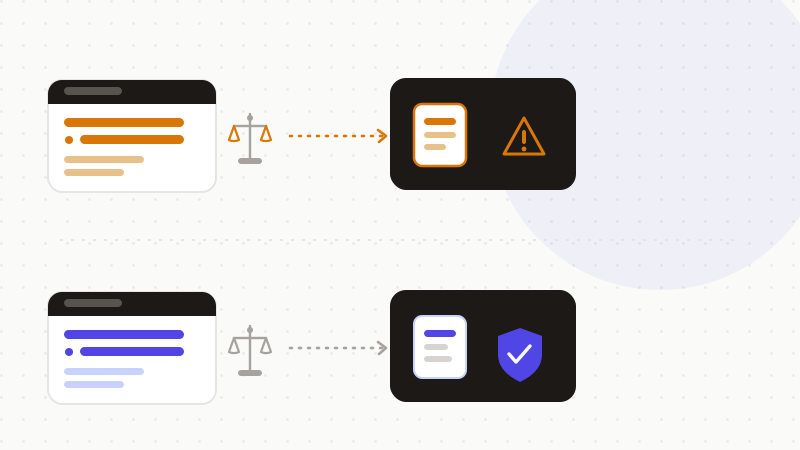
The method is simple. You replace each identifying element with a token before you send. The AI reasons about the shape of the file, without seeing the real values. You restore the real values afterwards, locally, in the final letter.
- 1Spot the sensitive data: name, amount, contact details, hardship or medical note.
- 2Replace it with reversible tokens, in the browser.
- 3Send only the anonymized text to the AI.
- 4Restore the real values in the reply, locally.
That's what ONYRI Sanitize is for. The engine detects sensitive data — name, amount, contact details, hardship note — and replaces it with reversible tokens before sending. Detection and the mapping stay in your browser. Only anonymized text reaches the model. The AI finds only tokens, never a real debtor's identity. You keep the help of AI, and the compliance that the FDCPA, the FCA and the GDPR expect from you.
Frequently asked questions
- Is it safe to use AI for debt collection?
- Yes for drafting and summaries, no with debtor data. AI can draft a letter or summarise an account on de-identified text. But never paste a name tied to a debt, to contact details or to a hardship note into a consumer AI. The FDCPA bars telling a third party that the person owes a debt. Anonymise before you send.
- Is a medical-debt note sensitive data?
- Yes. The FDCPA explicitly covers medical bills. A note explaining a missed payment through illness or a hospital stay reveals health data. Under the GDPR and the UK GDPR, health is special category data, the Article 9 category. It needs stronger protection. Keep these notes out of the prompt.
- How can AI help without the debtor's data?
- By working on de-identified text. Replace the name, the amount and the contact details with tokens before you send. The AI drafts the letter or summarises the account on that basis. You restore the real values locally in the final document. Stay within what the FDCPA or the FCA allows, and use a tool covered by a data processing agreement.
Sources & references
- Fair Debt Collection Practices Act (full statutory text of the federal law) — U.S. Federal Trade Commission
- Debt Collection FAQs (who a collector may contact; what they can never reveal) — U.S. Federal Trade Commission (consumer.ftc.gov)
- What is special category data? (health, an Article 9 category under the UK GDPR) — UK Information Commissioner's Office (ICO)
Keep your sensitive data in your browser
ONYRI Sanitize detects and masks your sensitive data before it reaches the AI, then restores the answer — from names to API keys.