Is It Safe to Use AI as a Journal or Diary?
Yes, if you keep identities out. An AI journal sends every entry to servers, where it can be retained, reviewed, or used for training.
Here is the honest answer. A paper diary has no reader; an AI journal has one. Every entry leaves your device the moment you send it. Your raw thoughts, the names of people you love, your health and your secrets all travel to a company's servers. There, they can be retained, sometimes reviewed for safety, sometimes used to train the model. Journaling still helps you reflect. But keep the identities out. Write your feelings without naming anyone, turn training off, and use a local app for the rawest material.
A private diary, but with a reader
A paper diary speaks to no one. You write, you close the notebook, no one else reads. An AI journal works the other way. Every sentence you type travels to a company's servers. Your unfiltered thoughts leave the device the moment you send. That is the core difference: your most intimate text suddenly has an audience.
Stored, sometimes reviewed, sometimes used for training
What happens to an entry once it is sent? Three things can follow. It can be kept for a while. It can be reviewed if it gets flagged. It can be used to improve the model.
- Retention: the entry can be stored on the provider's servers.
- Review: content flagged for safety can be read by a person or a system.
- Training: unless you set it otherwise, the entry can improve the model.
The training setting varies by service. On Claude's privacy page, Anthropic states that your conversations improve Claude only if you choose to allow it. That is a choice, adjustable at any time. Other services turn training on by default and let you switch it off. The practical rule: check the app's data controls. Do nothing, and your entries may feed a model.
Turning training off does not make everything invisible. Anthropic notes that a conversation flagged for safety review can be used. It can help detect abuse better. It can even train the models of its Safeguards team. In other words: “not used for training” does not mean “never seen.”
Deleting does not always erase
Deleting a conversation does not guarantee it is gone. One case showed this in 2025. In New York Times v. OpenAI, a federal court in New York (the S.D.N.Y., the Southern District of New York) issued an order. Dated 13 May 2025, under Judge Ona T. Wang, it required OpenAI to retain output log data. That included conversations users had asked to remove.
That broad obligation was later wound down. But the principle stands. A stored AI journal can, in theory, be preserved by a court order. A paper notebook in a drawer escapes all of that.
Your journal names other people
A journal is never only about you. You write about your partner. About your boss. About your family and your friends. You then hand their personal data to a third-party company. Without their consent, often without their knowledge. It is a responsibility few diarists ever weigh.
| Paper diary | AI journal |
|---|---|
| No reader: the notebook stays with you | Every entry travels to a company's servers |
| Nothing is reviewed or flagged | Flagged content can be reviewed for safety |
| Trains no model | Can be used for training, unless you set it otherwise |
| Cannot be subpoenaed | Can, in principle, be preserved by a court order |
The fix: reflect without giving yourself away
Good news: the reflective benefit of journaling stays intact. You can write your feelings, take stock, gain perspective. The key is simple: keep the identities out. Speak about what you feel, without naming the people, places or details that identify.
- 1Write your feelings without naming people, places or precise details.
- 2Turn off model training in the app's data controls.
- 3For the rawest material, choose a local or offline journaling app.
- 4Never treat an AI journal as private or confidential.
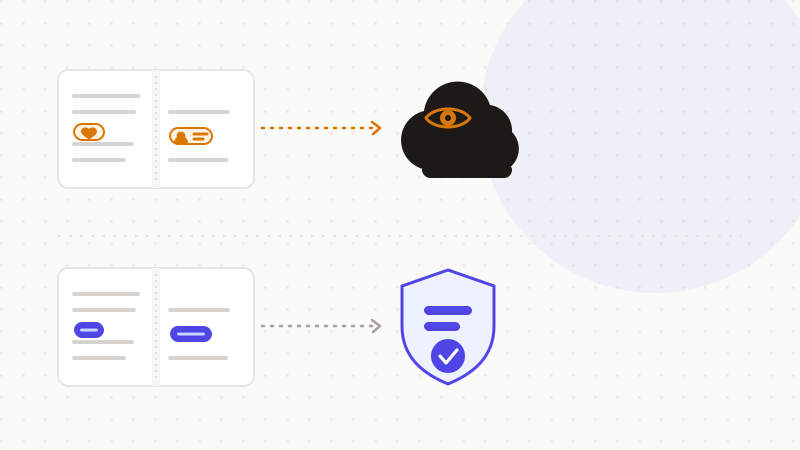
That is what ONYRI Sanitize is for. The engine spots sensitive data — names, health, places, intimate details — and replaces it with reversible tokens before sending. Detection and the mapping stay in your browser. Only anonymized text reaches the model. You keep the perspective of a journal, without handing your private life to an invisible reader.
Frequently asked questions
- Is it safe to use AI as a journal or diary?
- Yes, as long as you keep the identities out. AI can help you reflect and take stock. But every entry travels to a company's servers. It can be retained, reviewed if it gets flagged, or used for training. Write your feelings without naming anyone, turn training off, and use a local app for the rawest material.
- Are my entries used to train the AI?
- It depends on the service. Anthropic states that your conversations improve Claude only if you choose to allow it. Other services turn training on by default. Check the app's data controls and switch training off. Note too that content flagged for safety can be reviewed, even without training.
- Can an AI journal be exposed later?
- It can, unlike a paper notebook. Deleting a conversation does not guarantee it is gone. In 2025, in New York Times v. OpenAI, a court ordered the retention of logs, including deleted ones. That obligation was later wound down, but the principle stands: stored content can, in theory, resurface.
Sources & references
- How do you use personal data in model training? (opt-in training and safety review of flagged conversations) — Anthropic (Claude privacy help)
- Regulation (EU) 2016/679 (GDPR) — Article 9, processing of special categories of personal data — EUR-Lex (Publications Office of the European Union)
- OpenAI forced to preserve ChatGPT chats — preservation order in NYT v. OpenAI (including deleted conversations) — Malwarebytes
Keep your sensitive data in your browser
ONYRI Sanitize detects and masks your sensitive data before it reaches the AI, then restores the answer — from names to API keys.