Does Meta AI Train on Your Data?
Yes, for your public content. Meta says it trains its AI on public Facebook and Instagram posts, photos and comments from adults.
Yes, in part. For your public content, the answer is yes. Meta says it trains its generative AI on public posts from adult Facebook and Instagram accounts. That covers posts, photos, captions and comments. Your private messages, though, are treated differently. Meta says it does not use them. One exception matters: anything you send to Meta AI is used. In Europe and the UK, you can object through a form. Elsewhere, that right often does not exist.
The short answer: public content, yes
Meta has said this since 2023. It uses publicly shared content to train its generative AI models. Its wording is explicit. Public posts from Instagram and Facebook, including photos and text, are part of the training data. Meta names other sources too. Licensed data. Other publicly available information online. One point is essential. Only public content is in scope. A private account changes everything.
The reach is wide. An open post, a caption, a comment under a photo: all of that is public. Your public images count as well. We cover the question “can Meta AI see your photos?” separately. Here, hold on to the principle. If content is visible to everyone, Meta treats it as trainable.
Public versus private: the line not to blur
Meta draws a sharp line. It states it does not train its AI on the content of your private messages with friends and family. Meta's exact caveat deserves a word-for-word quote. It holds true “unless you or someone in the chat chooses to share those messages with our AIs”. So a message addressed to Meta AI leaves that protection. Meta also says it uses the information people share when using its AI features. In plain terms: talking to the assistant feeds the product.
The distinction is easy to keep. Your conversations between people are not used for training. What you type into Meta AI is. If you use Meta AI in WhatsApp, in Messenger or on Instagram, the rule holds. The private thread is one thing. The prompt sent to the assistant is another.
| Type of content | Used to train the AI? (per Meta) |
|---|---|
| Public posts, photos and comments (adults) | Yes — public content from Facebook and Instagram accounts |
| Private messages with friends and family | No — unless you share them with Meta AI |
| What you send to Meta AI | Yes — interactions are used to improve the products |
| Content from accounts of minors | No — excluded from the EU training (18+ only) |
The EU story: paused in 2024, resumed in 2025
Europe saw a standoff. In 2024, Meta paused its plan to train AI on Europeans' public content. The privacy group noyb had filed complaints. Ireland's Data Protection Commission, the DPC, had raised concerns too. In April 2025, Meta announced it would resume. On 21 May 2025, the DPC said it would not stand in the way. Meta had added transparency measures and safeguards.
The legal point matters. Meta relies on “legitimate interests” under the GDPR, the EU General Data Protection Regulation. That is Article 6(1)(f). So Meta does not ask for your prior consent. Instead, people in the EU, the EEA and the UK get notices, in-app and by email. Those notices link to an objection form. Article 21 of the GDPR grants this right to object to the use of your public data.
- 2024: the plan is paused after noyb complaints and DPC concerns.
- April 2025: Meta announces it will resume training on public content.
- 21 May 2025: the DPC says it will not stand in the way.
- Legal basis: “legitimate interests” (GDPR Art. 6(1)(f)), not consent.
- Remedy: object via Article 21, through a dedicated form.
The right to object is not global
This right depends on where you live. Meta offers an objection route in the EU, the EEA, the UK and Brazil. Meta itself notes a limit. These settings are not available everywhere. They will not completely prevent your data being used for training. In the US, and in countries without comparable laws, there is generally no equivalent. The only real fallback there is making your account private, or removing your public posts.
One last instinct counts: act early. Training largely works one way. Objecting stops future use of your public content. It does not reliably pull back what a model has already absorbed. This reasoning is analysis, not a Meta quote. But it reorders your priorities. Better to act before, not after.
How to take back control, in practice
You are not powerless. The right approach mixes four simple moves. The first is the form, where it exists. The others shrink your exposed surface. Here is the order to follow.
- 1Submit the objection form if you are in the EU, the EEA, the UK or Brazil.
- 2Make sensitive posts non-public: a private account falls outside the scope.
- 3Never send sensitive content to Meta AI, since that prompt is used.
- 4Check whether you can turn off or limit Meta AI in your settings per platform.
- 5Anonymise any text before you paste it into an AI, whichever one it is.
This last point is the most universal. The form does not cover everyone. Making an account private only protects future posts. But anonymising a prompt is always possible, anywhere, for any model. For the full picture, see our general article “Is Meta AI safe with your data?”.
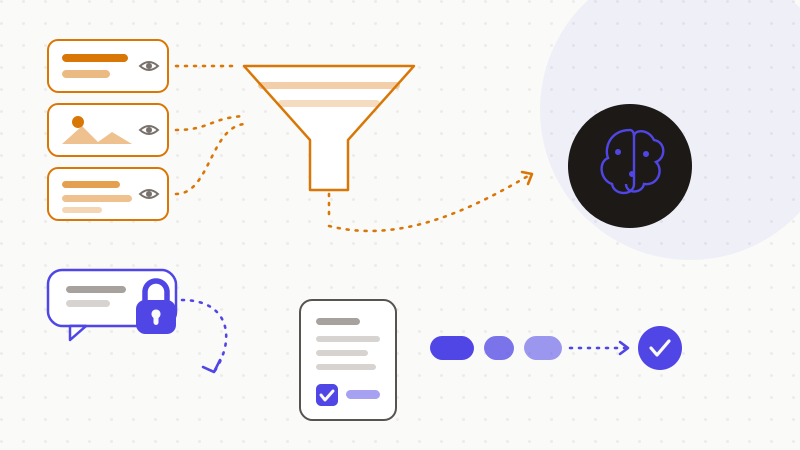
The point is not to flee AI. The point is to give it only what it needs to see. Your sensitive data can stay with you, even when you use an assistant.
That is what ONYRI Sanitize is for. The engine detects sensitive data in your text — names, contact details, amounts, identifiers, technical secrets — and replaces it with reversible tokens. Detection and the mapping stay in your browser. You then copy anonymized text, into Meta AI or any other model. The AI works on tokens, never on your real values. You restore the original on your side. The training question then loses its edge: what you do not send cannot enter a model.
Frequently asked questions
- Does Meta AI train on your data?
- For your public content, yes. Meta says it uses public posts, photos, captions and comments from adult Facebook and Instagram accounts to train its generative AI, alongside licensed data and other publicly available information online. Your private messages are treated separately: Meta says it does not use them, unless you share them with Meta AI. Anything you send to the assistant, however, is used.
- Can I object to Meta AI using my data?
- It depends on where you live. In the EU, the EEA, the UK and Brazil, Meta offers an objection form, based on Article 21 of the GDPR. Meta notes this setting is not available everywhere and will not completely prevent your data being used. Elsewhere, there is often no equivalent: the only fallback is making your account private or removing your public posts.
- If I object, does Meta remove data it has already used?
- Not reliably. Training largely works one way. Objecting stops future use of your public content, but does not guarantee the removal of what has already entered a trained model. This is analysis, not a Meta promise. The practical takeaway: act early, and keep sensitive data out of every prompt.
Sources & references
- Privacy Matters: Meta's Generative AI Features (Meta official — public content used for training; private messages not used unless shared with the AI) — Meta (about.fb.com)
- DPC statement on Meta AI (21 May 2025 — the Irish regulator on the pause, resumption and objection route) — Irish Data Protection Commission
- Meta set to resume training AI models on EU user posts (2024 pause, 2025 resume, legitimate interests, opt-out form) — The Register
Keep your sensitive data in your browser
ONYRI Sanitize detects and masks your sensitive data before it reaches the AI, then restores the answer — from names to API keys.